
Circuit Documentation
Summary of the Circuit
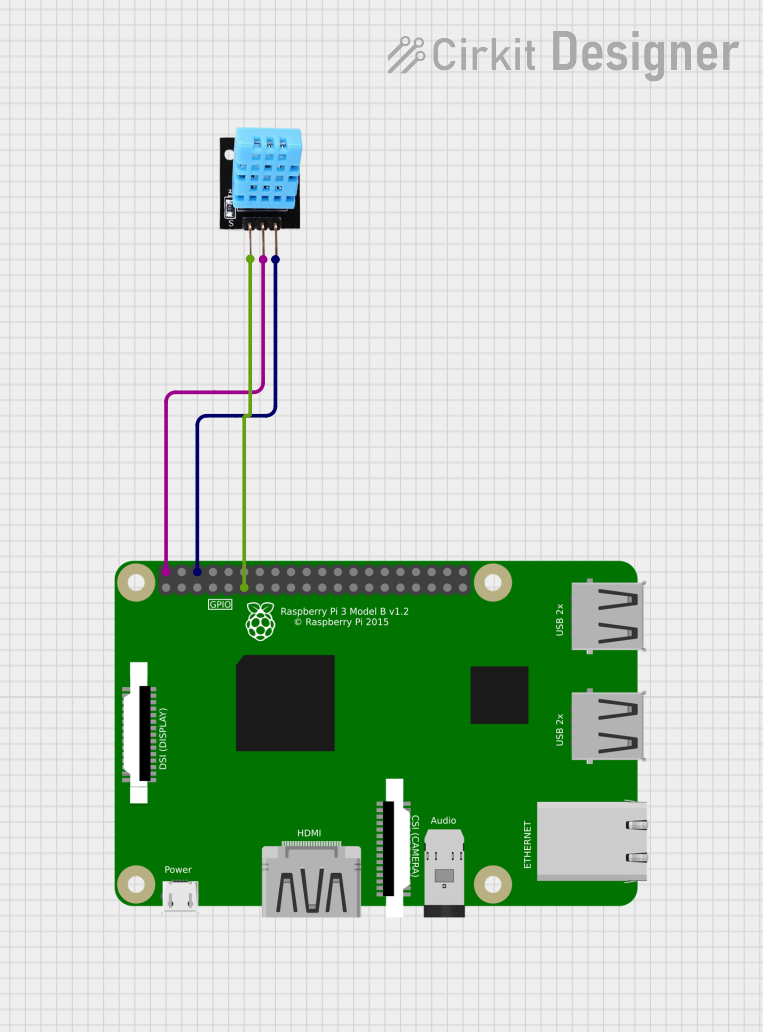
This circuit integrates a Raspberry Pi 3B with a DHT11 temperature and humidity sensor. The Raspberry Pi 3B serves as the central processing unit, capable of executing code to interact with the DHT11 sensor. The DHT11 sensor provides ambient temperature and humidity readings. The Raspberry Pi reads the sensor data through one of its GPIO pins and can process or log this data as required.
Component List
Raspberry Pi 3B
- Description: A small single-board computer with a variety of GPIO pins for interfacing with external hardware.
- Pins: 40 GPIO pins including power, ground, and data.
- Purpose: Acts as the main controller for the circuit, capable of running complex software and interfacing with various peripherals.
DHT11
- Description: A basic, low-cost digital temperature and humidity sensor.
- Pins: GND, VCC, OUT.
- Purpose: Measures the ambient temperature and humidity and provides the data to the Raspberry Pi.
Wiring Details
Raspberry Pi 3B
- 5V Power (Pin 2): Provides power to the DHT11 sensor.
- GPIO 11 (Pin 11): Receives the data signal from the DHT11 sensor.
- Ground (Pin 6): Common ground with the DHT11 sensor.
DHT11
- VCC: Connected to the 5V power supply from the Raspberry Pi 3B.
- OUT: Sends the temperature and humidity data to the Raspberry Pi 3B GPIO 11.
- GND: Connected to the ground pin on the Raspberry Pi 3B.
Documented Code
No code has been provided for the microcontrollers in the circuit. To fully utilize the DHT11 sensor with the Raspberry Pi 3B, code would need to be written and deployed on the Raspberry Pi to initialize the sensor, read data from it, and handle the data accordingly (e.g., logging, real-time display, etc.). This code would typically be written in Python, C, or another language supported by the Raspberry Pi's operating system.