
Battery-Powered Raspberry Pi 3B+ with TP4056 and DC/DC Booster
View and Edit Project In Cirkit Designer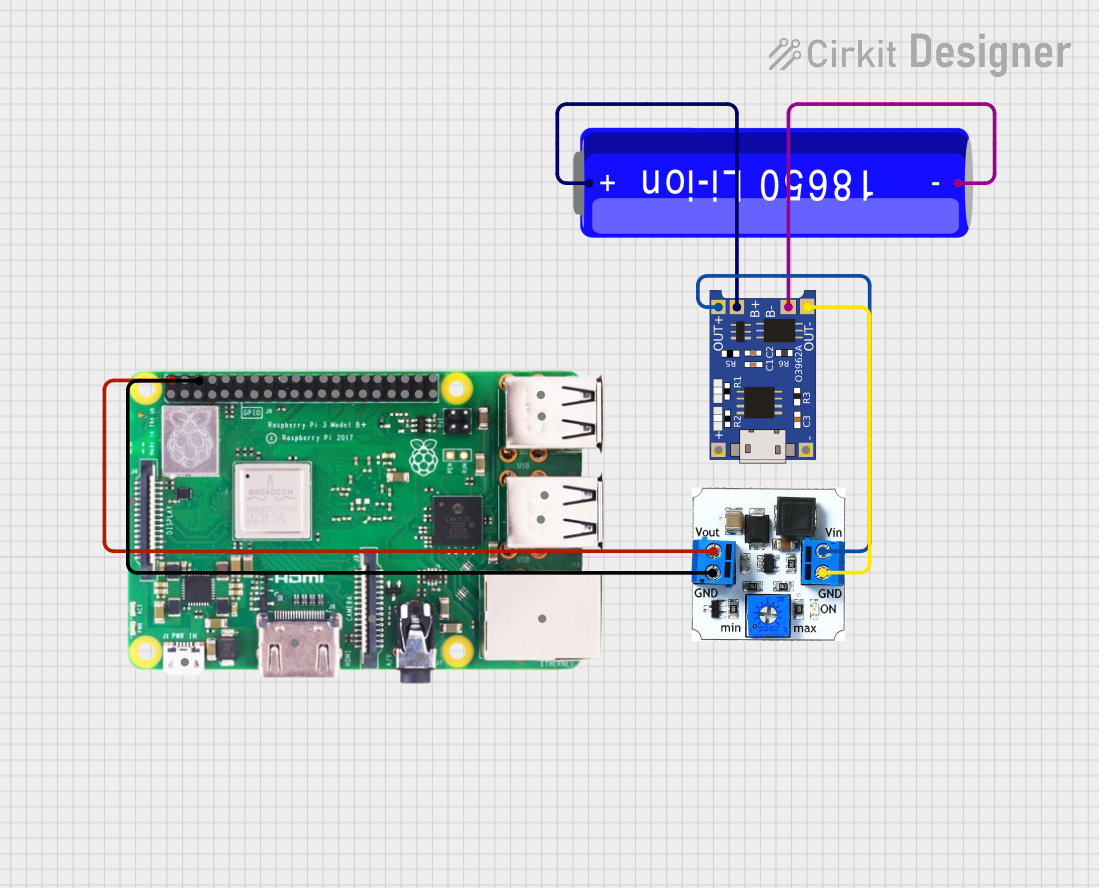
Circuit Documentation
Summary
This document provides a detailed overview of a circuit designed to charge a 18650 Li-ion battery using a TP4056 module, boost the voltage using a DC/DC booster, and power a Raspberry Pi 3b+. The document includes a list of components, wiring details, and code (if any) for the microcontrollers used in the circuit.
Component List
TP4056
- Description: Lithium-ion battery charger module.
- Pins: OUT-, B-, B+, OUT+, IN-, IN+
DC/DC Booster
- Description: Boosts the voltage from the battery to a higher level suitable for the Raspberry Pi.
- Pins: GND, Vin, Vout
18650 Li-ion Battery
- Description: Rechargeable lithium-ion battery.
- Pins: -, +
Raspberry Pi 3b+
- Description: Single-board computer.
- Pins: USB Port, LAN Port, 3.5mm 4-pole composite Video and Audio Socket, CSI Port Camera, HDMI, 5v via micro USB, 5V, Ground, GPIO14 (UART TX), GPIO 15 (UART RX), GPIO 18 chip Enable-CED (sp1)[PVSM], GPIO 23, GPIO 24, GPIO 25, GPIO 8 Enable-CED (5PIO), GPIO 7 Chip Enable-(5PIO), GPIO 1 EEPROM Serial Clock (12C), GPIO 12 (PVSM), GPIO 16 Chip Enable-CE2(SPI 1), GPIO 20 MISO (SPI 1), GPIO 21 SCLK (SPI 1), GPIO 26, [PWM] GPIO 19 MISO(SPI 1), GPIO 13(PWM), GPIO 6, GPIO 5, DNC 12C, GPIO 11 SCLK (SI O), GPIO 09 MISO (SPI 0), GPIO 10 MOSI(SPI O), 3.3V, GPIO 22, GPIO 27, PIO 17 Chip Enable-CEI(SPI1), GPIO 4, GPIO3 Serial Clock (12C), GPIO Serial Data(12C), DSI Display Connector, Micro SD card slot
Wiring Details
TP4056
- OUT- is connected to GND of the DC/DC Booster.
- B- is connected to - of the 18650 Li-ion Battery.
- B+ is connected to + of the 18650 Li-ion Battery.
- OUT+ is connected to Vin of the DC/DC Booster.
DC/DC Booster
- GND is connected to OUT- of the TP4056.
- Vin is connected to OUT+ of the TP4056.
- Vout is connected to 5V of the Raspberry Pi 3b+.
- GND is connected to Ground of the Raspberry Pi 3b+.
18650 Li-ion Battery
- - is connected to B- of the TP4056.
- + is connected to B+ of the TP4056.
Raspberry Pi 3b+
- Ground is connected to GND of the DC/DC Booster.
- 5V is connected to Vout of the DC/DC Booster.
Code
No microcontroller code is provided for this circuit.
This document provides a comprehensive overview of the circuit, including the components used, their connections, and any relevant code. This should serve as a useful reference for understanding and replicating the circuit.