
Circuit Documentation
Summary
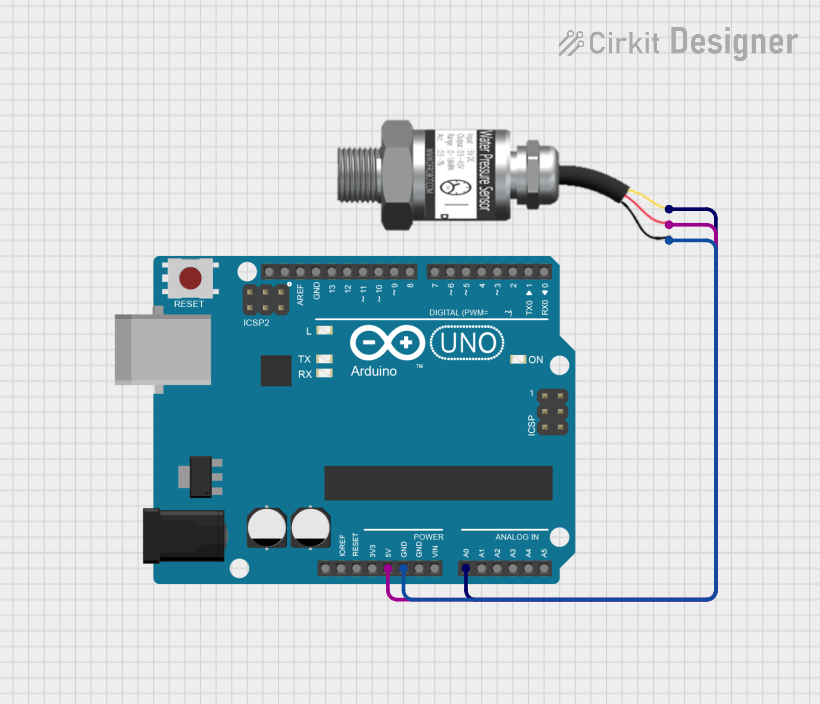
This circuit integrates an Arduino UNO microcontroller with a Gravity: Analog Water Pressure Sensor. The purpose of the circuit is to measure water pressure and process the signal using the Arduino UNO. The sensor's analog output is connected to one of the Arduino's analog input pins for data acquisition. The sensor and the Arduino are powered by a 5V supply, and a common ground is established between the two components.
Component List
Arduino UNO
- Description: A microcontroller board based on the ATmega328P. It has 14 digital input/output pins, 6 analog inputs, a 16 MHz quartz crystal, a USB connection, a power jack, an ICSP header, and a reset button.
- Purpose: Acts as the central processing unit for the circuit, reading sensor data and executing embedded code.
Gravity: Analog Water Pressure Sensor
- Description: A sensor that measures the pressure of water and outputs an analog voltage proportional to the pressure.
- Purpose: To measure water pressure and provide an analog signal to the Arduino UNO for processing.
Wiring Details
Arduino UNO
- 5V: Provides power to the Gravity: Analog Water Pressure Sensor.
- GND: Common ground for the circuit.
- A0: Receives the analog signal from the Gravity: Analog Water Pressure Sensor.
Gravity: Analog Water Pressure Sensor
- Signal: Outputs an analog voltage to the Arduino UNO's A0 pin.
- VCC: Connected to the Arduino UNO's 5V pin for power.
- GND: Connected to the Arduino UNO's GND pin to establish a common ground.
Documented Code
Arduino UNO Code (sketch.ino)
void setup() {
  // put your setup code here, to run once:

}

void loop() {
  // put your main code here, to run repeatedly:

}
Additional Notes
- The provided code is a template and does not contain any functional code for reading the sensor or processing data.
- Further implementation is required to initialize the analog input pin and to read the sensor data in the
setup()andloop()functions, respectively. - The code should include calibration for the sensor to convert the analog readings to meaningful pressure values.
- Error handling and data smoothing may also be considered for more robust sensor readings.