
Arduino Nano-Based Environmental Monitoring System with Battery Power
View and Edit Project In Cirkit Designer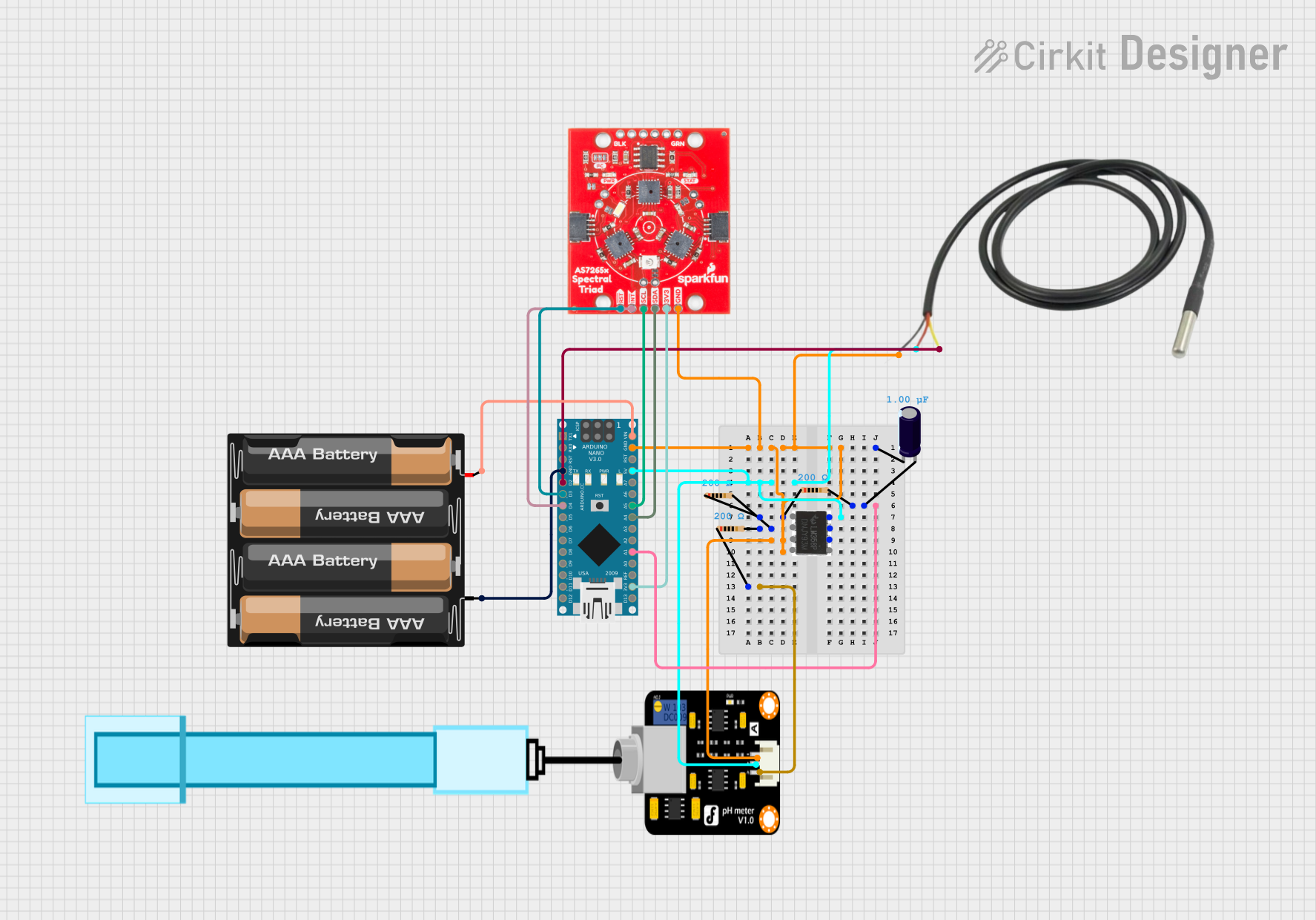
Circuit Documentation
Summary
This document provides a detailed overview of a circuit that includes an Arduino Nano, a temperature sensor, a pH meter, a spectroscopy sensor, an op-amp, resistors, a capacitor, and a battery mount. The circuit is designed to measure temperature, pH levels, and spectral data, and it is powered by a 4 x AAA battery mount.
Component List
Arduino Nano
- Description: A small, complete, and breadboard-friendly board based on the ATmega328P.
- Pins: D1/TX, D0/RX, RESET, GND, D2, D3, D4, D5, D6, D7, D8, D9, D10, D11/MOSI, D12/MISO, VIN, 5V, A7, A6, A5, A4, A3, A2, A1, A0, AREF, 3V3, D13/SCK
Temperature Sensor
- Description: A sensor used to measure temperature.
- Pins: Temp GND Black, Temp VDD Red, Temp DQ Data Yellow
4 x AAA Battery Mount
- Description: A battery holder for four AAA batteries.
- Pins: -, +
SparkFun Triad Spectroscopy Sensor - AS7265x (Qwicc)
- Description: A sensor used for spectroscopy measurements.
- Pins: RST, INT, SCL, SDA, 3V3, GND
PH Meter
- Description: A sensor used to measure pH levels.
- Pins: Signal, VCC, GND
LM358 Op-Amp
- Description: A dual operational amplifier.
- Pins: 8, 1, 2, 3, 4, 5, 6, 7
Resistor (200 Ohms)
- Description: A resistor with a resistance of 200 Ohms.
- Pins: pin1, pin2
Electrolytic Capacitor (1 µF)
- Description: A capacitor with a capacitance of 1 µF.
- Pins: -, +
Wiring Details
Arduino Nano
- GND: Connected to the GND pin of the Electrolytic Capacitor, SparkFun Triad Spectroscopy Sensor, Temperature Sensor, PH Meter, and the - pin of the 4 x AAA Battery Mount.
- 5V: Connected to pin 8 of the LM358 Op-Amp, Temp VDD Red pin of the Temperature Sensor, and VCC pin of the PH Meter.
- A1: Connected to pin2 of the Resistor and the + pin of the Electrolytic Capacitor.
- D2: Connected to the Temp DQ Data Yellow pin of the Temperature Sensor.
- D3: Connected to the RST pin of the SparkFun Triad Spectroscopy Sensor.
- D4: Connected to the INT pin of the SparkFun Triad Spectroscopy Sensor.
- VIN: Connected to the + pin of the 4 x AAA Battery Mount.
- A5: Connected to the SCL pin of the SparkFun Triad Spectroscopy Sensor.
- A4: Connected to the SDA pin of the SparkFun Triad Spectroscopy Sensor.
- 3V3: Connected to the 3V3 pin of the SparkFun Triad Spectroscopy Sensor.
Temperature Sensor
- Temp GND Black: Connected to the GND pin of the Arduino Nano.
- Temp VDD Red: Connected to the 5V pin of the Arduino Nano.
- Temp DQ Data Yellow: Connected to the D2 pin of the Arduino Nano.
4 x AAA Battery Mount
- -: Connected to the GND pin of the Arduino Nano.
- +: Connected to the VIN pin of the Arduino Nano.
SparkFun Triad Spectroscopy Sensor - AS7265x (Qwicc)
- GND: Connected to the GND pin of the Arduino Nano.
- RST: Connected to the D3 pin of the Arduino Nano.
- INT: Connected to the D4 pin of the Arduino Nano.
- SCL: Connected to the A5 pin of the Arduino Nano.
- SDA: Connected to the A4 pin of the Arduino Nano.
- 3V3: Connected to the 3V3 pin of the Arduino Nano.
PH Meter
- GND: Connected to the GND pin of the Arduino Nano.
- VCC: Connected to the 5V pin of the Arduino Nano.
- Signal: Connected to pin1 of the Resistor.
LM358 Op-Amp
- Pin 8: Connected to the 5V pin of the Arduino Nano.
Resistor (200 Ohms)
Instance 1:
- pin1: Connected to the Signal pin of the PH Meter.
- pin2: Connected to pin2 of another Resistor.
Instance 2:
- pin1: Connected to pin1 of another Resistor.
- pin2: Connected to pin2 of another Resistor.
Instance 3:
- pin1: Connected to pin1 of another Resistor.
- pin2: Connected to the + pin of the Electrolytic Capacitor and A1 pin of the Arduino Nano.
Electrolytic Capacitor (1 µF)
- -: Connected to the GND pin of the Arduino Nano.
- +: Connected to pin2 of the Resistor and A1 pin of the Arduino Nano.
Documented Code
Arduino Nano Code (sketch.ino)
void setup() {
  // put your setup code here, to run once:

}

void loop() {
  // put your main code here, to run repeatedly:

}
Documentation (documentation.txt)
This document provides a comprehensive overview of the circuit, including a summary, component list, wiring details, and documented code.