
Circuit Documentation
Summary
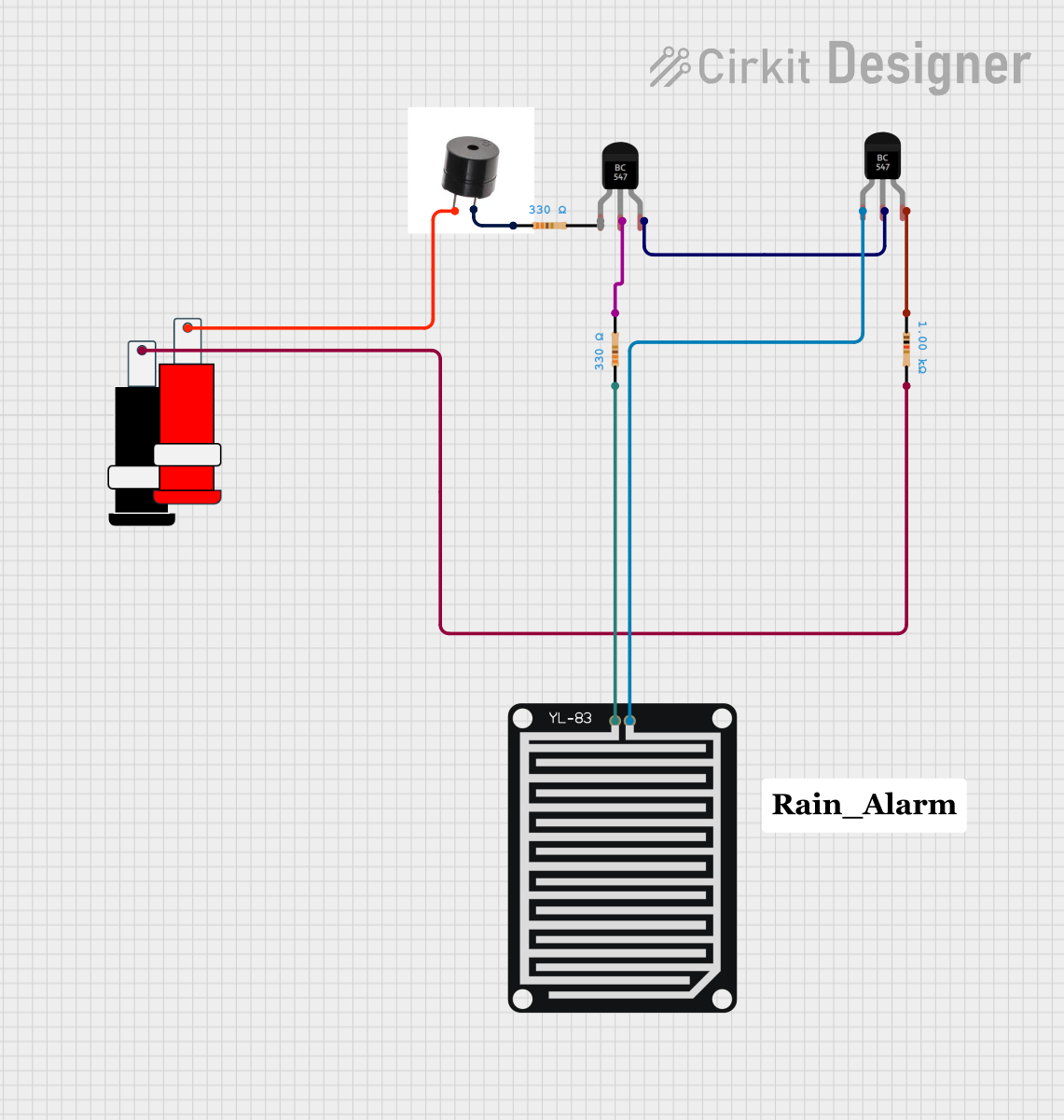
This circuit is designed to detect rain using a YL-83 Rain Sensor and activate a buzzer when rain is detected. The circuit utilizes two BC547 transistors, resistors, a buzzer, and a 5V power supply to achieve this functionality.
Component List
BC547 Transistor
- Description: NPN Bipolar Junction Transistor
- Pins: Collector, Base, Emitter
Resistor (330 Ohms)
- Description: Resistor with a resistance of 330 Ohms
- Pins: pin1, pin2
Resistor (1000 Ohms)
- Description: Resistor with a resistance of 1000 Ohms
- Pins: pin1, pin2
Buzzer
- Description: Electronic component that emits sound when powered
- Pins: +, GND
Connector 5V
- Description: Power supply connector providing 5V and GND
- Pins: VCC, GND
YL-83 Rain Sensor - Detection Board
- Description: Sensor to detect the presence of rain
- Pins: POS, NEG
Wiring Details
BC547 Transistor 1
- Collector is connected to NEG of the YL-83 Rain Sensor - Detection Board.
- Base is connected to the Emitter of BC547 Transistor 2.
- Emitter is connected to pin1 of the 1000 Ohms Resistor.
BC547 Transistor 2
- Base is connected to pin2 of the 330 Ohms Resistor.
- Emitter is connected to the Base of BC547 Transistor 1.
Resistor (330 Ohms)
- pin1 is connected to POS of the YL-83 Rain Sensor - Detection Board.
- pin2 is connected to the Base of BC547 Transistor 2.
Resistor (1000 Ohms)
- pin1 is connected to the Emitter of BC547 Transistor 1.
- pin2 is connected to GND of the Connector 5V.
Resistor (330 Ohms)
- pin1 is connected to GND of the Buzzer.
- pin2 is connected to GND of the Connector 5V.
Buzzer
- + is connected to VCC of the Connector 5V.
- GND is connected to pin1 of the 330 Ohms Resistor.
Connector 5V
- VCC is connected to + of the Buzzer.
- GND is connected to pin2 of the 1000 Ohms Resistor and pin2 of the 330 Ohms Resistor.
YL-83 Rain Sensor - Detection Board
- POS is connected to pin1 of the 330 Ohms Resistor.
- NEG is connected to the Collector of BC547 Transistor 1.
Code
There is no microcontroller code associated with this circuit.
This documentation provides a comprehensive overview of the circuit, including a summary, detailed component list, wiring details, and code section. The components are clearly described, and their connections are outlined to ensure proper assembly and understanding of the circuit.