
ESP8266 NodeMCU-Based Multifunctional Sensor Platform with Wi-Fi and Data Logging
View and Edit Project In Cirkit Designer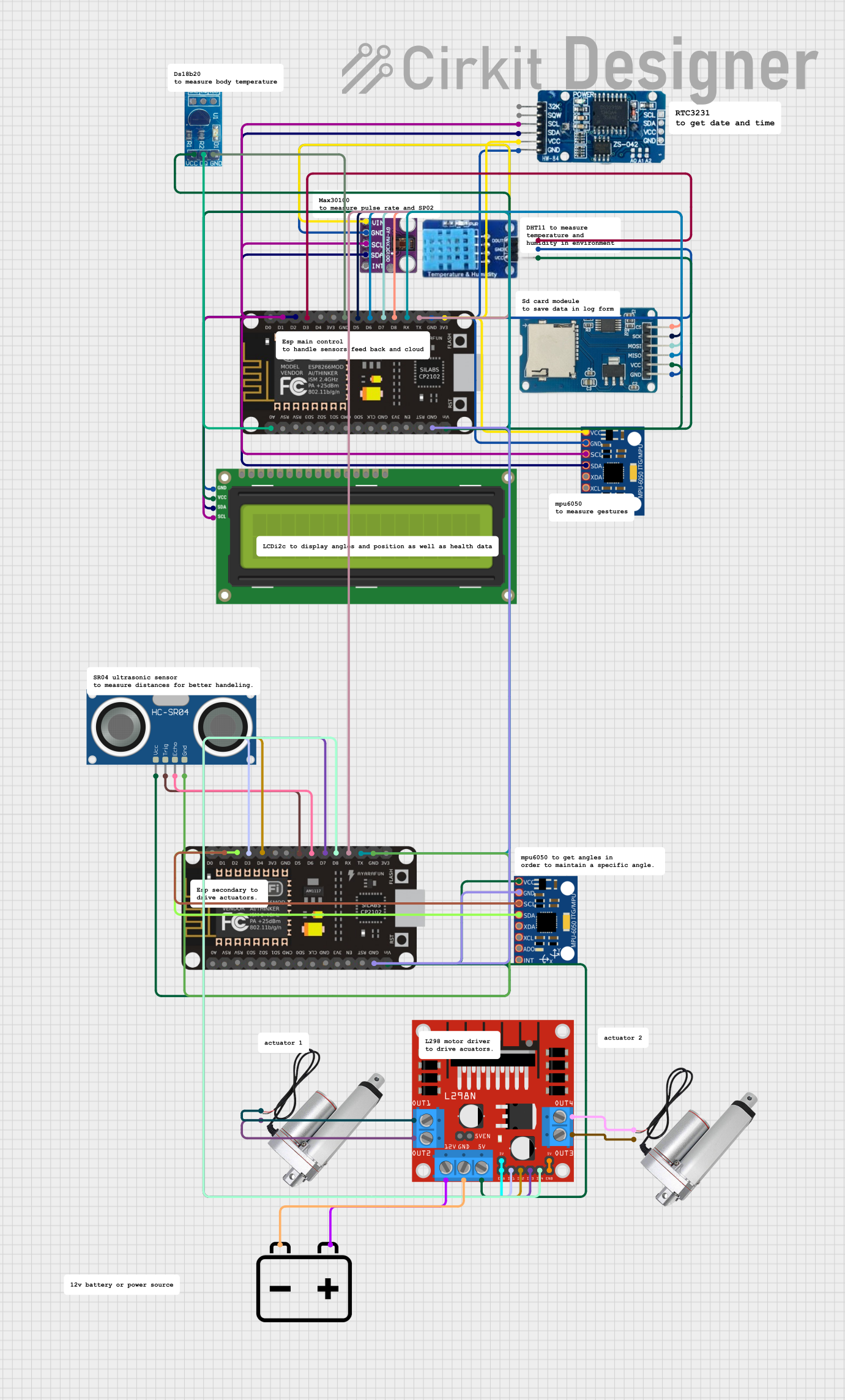
Circuit Documentation
Summary
The circuit in question appears to be a complex system involving multiple sensors, actuators, and an ESP8266 NodeMCU microcontroller as the central processing unit. The system includes sensors for environmental data acquisition (temperature, humidity, pulse oximetry, and motion), an LCD for data display, a real-time clock for timekeeping, a micro SD card module for data logging, and motor drivers to control linear actuators. The ESP8266 NodeMCU is used for interfacing with the various components, likely for the purpose of monitoring and control in an IoT application.
Component List
Microcontrollers
- ESP8266 NodeMCU: A Wi-Fi enabled microcontroller with a variety of digital and analog pins for interfacing with sensors, actuators, and other peripherals.
Sensors
- MAX30100: A pulse oximeter and heart-rate sensor module for wearable health monitoring.
- MPU-6050: A motion tracking device with a 3-axis gyroscope and a 3-axis accelerometer.
- DHT11: A basic, ultra low-cost digital temperature and humidity sensor.
- DS18B20 Module: A digital thermometer providing 9-bit to 12-bit Celsius temperature measurements.
- HC-SR04 Ultrasonic Sensor: An ultrasonic ranging module for distance measurement.
Actuators
- Linear Actuator: A type of actuator that creates motion in a straight line, used in various mechanical systems.
- L298N DC Motor Driver: A high current dual full-bridge driver designed to accept standard TTL logic levels to drive inductive loads such as relays, solenoids, and DC and stepping motors.
Display
- I2C LCD 16x2 Screen: A 16x2 LCD display that uses the I2C communication protocol.
Storage
- Micro SD Card Module: A module that allows a microcontroller to interface with a micro SD card for data storage.
Timekeeping
- RTC DS3231: A highly accurate I2C real-time clock with an integrated temperature-compensated crystal oscillator.
Power
- 12v Battery: A battery providing a 12V power source for the circuit.
Wiring Details
ESP8266 NodeMCU
- Digital Pins:
- D0-D8: Various connections to sensors, actuators, and SD card module.
- RX/TX: Serial communication with another ESP8266 NodeMCU.
- Analog Pins:
- A0: Connected to the DS18B20 Module for temperature readings.
- Power Pins:
- 3V3: Power supply to RTC DS3231, MAX30100, and MPU-6050.
- GND: Common ground for all components.
- VIN: Power input from the 12v Battery and supply to I2C LCD, DHT11, Micro SD Card Module, and DS18B20 Module.
MAX30100
- SCL/SDA: I2C communication with ESP8266 NodeMCU.
- Vin: 3.3V power supply from ESP8266 NodeMCU.
- GND: Ground connection.
MPU-6050
- SCL/SDA: I2C communication with ESP8266 NodeMCU.
- VCC: 3.3V power supply from ESP8266 NodeMCU.
- GND: Ground connection.
DHT11
- DATA: Digital signal connected to ESP8266 NodeMCU.
- VCC: 5V power supply from ESP8266 NodeMCU.
- GND: Ground connection.
DS18B20 Module
- DQ: Data line connected to the analog pin A0 of ESP8266 NodeMCU.
- VCC: 5V power supply from ESP8266 NodeMCU.
- GND: Ground connection.
I2C LCD 16x2 Screen
- SCL/SDA: I2C communication with ESP8266 NodeMCU.
- VCC (5V): 5V power supply from ESP8266 NodeMCU.
- GND: Ground connection.
Micro SD Card Module
- SCK/MOSI/MISO/CS: SPI communication with ESP8266 NodeMCU.
- VCC: 5V power supply from ESP8266 NodeMCU.
- GND: Ground connection.
RTC DS3231
- SCL/SDA: I2C communication with ESP8266 NodeMCU.
- VCC: 3.3V power supply from ESP8266 NodeMCU.
- GND: Ground connection.
L298N DC Motor Driver
- IN1-IN4: Control signals from ESP8266 NodeMCU.
- OUT1-OUT4: Connections to linear actuators.
- ENA/ENB: Enable pins connected to jumper settings for motor control.
- 12V: Power supply from the 12v Battery.
- GND: Ground connection to the 12v Battery.
HC-SR04 Ultrasonic Sensor
- TRIG/ECHO: Trigger and echo pins connected to ESP8266 NodeMCU.
- VCC: 5V power supply from ESP8266 NodeMCU.
- GND: Ground connection.
Linear Actuator
- +/-: Connected to the L298N DC motor driver for actuation control.
12v Battery
- +/–: Provides power to the L298N DC motor driver.
Documented Code
No code was provided in the input. For a complete documentation, the code running on the ESP8266 NodeMCU microcontrollers would be necessary to understand the logic and functionality of the circuit. The code would typically include setup and loop functions, initialization of communication protocols (I2C, SPI), sensor readings, actuator control, and possibly communication with a server or cloud service for IoT capabilities.