
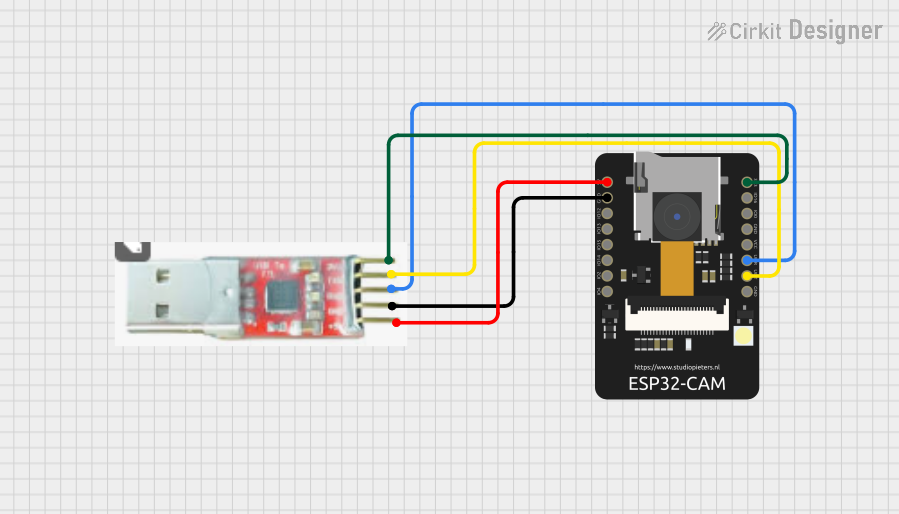
Circuit Documentation
Summary of the Circuit
This circuit is designed to interface an ESP32-CAM module with a USB to TTL module for communication and power supply purposes. The ESP32-CAM is a small camera module with Wi-Fi capabilities that can be used for various IoT applications. The USB to TTL module is used to provide a serial connection between the ESP32-CAM and a computer for programming and debugging purposes. The circuit ensures that the ESP32-CAM is powered and can communicate over a serial connection through the USB to TTL module.
Component List
USB to TTL Module
- Description: A module that converts USB signals to TTL serial signals.
- Pins: 3V3, TXD, RXD, GND, 5V
- Purpose: To provide a serial interface between the ESP32-CAM and a computer for programming and debugging.
ESP32 - CAM
- Description: A small-sized camera module with Wi-Fi capabilities.
- Pins: 5V, GND, IO12, IO13, IO15, IO14, IO2, IO4, VOT, VOR, VCC, IO0, IO16, 3V3
- Purpose: To capture images and/or video and send them over Wi-Fi or a serial connection.
Wiring Details
USB to TTL Module
- 3V3: Connected to the 3V3 pin of the ESP32-CAM to provide a 3.3V power supply.
- TXD: Connected to the VOT pin of the ESP32-CAM to transmit data from the USB to TTL module to the ESP32-CAM.
- RXD: Connected to the VOR pin of the ESP32-CAM to receive data from the ESP32-CAM.
- GND: Connected to the GND pin of the ESP32-CAM to provide a common ground reference.
- 5V: Connected to the 5V pin of the ESP32-CAM to provide a 5V power supply.
ESP32 - CAM
- 3V3: Receives 3.3V power supply from the USB to TTL module.
- VOT: Receives transmitted data from the TXD pin of the USB to TTL module.
- VOR: Sends data to the RXD pin of the USB to TTL module.
- GND: Common ground with the USB to TTL module.
- 5V: Receives 5V power supply from the USB to TTL module.
Documented Code
No code has been provided for the microcontrollers in the circuit. If code is later provided, it should be documented in this section with details on the functionality, setup, and main loop, along with comments explaining the purpose of each section of the code.