
How to Use TCS3200 Color sensor : Examples, Pinouts, and Specs
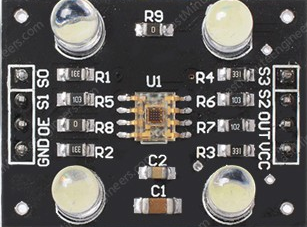
 Design with TCS3200 Color sensor in Cirkit Designer
Introduction
The TCS3200 Color Sensor is a versatile and precise device designed to detect the color of an object. It operates by using an array of photodiodes, each equipped with red, green, and blue filters, to measure the intensity of light in these color bands. The sensor outputs a frequency signal proportional to the intensity of the detected colors, making it easy to interface with microcontrollers and other digital systems.
Explore Projects Built with TCS3200 Color sensor
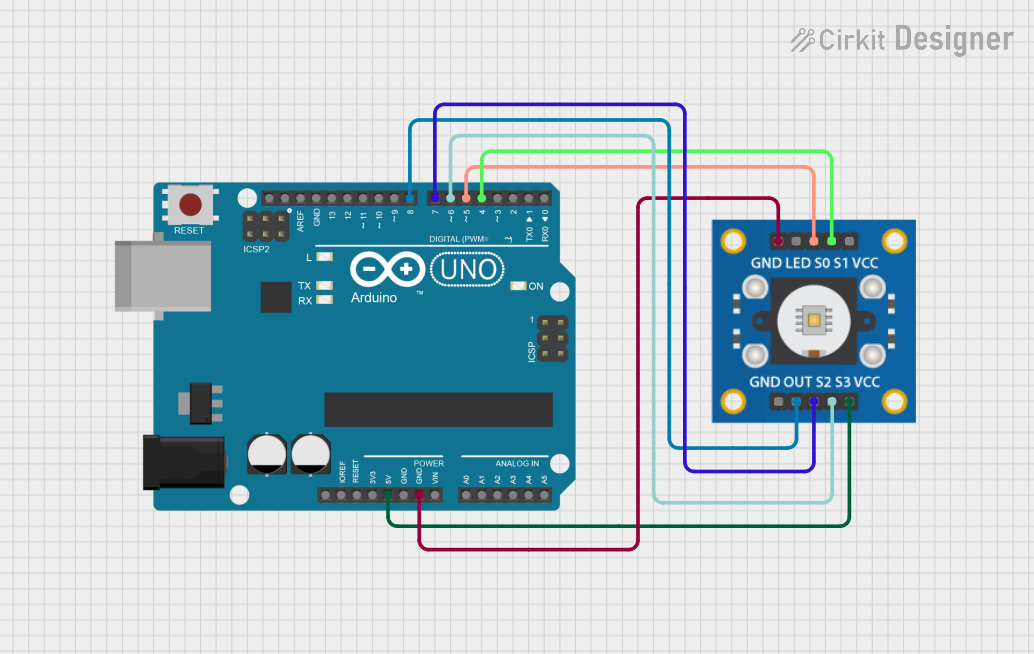 Open Project in Cirkit Designer
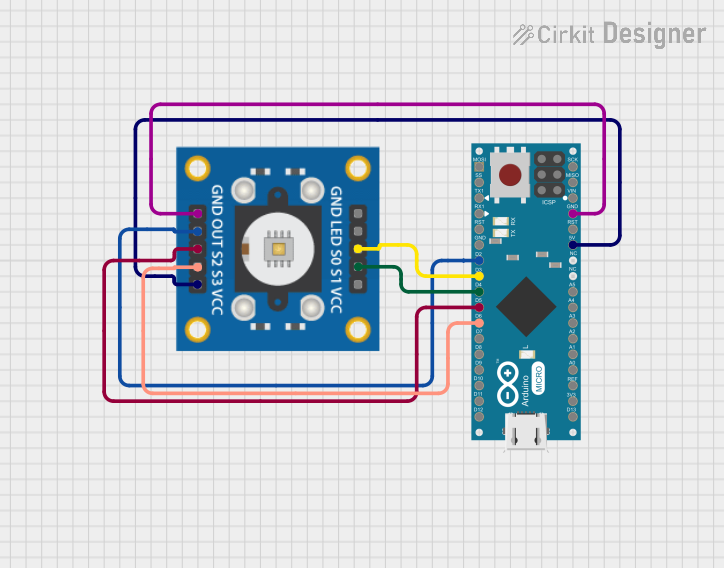 Open Project in Cirkit Designer
 Open Project in Cirkit Designer
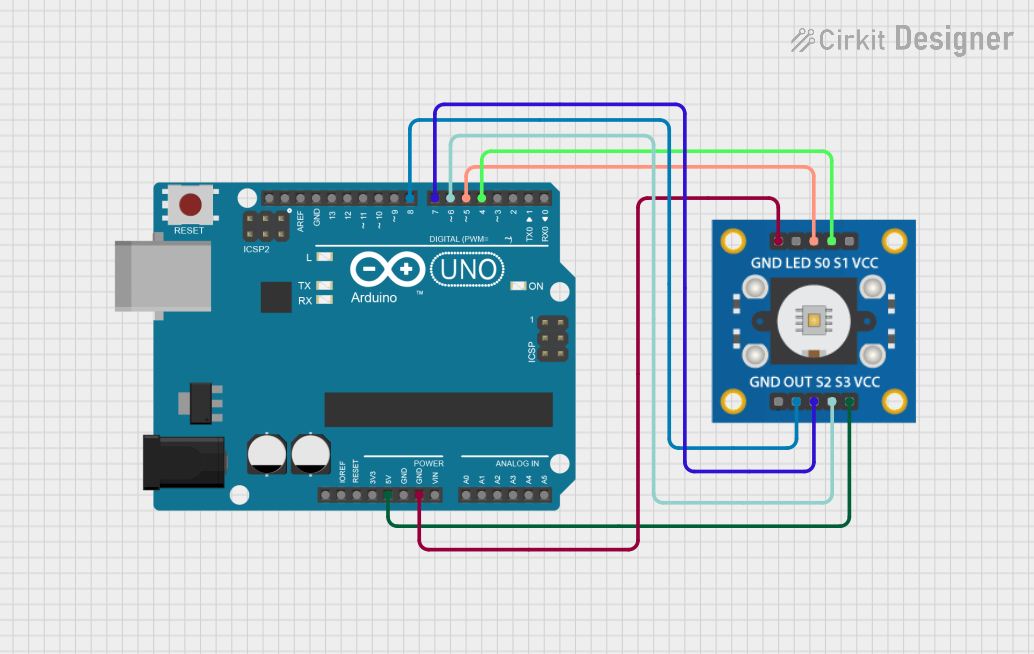 Open Project in Cirkit Designer
Explore Projects Built with TCS3200 Color sensor
Open Project in Cirkit DesignerOpen Project in Cirkit DesignerOpen Project in Cirkit DesignerOpen Project in Cirkit DesignerCommon Applications and Use Cases
- Color recognition: Identifying the color of objects in robotics and automation.
- Color sorting: Sorting objects based on their color in industrial systems.
- Ambient light sensing: Measuring light intensity in specific color bands.
- Educational projects: Teaching color detection and sensor interfacing with microcontrollers.
Technical Specifications
The TCS3200 Color Sensor is built on the TCS3200 chip and includes an array of photodiodes, a current-to-frequency converter, and configurable output scaling.
Key Technical Details
| Parameter | Value |
|---|---|
| Supply Voltage | 2.7V to 5.5V |
| Output Frequency Range | 2 Hz to 500 kHz |
| Operating Temperature | -40°C to 85°C |
| Photodiode Array | 8x8 (64 photodiodes) |
| Filters | 16 red, 16 green, 16 blue, 16 clear |
| Output Type | Square wave (frequency proportional to light intensity) |
| Scaling Options | 1%, 10%, 100% (selectable via S0 and S1) |
Pin Configuration and Descriptions
| Pin Name | Pin Number | Description |
|---|---|---|
| VCC | 1 | Power supply (2.7V to 5.5V). |
| GND | 2 | Ground. |
| S0 | 3 | Output frequency scaling selection (bit 0). |
| S1 | 4 | Output frequency scaling selection (bit 1). |
| S2 | 5 | Photodiode filter selection (bit 0). |
| S3 | 6 | Photodiode filter selection (bit 1). |
| OUT | 7 | Frequency output signal. |
| OE | 8 | Output enable (active low). |
Usage Instructions
How to Use the TCS3200 in a Circuit
- Power the Sensor: Connect the VCC pin to a 3.3V or 5V power source and the GND pin to ground.
- Configure the Output Frequency Scaling:
- Use the S0 and S1 pins to set the output frequency scaling:
- S0 = LOW, S1 = LOW: Power down.
- S0 = LOW, S1 = HIGH: 2% scaling.
- S0 = HIGH, S1 = LOW: 20% scaling.
- S0 = HIGH, S1 = HIGH: 100% scaling.
- Use the S0 and S1 pins to set the output frequency scaling:
- Select the Color Filter:
- Use the S2 and S3 pins to select the active photodiode filter:
- S2 = LOW, S3 = LOW: Red filter.
- S2 = LOW, S3 = HIGH: Blue filter.
- S2 = HIGH, S3 = LOW: Clear (no filter).
- S2 = HIGH, S3 = HIGH: Green filter.
- Use the S2 and S3 pins to select the active photodiode filter:
- Read the Output:
- Connect the OUT pin to a microcontroller or frequency counter to measure the output frequency.
- The frequency corresponds to the intensity of the selected color.
Important Considerations and Best Practices
- Output Enable (OE): The OE pin is active low. Pull it LOW to enable the output or HIGH to disable it.
- Scaling Selection: Use the appropriate scaling factor to match the light intensity in your application.
- Ambient Light: Minimize ambient light interference by enclosing the sensor or using it in controlled lighting conditions.
- Calibration: Calibrate the sensor for your specific application to improve accuracy.
Example Code for Arduino UNO
The following code demonstrates how to interface the TCS3200 with an Arduino UNO to measure the intensity of red, green, and blue light.
// Pin definitions for TCS3200
#define S0 2  // Connect to S0 pin of TCS3200
#define S1 3  // Connect to S1 pin of TCS3200
#define S2 4  // Connect to S2 pin of TCS3200
#define S3 5  // Connect to S3 pin of TCS3200
#define OUT 6 // Connect to OUT pin of TCS3200

void setup() {
  // Set pin modes
  pinMode(S0, OUTPUT);
  pinMode(S1, OUTPUT);
  pinMode(S2, OUTPUT);
  pinMode(S3, OUTPUT);
  pinMode(OUT, INPUT);

  // Set frequency scaling to 20%
  digitalWrite(S0, HIGH);
  digitalWrite(S1, LOW);

  Serial.begin(9600); // Initialize serial communication
}

void loop() {
  int red, green, blue;

  // Measure red light intensity
  digitalWrite(S2, LOW);
  digitalWrite(S3, LOW);
  red = pulseIn(OUT, LOW); // Measure frequency for red filter

  // Measure green light intensity
  digitalWrite(S2, HIGH);
  digitalWrite(S3, HIGH);
  green = pulseIn(OUT, LOW); // Measure frequency for green filter

  // Measure blue light intensity
  digitalWrite(S2, LOW);
  digitalWrite(S3, HIGH);
  blue = pulseIn(OUT, LOW); // Measure frequency for blue filter

  // Print the results
  Serial.print("Red: ");
  Serial.print(red);
  Serial.print(" Green: ");
  Serial.print(green);
  Serial.print(" Blue: ");
  Serial.println(blue);

  delay(500); // Wait for 500ms before the next reading
}
Troubleshooting and FAQs
Common Issues and Solutions
No Output Signal:
- Ensure the OE pin is pulled LOW to enable the output.
- Verify the power supply voltage is within the specified range (2.7V to 5.5V).
Inconsistent Readings:
- Check for ambient light interference and minimize it.
- Ensure proper calibration for your specific application.
Incorrect Color Detection:
- Verify the S2 and S3 pin configurations for the selected color filter.
- Ensure the object is placed at an appropriate distance from the sensor.
FAQs
Q: Can the TCS3200 detect colors in complete darkness?
A: No, the TCS3200 requires a light source to detect colors. Use an external light source for accurate readings.
Q: How do I improve the accuracy of the sensor?
A: Calibrate the sensor for your specific application and minimize ambient light interference.
Q: Can I use the TCS3200 with a 3.3V microcontroller?
A: Yes, the TCS3200 operates within a supply voltage range of 2.7V to 5.5V, making it compatible with 3.3V systems.