
How to Use ATS 230V 2P: Examples, Pinouts, and Specs
 Design with ATS 230V 2P in Cirkit Designer
Introduction
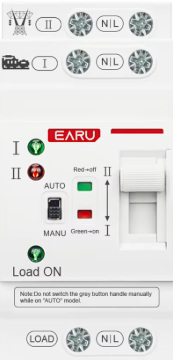
The ATS 230V 2P is an Automatic Transfer Switch designed for 230V applications. It enables seamless switching between two power sources, such as a primary power grid and a backup generator, ensuring an uninterrupted power supply. This component is widely used in residential, commercial, and industrial settings where power reliability is critical.
Explore Projects Built with ATS 230V 2P
 Open Project in Cirkit Designer
 Open Project in Cirkit Designer
 Open Project in Cirkit Designer
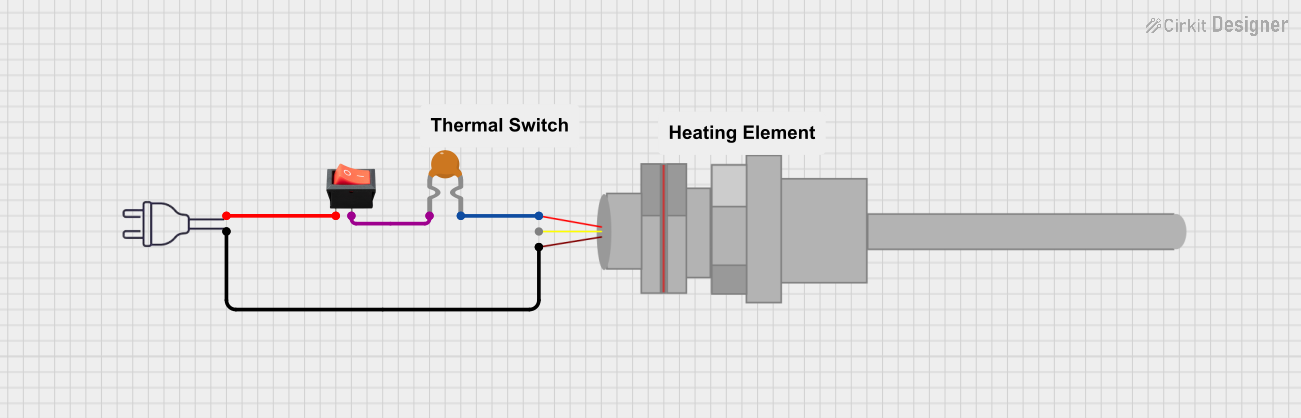 Open Project in Cirkit Designer
Explore Projects Built with ATS 230V 2P
Open Project in Cirkit DesignerOpen Project in Cirkit DesignerOpen Project in Cirkit DesignerOpen Project in Cirkit DesignerCommon Applications and Use Cases
- Backup power systems for homes and offices
- Industrial equipment requiring continuous power
- Data centers and server rooms
- Hospitals and medical facilities
- Renewable energy systems (e.g., solar and wind power integration)
Technical Specifications
The ATS 230V 2P is built to handle high reliability and safety standards. Below are its key technical details:
Key Specifications
| Parameter | Value |
|---|---|
| Rated Voltage | 230V AC |
| Rated Current | 63A |
| Frequency | 50/60 Hz |
| Number of Poles | 2 |
| Switching Time | ≤ 3 seconds |
| Operating Temperature | -20°C to 55°C |
| Insulation Resistance | ≥ 50 MΩ |
| Mechanical Life | ≥ 10,000 cycles |
| Electrical Life | ≥ 5,000 cycles |
Pin Configuration and Descriptions
The ATS 230V 2P has a straightforward terminal layout for connecting two power sources and the load. Below is the terminal description:
| Terminal Label | Description |
|---|---|
| L1 (Source 1) | Live input from primary power source |
| N1 (Source 1) | Neutral input from primary source |
| L2 (Source 2) | Live input from backup power source |
| N2 (Source 2) | Neutral input from backup source |
| L (Load) | Live output to the load |
| N (Load) | Neutral output to the load |
Usage Instructions
How to Use the ATS 230V 2P in a Circuit
Power Source Connections:
- Connect the live (L1) and neutral (N1) terminals to the primary power source.
- Connect the live (L2) and neutral (N2) terminals to the backup power source.
- Ensure proper grounding for safety.
Load Connection:
- Connect the live (L) and neutral (N) terminals to the load (e.g., appliances, equipment).
Testing the ATS:
- Power on the primary source and verify that the load receives power.
- Simulate a power failure on the primary source to ensure the ATS switches to the backup source seamlessly.
Monitoring and Maintenance:
- Regularly inspect the ATS for signs of wear or damage.
- Test the switching mechanism periodically to ensure reliability.
Important Considerations and Best Practices
- Ensure the total load does not exceed the rated current (63A).
- Use appropriate circuit breakers or fuses for additional protection.
- Avoid exposing the ATS to extreme temperatures or moisture.
- Verify all connections are secure and insulated to prevent short circuits.
- For installations involving generators, ensure the generator is properly grounded and configured.
Arduino Integration (Optional Monitoring)
While the ATS 230V 2P does not directly interface with microcontrollers, you can use an Arduino UNO to monitor the status of the power sources. Below is an example code snippet for monitoring the live status of the two power sources using digital inputs:
// ATS Monitoring with Arduino UNO
// Connect Source 1 and Source 2 live signals to digital pins 2 and 3
// Use optocouplers or voltage dividers to step down 230V to safe levels

const int source1Pin = 2; // Digital pin for Source 1 status
const int source2Pin = 3; // Digital pin for Source 2 status

void setup() {
  pinMode(source1Pin, INPUT); // Set Source 1 pin as input
  pinMode(source2Pin, INPUT); // Set Source 2 pin as input
  Serial.begin(9600);         // Initialize serial communication
}

void loop() {
  int source1Status = digitalRead(source1Pin); // Read Source 1 status
  int source2Status = digitalRead(source2Pin); // Read Source 2 status

  // Print the status of both sources to the Serial Monitor
  if (source1Status == HIGH) {
    Serial.println("Source 1 is ON");
  } else {
    Serial.println("Source 1 is OFF");
  }

  if (source2Status == HIGH) {
    Serial.println("Source 2 is ON");
  } else {
    Serial.println("Source 2 is OFF");
  }

  delay(1000); // Wait for 1 second before the next reading
}
Note: Ensure proper isolation and voltage level conversion when interfacing with high-voltage systems.
Troubleshooting and FAQs
Common Issues and Solutions
Issue: The ATS does not switch to the backup source during a primary source failure.
- Solution: Verify the backup source is active and properly connected. Check for loose or faulty wiring.
Issue: The load does not receive power from either source.
- Solution: Ensure the load connections (L and N) are secure. Check the circuit breakers or fuses.
Issue: The ATS switches intermittently or fails to hold the selected source.
- Solution: Inspect the ATS for mechanical wear or electrical faults. Ensure the load does not exceed the rated current.
Issue: The ATS generates excessive heat during operation.
- Solution: Verify the load current is within the rated limit. Ensure proper ventilation around the ATS.
FAQs
Q1: Can the ATS 230V 2P be used with a three-phase system?
A1: No, the ATS 230V 2P is designed for single-phase systems only. For three-phase systems, use an ATS rated for three-phase applications.
Q2: Is the ATS suitable for outdoor installations?
A2: The ATS 230V 2P is not weatherproof. Use an appropriate enclosure for outdoor installations.
Q3: Can I manually override the ATS switching mechanism?
A3: Yes, most ATS units include a manual override option. Refer to the specific model's user manual for instructions.
Q4: How often should I test the ATS?
A4: It is recommended to test the ATS at least once every three months to ensure proper functionality.