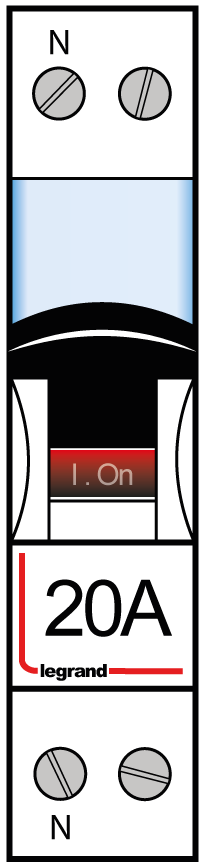
The Breaker 20A by Legrand is a 20-amp circuit breaker designed to protect electrical circuits from overloads and short circuits. It ensures the safety of electrical systems by interrupting the flow of electricity when the current exceeds safe levels. This component is essential in residential, commercial, and industrial electrical installations to prevent damage to wiring, appliances, and other connected devices.
Explore Projects Built with Breaker 20A
Use Cirkit Designer to design, explore, and prototype these projects online. Some projects support real-time simulation. Click "Open Project" to start designing instantly!
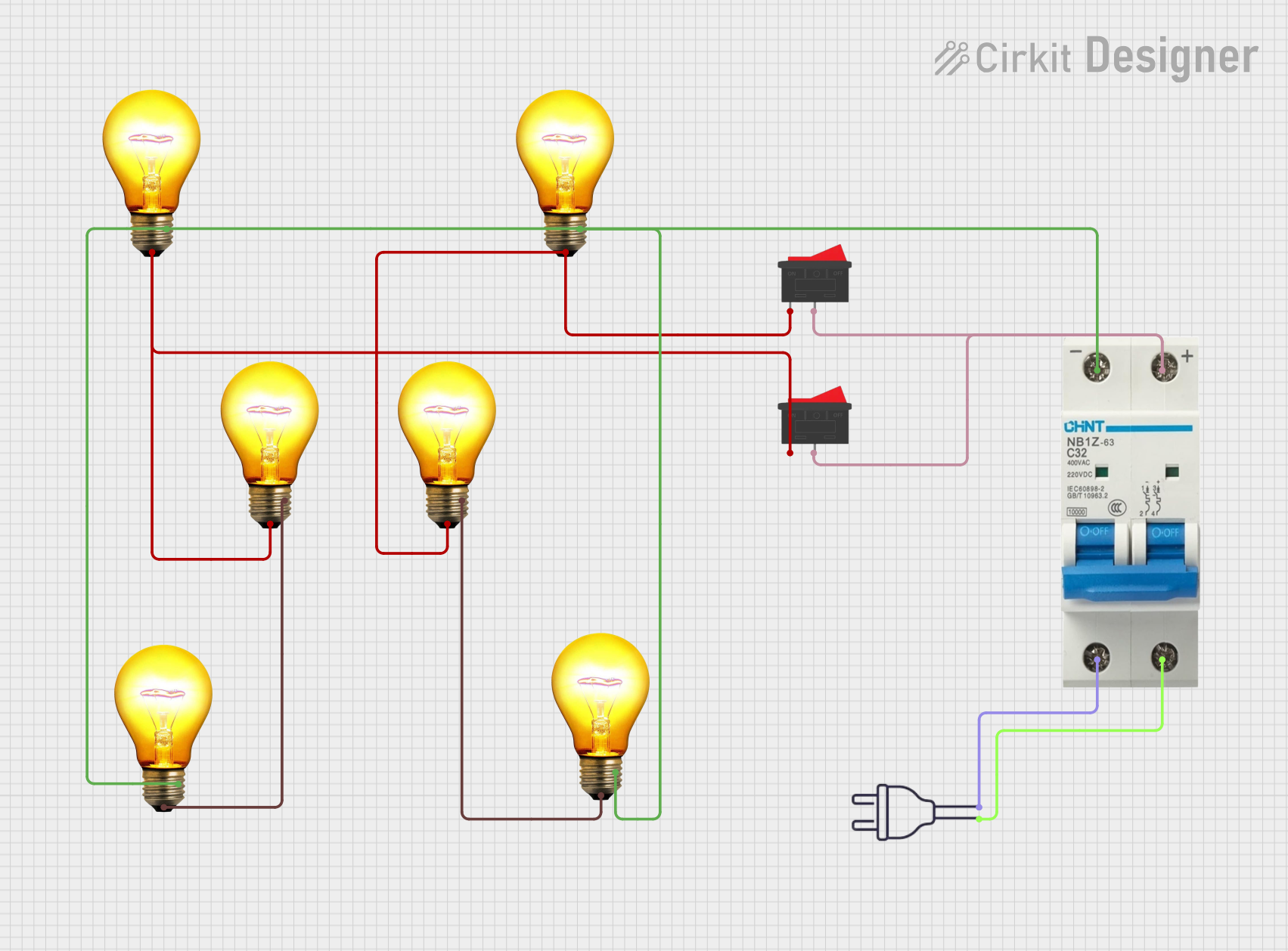
This circuit is designed to control multiple AC bulbs using two rocker switches and a circuit breaker for safety. The circuit is powered by a 220V AC source, with the circuit breaker providing protection and the rocker switches allowing selective control of the connected bulbs.
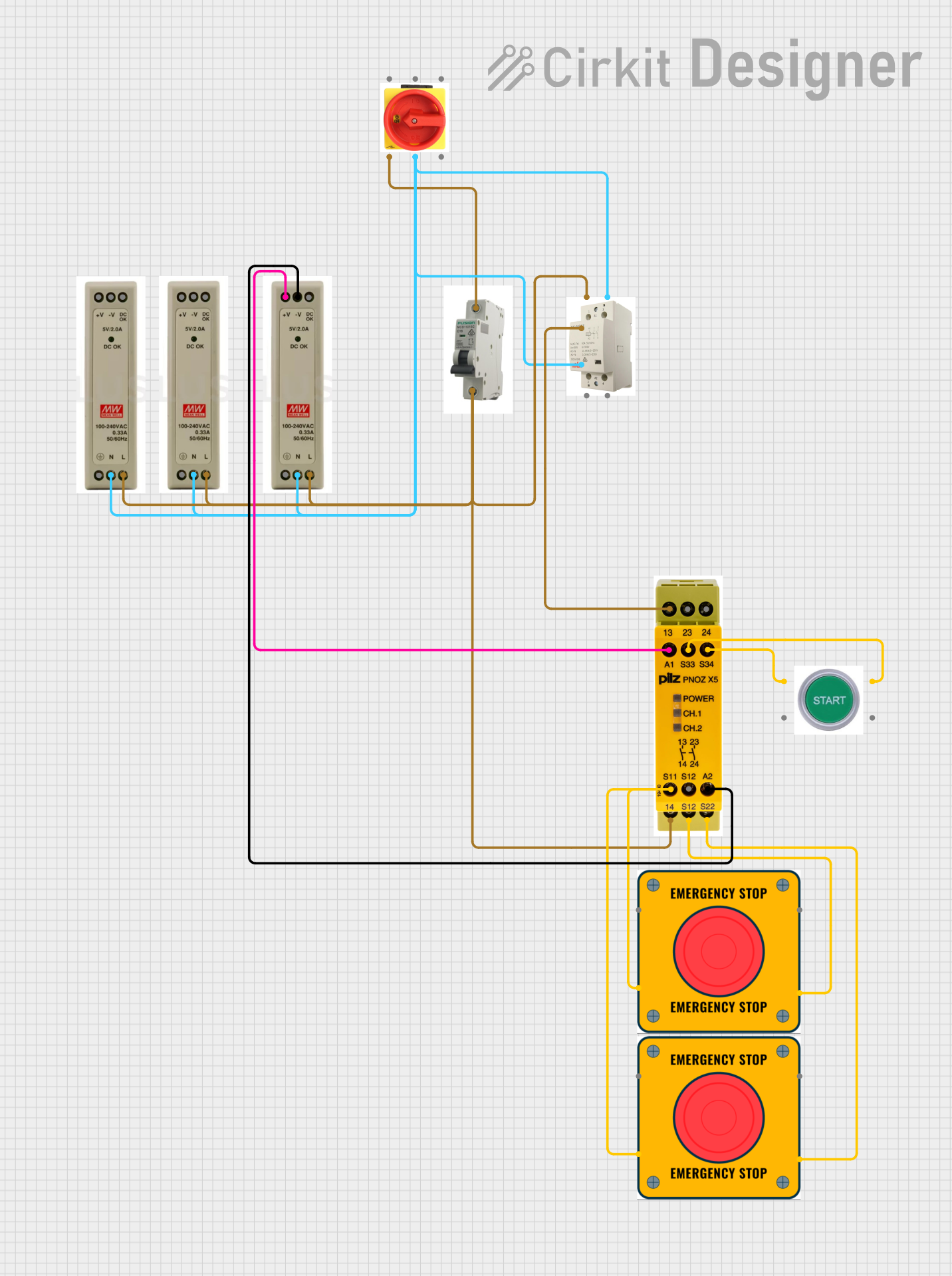
This circuit is designed for power distribution and safety control in an industrial setting. It features a main isolator and circuit breaker for power management, multiple PSUs for 5V, 12V, and 24V outputs, and a safety relay system that interfaces with E-stop buttons and a start switch to control a main contactor, ensuring safe operation and emergency power cut-off capabilities.
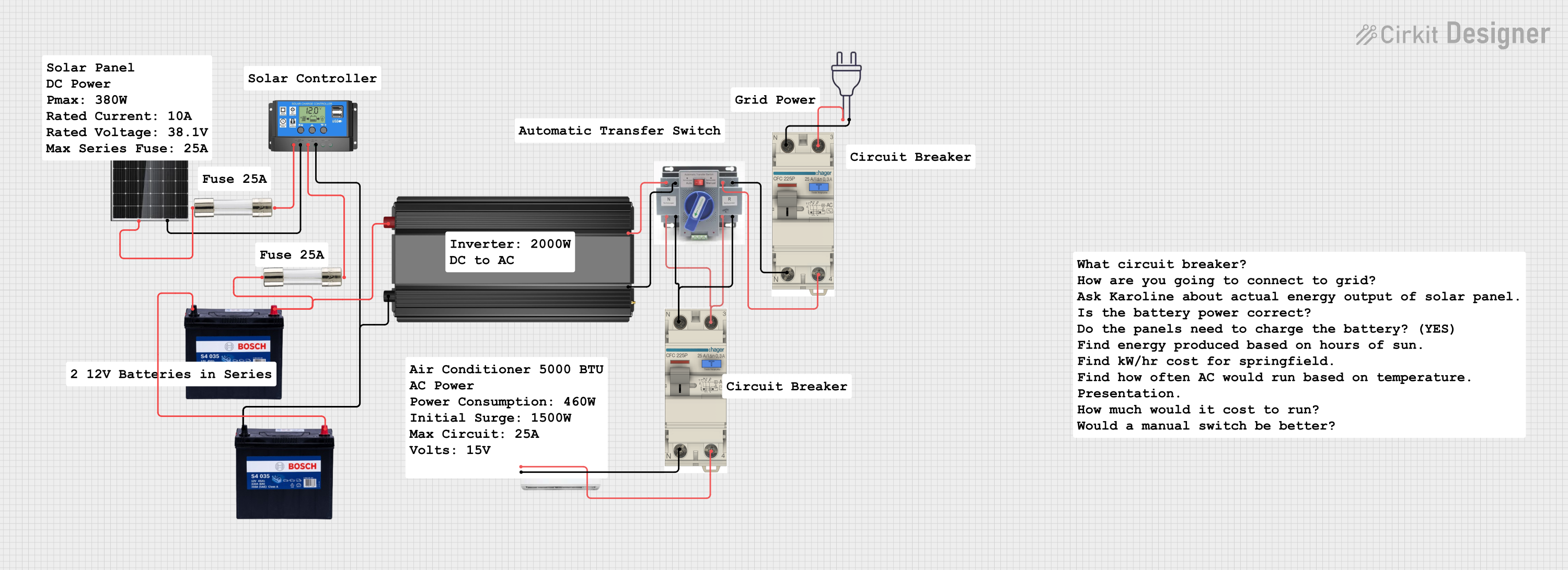
This circuit is a solar power system designed to charge a 12V battery using a 380W solar panel, with a solar charge controller managing the charging process. The stored energy is then converted to AC power via a power inverter, which can be used to power an air conditioner through an automatic transfer switch (ATS) and AC circuit breakers for safety.
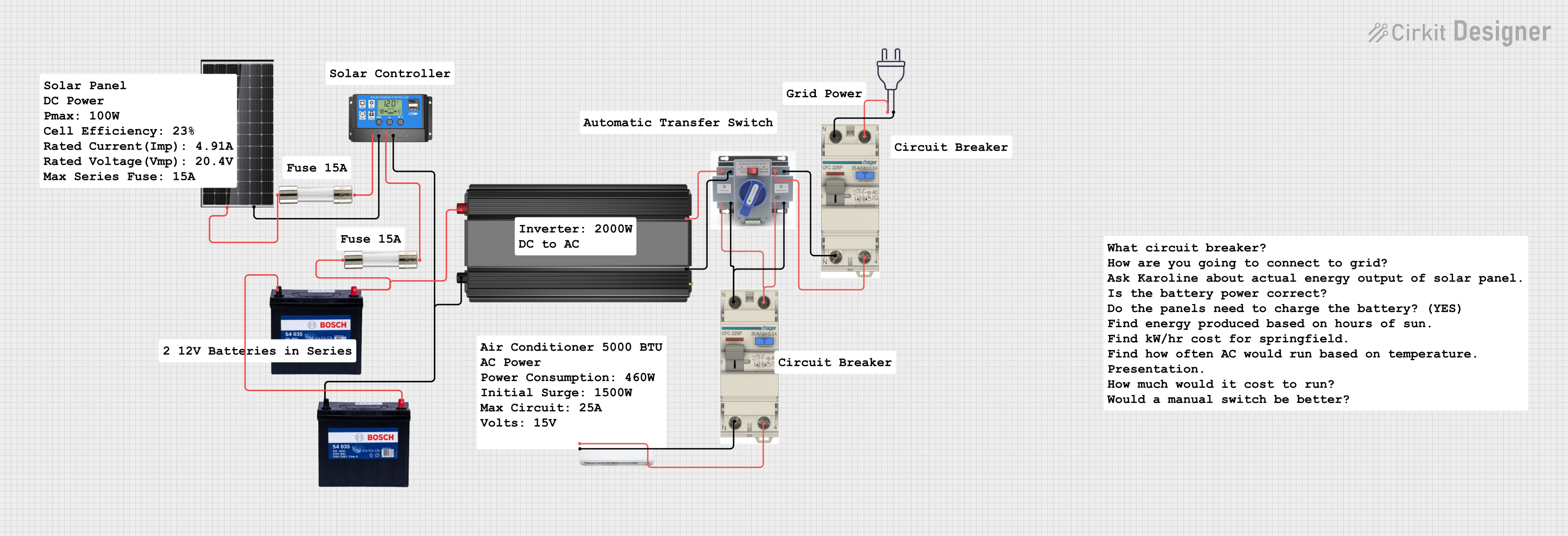
This circuit is a solar power system designed to charge a 12V battery using a 380W solar panel and a solar charge controller. The stored energy is then used to power an inverter, which supplies AC power to an air conditioner through an automatic transfer switch (ATS) and circuit breakers for safety.
Residential Electrical Panels: Protects home wiring and appliances from electrical faults.
Commercial Buildings: Ensures safe operation of lighting, HVAC systems, and office equipment.
Industrial Systems: Safeguards machinery and equipment from electrical overloads.
Renewable Energy Systems: Used in solar panel installations to protect circuits.
Temporary Power Systems: Provides protection in portable power distribution setups.
Technical Specifications
The following table outlines the key technical details of the Breaker 20A:
Specification
Details
Manufacturer
Legrand
Rated Current
20 Amperes
Rated Voltage
120/240 Volts AC
Interrupting Capacity
10,000 Amperes (10 kA)
Type
Thermal-Magnetic Circuit Breaker
Poles
Single-Pole
Mounting Style
DIN Rail or Panel Mount
Operating Temperature
-25°C to +70°C
Compliance Standards
UL 489, IEC 60947-2
Pin Configuration and Descriptions
The Breaker 20A does not have traditional pins like electronic components but instead features terminals for wiring. The table below describes the terminal connections:
Terminal
Description
Line Terminal
Connects to the incoming power supply (hot/live wire).
Load Terminal
Connects to the outgoing circuit or device being protected.
Ground Screw
Provides a connection point for grounding the breaker (if applicable).
Usage Instructions
How to Use the Breaker 20A in a Circuit
Turn Off Power: Before installation, ensure the main power supply is turned off to avoid electrical shock.
Mount the Breaker: Secure the breaker onto a DIN rail or panel mount in the electrical panel.
Connect the Wires:
Attach the incoming power supply (hot/live wire) to the Line Terminal.
Connect the outgoing circuit or device to the Load Terminal.
If required, connect the ground wire to the Ground Screw.
Test the Installation:
Turn on the main power supply.
Switch the breaker to the "ON" position and verify that the connected circuit operates correctly.
Reset After Tripping:
If the breaker trips, identify and resolve the cause of the overload or short circuit.
Reset the breaker by switching it to the "OFF" position, then back to "ON".
Important Considerations and Best Practices
Do Not Exceed Rated Current: Ensure the connected load does not exceed 20A to prevent tripping.
Proper Wire Sizing: Use wires rated for at least 20A to avoid overheating and potential fire hazards.
Regular Inspection: Periodically check the breaker for signs of wear, damage, or loose connections.
Avoid Frequent Tripping: Repeated tripping may indicate an underlying issue in the circuit that needs to be addressed.
Compatibility: Ensure the breaker is compatible with the electrical panel and complies with local electrical codes.
Arduino UNO Integration
While the Breaker 20A is not directly used with microcontrollers like the Arduino UNO, it can be part of a larger system where the Arduino monitors or controls the circuit. For example, an Arduino can be used to monitor current flow and trigger an alert if the breaker trips. Below is an example code snippet for monitoring current using a current sensor (e.g., ACS712) in conjunction with the breaker:
// Example: Monitor current flow in a circuit protected by the Breaker 20A
// This code uses an ACS712 current sensor to measure current and alerts if it exceeds 20A.

const int sensorPin = A0;  // Analog pin connected to the ACS712 sensor
const float sensitivity = 0.1;  // Sensitivity of ACS712 (e.g., 0.1V/A for 20A version)
const float maxCurrent = 20.0;  // Maximum current rating of the breaker (20A)

void setup() {
  Serial.begin(9600);  // Initialize serial communication
  pinMode(sensorPin, INPUT);  // Set sensor pin as input
}

void loop() {
  int sensorValue = analogRead(sensorPin);  // Read sensor value
  float voltage = (sensorValue / 1023.0) * 5.0;  // Convert to voltage (assuming 5V ADC)
  float current = voltage / sensitivity;  // Calculate current in Amperes

  Serial.print("Current: ");
  Serial.print(current);
  Serial.println(" A");

  // Check if current exceeds breaker rating
  if (current > maxCurrent) {
    Serial.println("Warning: Current exceeds 20A! Check the circuit.");
  }

  delay(1000);  // Wait 1 second before next reading
}
Troubleshooting and FAQs
Common Issues and Solutions
Issue
Possible Cause
Solution
Breaker trips frequently
Overloaded circuit or short circuit
Reduce the load or inspect the circuit for faults.
Breaker does not reset
Persistent fault in the circuit
Identify and resolve the fault before attempting to reset the breaker.
Breaker feels hot to the touch
Loose connections or excessive current
Tighten connections and ensure the load does not exceed 20A.
Breaker does not trip during overload
Faulty breaker or incorrect installation
Replace the breaker or verify proper installation.
FAQs
Can the Breaker 20A be used for DC circuits?
No, this breaker is designed for AC circuits. Use a DC-rated breaker for DC applications.
What happens if I use a wire smaller than 20A rating?
Using undersized wires can cause overheating, which may lead to fire hazards.
How do I know if the breaker is compatible with my panel?
Check the panel's specifications and ensure it supports Legrand breakers with the same mounting style.
Can I use this breaker for a 15A circuit?
While it is possible, it is recommended to use a breaker rated for the specific circuit current to ensure optimal protection.
By following this documentation, users can safely and effectively install and operate the Breaker 20A by Legrand.

 Open Project in Cirkit Designer