
How to Use HLK-PM12: Examples, Pinouts, and Specs
 Design with HLK-PM12 in Cirkit Designer
Introduction
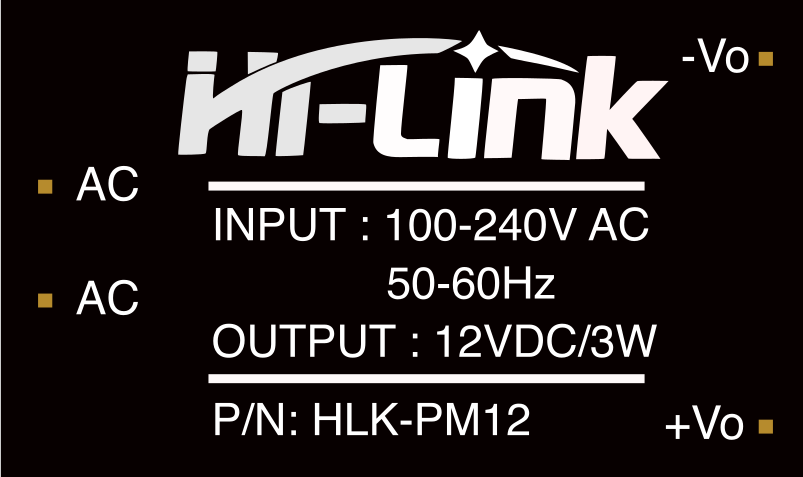
The HLK-PM12 is a compact and efficient AC-DC power module manufactured by Shenzhen Hi-Link Electronic Co., Ltd. It is designed to convert a wide range of AC input voltages (85-265V AC) into a stable 12V DC output. This module is widely used in applications requiring a reliable and space-saving power supply solution, such as IoT devices, home automation systems, industrial control circuits, and embedded systems.
Explore Projects Built with HLK-PM12
 Open Project in Cirkit Designer
 Open Project in Cirkit Designer
 Open Project in Cirkit Designer
 Open Project in Cirkit Designer
Explore Projects Built with HLK-PM12
Open Project in Cirkit DesignerOpen Project in Cirkit DesignerOpen Project in Cirkit DesignerOpen Project in Cirkit DesignerCommon Applications and Use Cases
- Powering microcontrollers and sensors in IoT projects
- Home automation devices
- Industrial control systems
- LED lighting systems
- Small appliances and consumer electronics
Technical Specifications
The HLK-PM12 is designed to provide a stable and efficient power supply with the following key specifications:
| Parameter | Value |
|---|---|
| Input Voltage Range | 85-265V AC |
| Output Voltage | 12V DC |
| Output Current | 250mA (maximum) |
| Output Power | 3W |
| Efficiency | ≥ 70% |
| Frequency Range | 47-63Hz |
| Operating Temperature | -20°C to +60°C |
| Storage Temperature | -40°C to +80°C |
| Isolation Voltage | 3000V AC |
| Dimensions | 35mm x 18mm x 15mm |
| Weight | ~15g |
Pin Configuration and Descriptions
The HLK-PM12 module has six pins, as described in the table below:
| Pin Number | Pin Name | Description |
|---|---|---|
| 1 | AC(L) | AC live input (connect to the live wire of AC mains) |
| 2 | AC(N) | AC neutral input (connect to the neutral wire) |
| 3 | NC | Not connected (leave unconnected) |
| 4 | +VOUT | Positive DC output (12V DC) |
| 5 | -VOUT | Negative DC output (ground) |
| 6 | NC | Not connected (leave unconnected) |
Usage Instructions
How to Use the HLK-PM12 in a Circuit
- Input Connection: Connect the AC(L) and AC(N) pins to the live and neutral wires of the AC mains supply, respectively. Ensure proper insulation and safety precautions when handling high-voltage AC connections.
- Output Connection: Connect the +VOUT and -VOUT pins to the load or circuit requiring a 12V DC power supply. Ensure the load does not exceed the maximum output current of 250mA.
- Mounting: Secure the module on a PCB or enclosure using appropriate mounting techniques. Ensure adequate spacing and insulation to prevent short circuits or accidental contact with high-voltage pins.
- Filtering: For improved performance and reduced noise, consider adding external capacitors (e.g., 10µF electrolytic and 0.1µF ceramic) across the output terminals.
Important Considerations and Best Practices
- Safety: Always handle the module with care, as it involves high-voltage AC input. Ensure proper insulation and avoid touching the module while it is powered.
- Load Requirements: Do not exceed the maximum output current of 250mA to prevent overheating or damage to the module.
- Ventilation: Ensure adequate ventilation around the module to prevent overheating, especially in high-temperature environments.
- Testing: Before connecting the module to your final circuit, test it with a dummy load to verify proper operation.
Example: Using HLK-PM12 with Arduino UNO
The HLK-PM12 can be used to power an Arduino UNO by providing a stable 12V DC supply. Below is an example circuit and code to blink an LED using the Arduino UNO powered by the HLK-PM12.
Circuit Connections
- Connect the AC(L) and AC(N) pins of the HLK-PM12 to the AC mains supply.
- Connect the +VOUT pin of the HLK-PM12 to the VIN pin of the Arduino UNO.
- Connect the -VOUT pin of the HLK-PM12 to the GND pin of the Arduino UNO.
- Connect an LED and a 220-ohm resistor to pin 13 of the Arduino UNO.
Arduino Code
// Blink an LED connected to pin 13 of the Arduino UNO
// Ensure the HLK-PM12 is providing a stable 12V DC to the Arduino's VIN pin

void setup() {
  pinMode(13, OUTPUT); // Set pin 13 as an output pin
}

void loop() {
  digitalWrite(13, HIGH); // Turn the LED on
  delay(1000);            // Wait for 1 second
  digitalWrite(13, LOW);  // Turn the LED off
  delay(1000);            // Wait for 1 second
}
Troubleshooting and FAQs
Common Issues and Solutions
No Output Voltage
- Cause: Incorrect AC input connection or insufficient input voltage.
- Solution: Verify that the AC(L) and AC(N) pins are connected to the live and neutral wires of the AC mains supply. Ensure the input voltage is within the specified range (85-265V AC).
Overheating
- Cause: Exceeding the maximum output current or poor ventilation.
- Solution: Ensure the load does not exceed 250mA. Provide adequate ventilation around the module.
Noise or Ripple in Output
- Cause: Insufficient filtering or high-frequency noise.
- Solution: Add external capacitors (e.g., 10µF electrolytic and 0.1µF ceramic) across the output terminals to reduce noise.
Module Not Working After Power Surge
- Cause: Damage due to a power surge or overvoltage.
- Solution: Use a surge protector or fuse on the AC input to protect the module from power surges.
FAQs
Q: Can the HLK-PM12 power a Raspberry Pi?
A: No, the HLK-PM12 cannot power a Raspberry Pi directly, as the Raspberry Pi typically requires higher current (e.g., 2.5A for Raspberry Pi 4) than the HLK-PM12 can provide (250mA maximum).
Q: Is the HLK-PM12 suitable for outdoor use?
A: The HLK-PM12 is not designed for outdoor use unless it is enclosed in a weatherproof and insulated housing.
Q: Can I use the HLK-PM12 with a 24V DC input?
A: No, the HLK-PM12 is designed for AC input only (85-265V AC). It cannot operate with a DC input.
Q: Does the HLK-PM12 require a heatsink?
A: No, the HLK-PM12 does not require a heatsink under normal operating conditions, as long as the load does not exceed 250mA and there is adequate ventilation.