
How to Use HK19F-DC Relay (BT): Examples, Pinouts, and Specs
 Design with HK19F-DC Relay (BT) in Cirkit Designer
Introduction
The HK19F-DC is a compact relay designed for low voltage applications, featuring a Double Pole Double Throw (DPDT) configuration. This versatile relay is widely used in automation, control systems, and other electronic circuits where reliable switching is required. Its compact size, high reliability, and long service life make it an ideal choice for a variety of applications.
Explore Projects Built with HK19F-DC Relay (BT)
 Open Project in Cirkit Designer
 Open Project in Cirkit Designer
 Open Project in Cirkit Designer
 Open Project in Cirkit Designer
Explore Projects Built with HK19F-DC Relay (BT)
Open Project in Cirkit DesignerOpen Project in Cirkit DesignerOpen Project in Cirkit DesignerOpen Project in Cirkit DesignerCommon Applications
- Automation systems
- Industrial control circuits
- Home appliances
- Signal switching in low-power circuits
- Microcontroller-based projects
Technical Specifications
Key Specifications
| Parameter | Value |
|---|---|
| Coil Voltage | 5V DC, 12V DC, 24V DC |
| Contact Configuration | DPDT (Double Pole Double Throw) |
| Contact Rating | 1A at 120V AC / 2A at 30V DC |
| Coil Resistance | Varies by voltage (e.g., 5V: ~70Ω) |
| Switching Voltage (Max) | 250V AC / 220V DC |
| Switching Current (Max) | 2A |
| Insulation Resistance | ≥100MΩ at 500V DC |
| Dielectric Strength | 1500V AC (1 minute) |
| Operating Temperature | -40°C to +70°C |
| Dimensions | 19mm x 15.5mm x 10.5mm |
Pin Configuration
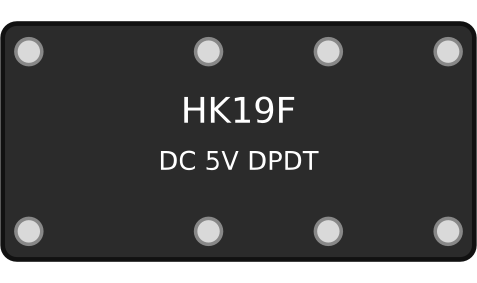
The HK19F-DC relay has 8 pins, which are configured as follows:
| Pin Number | Description |
|---|---|
| 1 | Coil Terminal 1 (Positive) |
| 2 | Coil Terminal 2 (Negative) |
| 3 | Common Terminal for Pole 1 |
| 4 | Normally Closed (NC) for Pole 1 |
| 5 | Normally Open (NO) for Pole 1 |
| 6 | Common Terminal for Pole 2 |
| 7 | Normally Closed (NC) for Pole 2 |
| 8 | Normally Open (NO) for Pole 2 |
Usage Instructions
How to Use the HK19F-DC in a Circuit
- Power the Coil: Connect the relay's coil terminals (Pins 1 and 2) to a DC power source matching the relay's rated coil voltage (e.g., 5V, 12V, or 24V DC). Use a current-limiting resistor if necessary.
- Switching Circuit: Connect the load to the appropriate terminals:
- For Pole 1: Use Pins 3 (Common), 4 (NC), and 5 (NO).
- For Pole 2: Use Pins 6 (Common), 7 (NC), and 8 (NO).
- Control Signal: Use a microcontroller, transistor, or other control circuit to activate the relay coil. When the coil is energized, the relay switches from NC to NO.
Important Considerations
- Flyback Diode: Always connect a flyback diode across the coil terminals to protect the driving circuit from voltage spikes when the relay is de-energized.
- Contact Ratings: Ensure the load does not exceed the relay's contact ratings (e.g., 2A at 30V DC).
- Isolation: Maintain proper isolation between the control and load circuits to prevent damage or interference.
Example: Connecting to an Arduino UNO
Below is an example of how to control the HK19F-DC relay using an Arduino UNO:
// Example: Controlling the HK19F-DC relay with an Arduino UNO
// Pin 7 is used to control the relay

const int relayPin = 7; // Define the pin connected to the relay module

void setup() {
  pinMode(relayPin, OUTPUT); // Set the relay pin as an output
  digitalWrite(relayPin, LOW); // Ensure the relay is off initially
}

void loop() {
  digitalWrite(relayPin, HIGH); // Turn the relay on
  delay(1000); // Keep the relay on for 1 second
  digitalWrite(relayPin, LOW); // Turn the relay off
  delay(1000); // Keep the relay off for 1 second
}
Note: Use a transistor or relay driver module to interface the relay with the Arduino, as the Arduino's GPIO pins cannot directly supply enough current to drive the relay.
Troubleshooting and FAQs
Common Issues and Solutions
Relay Not Switching
- Cause: Insufficient coil voltage or current.
- Solution: Verify the power supply voltage matches the relay's rated coil voltage. Check for loose connections.
Chattering or Unstable Operation
- Cause: Noise or insufficient driving current.
- Solution: Add a capacitor across the power supply to filter noise. Ensure the driving circuit can supply adequate current.
Load Not Switching
- Cause: Incorrect wiring of the load or exceeding contact ratings.
- Solution: Double-check the wiring and ensure the load does not exceed the relay's contact ratings.
Burnt Contacts
- Cause: Switching high-power loads without proper protection.
- Solution: Use a snubber circuit or a relay with higher contact ratings for high-power loads.
FAQs
Q: Can the HK19F-DC relay be used with AC loads?
A: Yes, the relay can switch AC loads up to 120V at 1A. Ensure the load does not exceed the specified ratings.
Q: Do I need a separate power supply for the relay?
A: It depends on your circuit. If the control circuit cannot supply sufficient current, use a separate power supply for the relay coil.
Q: How do I protect the relay from voltage spikes?
A: Use a flyback diode (e.g., 1N4007) across the coil terminals to suppress voltage spikes when the relay is turned off.
Q: Can I use the relay for high-frequency switching?
A: No, mechanical relays like the HK19F-DC are not suitable for high-frequency switching due to their slower response time and mechanical wear.