The FX2N PLC (Programmable Logic Controller) is a compact and versatile automation device manufactured by Mitsubishi Clone. Designed for industrial control and automation applications, the FX2N-14MR model is part of the FX2N series, offering reliable performance, modular expandability, and support for multiple programming languages such as ladder logic. This PLC is ideal for small to medium-sized automation tasks, including machine control, process automation, and data acquisition.
Explore Projects Built with FX2N PLC
Use Cirkit Designer to design, explore, and prototype these projects online. Some projects support real-time simulation. Click "Open Project" to start designing instantly!
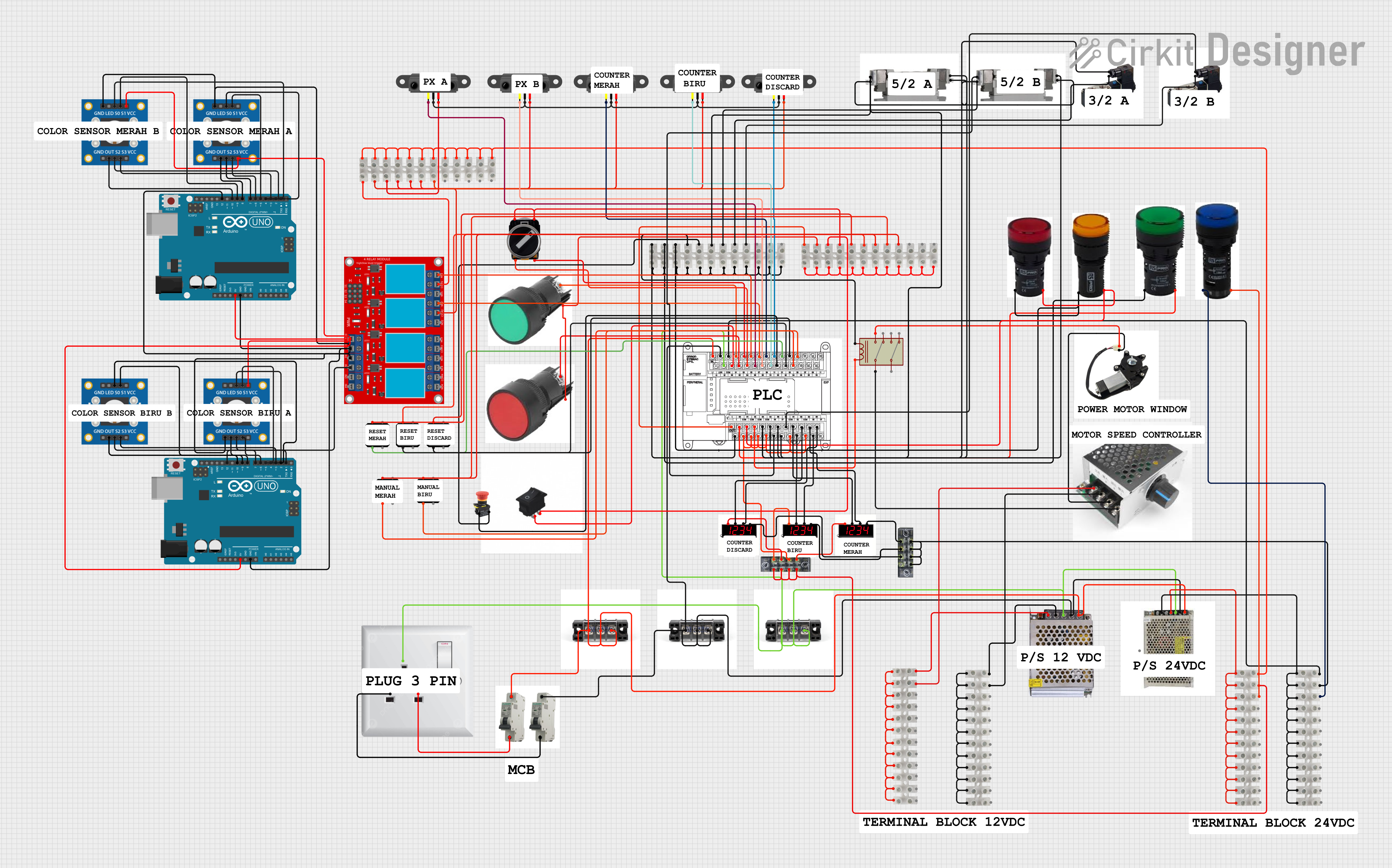
This circuit is designed to control a motorized window system using a PLC (Programmable Logic Controller) and an array of sensors and switches. It includes power supplies for 12V and 24V DC, an MCB (Miniature Circuit Breaker) for protection, and a relay module interfaced with an Arduino for additional control logic. The PLC manages inputs from pushbuttons, a 3-position switch, infrared proximity sensors, and an emergency stop, and it controls outputs such as the motor speed controller, lamps, and solenoid valves.
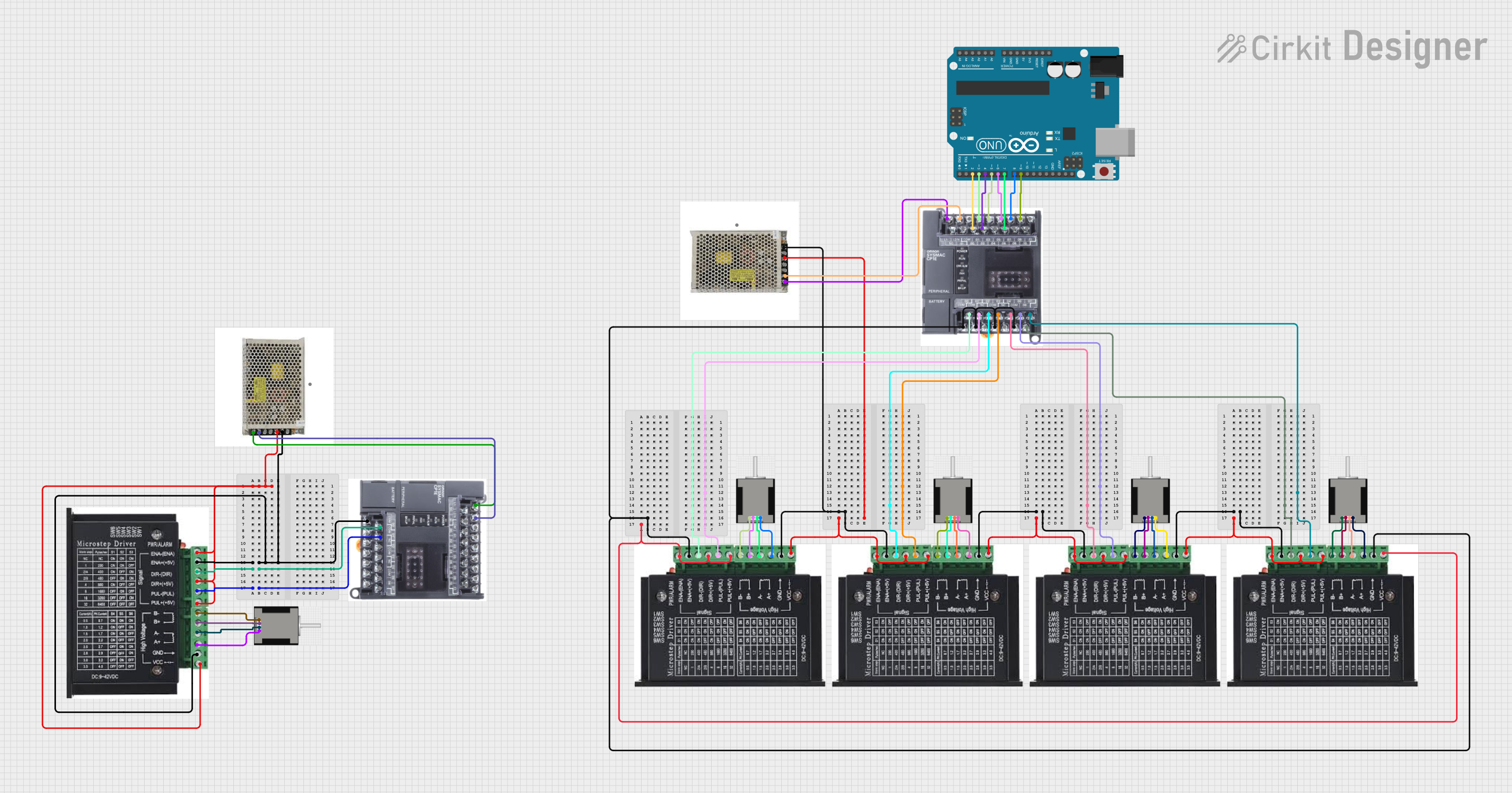
This circuit controls multiple NEMA 17 stepper motors using stepper drivers, a PLC, and an Arduino UNO. The PLC and Arduino coordinate to send control signals to the stepper drivers, which in turn drive the stepper motors. A 24V DC power supply provides the necessary power to the stepper drivers and PLC.
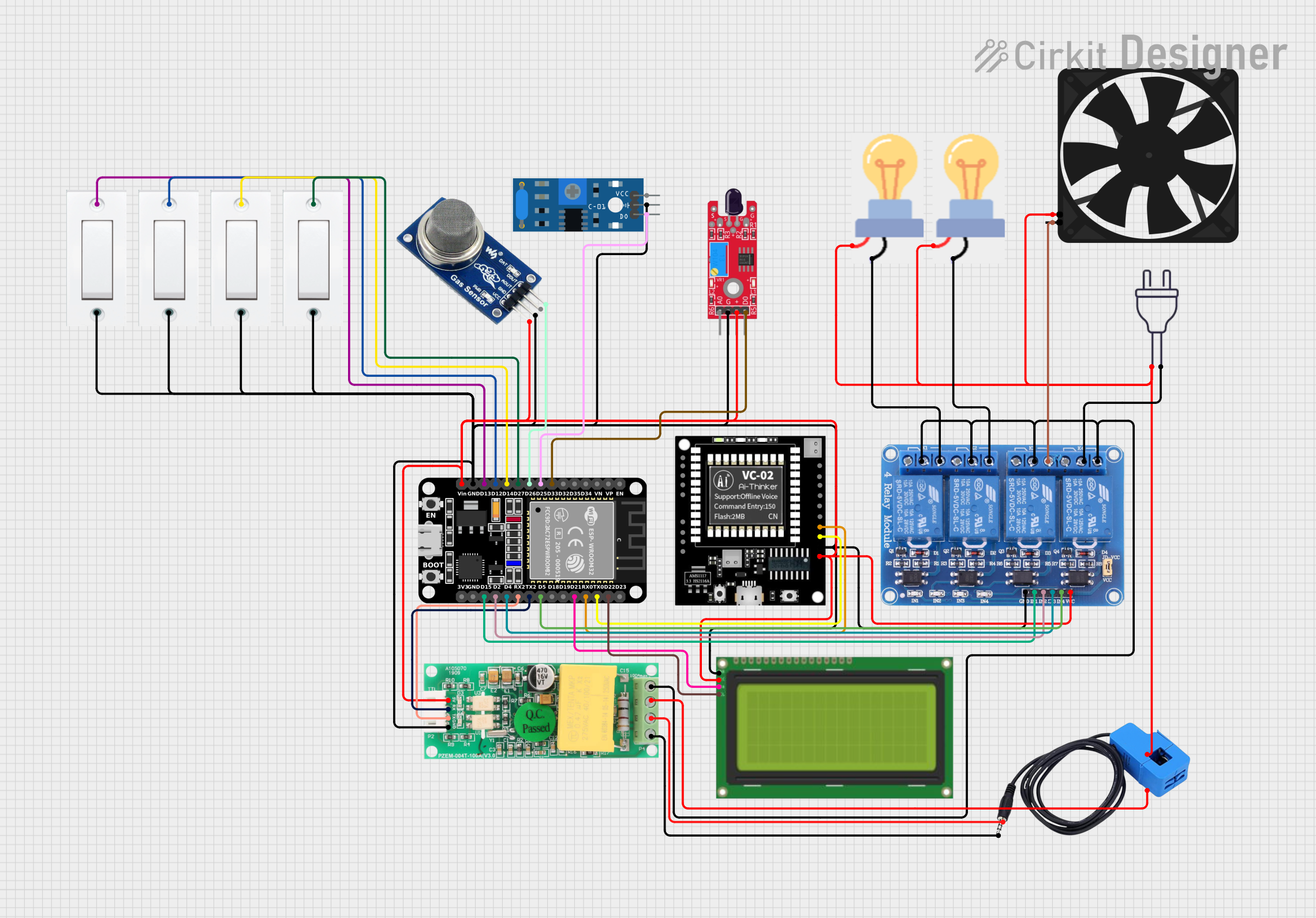
This is a smart environmental monitoring and control system featuring an ESP32 microcontroller interfaced with a PZEM004T for power monitoring, relay modules for actuating bulbs and a fan, and an LCD for user interface. It includes flame, gas, and vibration sensors for safety monitoring purposes.
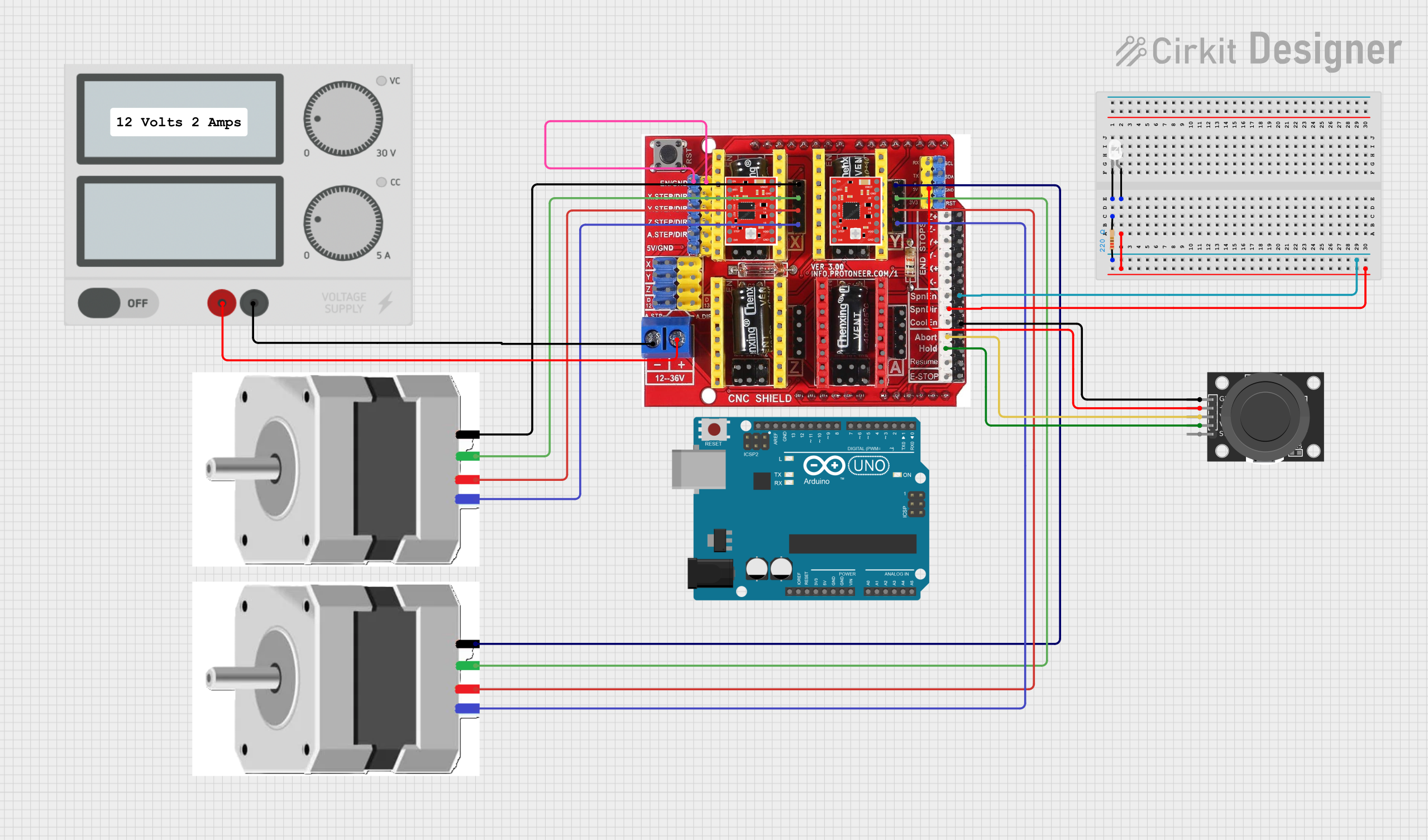
This circuit is a CNC control system that uses an Arduino UNO to interface with a CNC Shield V3, which drives two NEMA23 stepper motors for X and Y axis control. A KY-023 Dual Axis Joystick Module provides manual control inputs, and an LED with a current-limiting resistor indicates the spindle direction status.
Integration with sensors, actuators, and HMIs (Human-Machine Interfaces)
Technical Specifications
The FX2N-14MR is a compact PLC with built-in input and output capabilities, making it suitable for standalone or modular applications.
Key Technical Details
Parameter
Specification
Manufacturer
Mitsubishi Clone
Model Number
FX2N-14MR
Power Supply Voltage
24V DC or 100-240V AC (model-specific)
Digital Inputs
8
Digital Outputs
6 (Relay type)
Programming Language
Ladder Logic, Instruction List, etc.
Communication Ports
RS-232, RS-485 (optional modules)
Memory Capacity
8,000 steps
Expansion Capability
Yes (via additional I/O modules)
Operating Temperature
0°C to 55°C
Dimensions
90mm x 75mm x 60mm
Pin Configuration and Descriptions
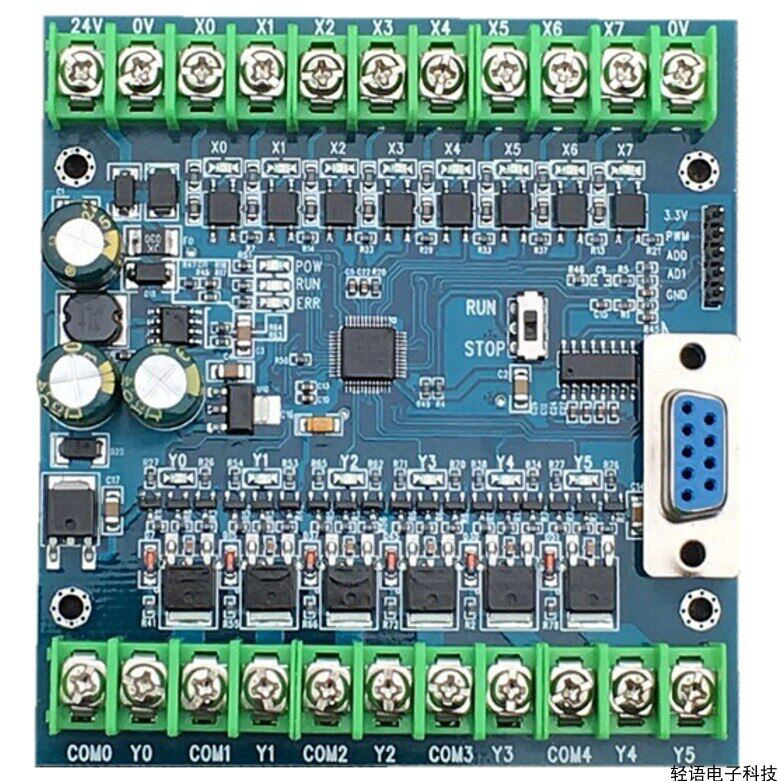
The FX2N-14MR features a terminal block for connecting inputs, outputs, and power. Below is the pin configuration:
Input Terminals
Pin Number
Description
Signal Type
X0
Input 0
Digital Input
X1
Input 1
Digital Input
X2
Input 2
Digital Input
X3
Input 3
Digital Input
X4
Input 4
Digital Input
X5
Input 5
Digital Input
X6
Input 6
Digital Input
X7
Input 7
Digital Input
Output Terminals
Pin Number
Description
Signal Type
Y0
Output 0
Relay Output
Y1
Output 1
Relay Output
Y2
Output 2
Relay Output
Y3
Output 3
Relay Output
Y4
Output 4
Relay Output
Y5
Output 5
Relay Output
Power Terminals
Pin Number
Description
L/+
Live/Positive Power
N/-
Neutral/Negative Power
Usage Instructions
How to Use the FX2N PLC in a Circuit
Power Connection: Connect the power supply to the L/+ and N/- terminals. Ensure the voltage matches the PLC's specifications (24V DC or 100-240V AC).
Input Connections: Connect sensors or switches to the input terminals (X0-X7). Use pull-up or pull-down resistors if required.
Output Connections: Connect actuators, relays, or other devices to the output terminals (Y0-Y5). Ensure the load does not exceed the output's current rating.
Programming: Use Mitsubishi's GX Developer or GX Works software to write and upload ladder logic programs to the PLC via the communication port.
Testing: After programming, test the PLC in a controlled environment to ensure proper operation.
Important Considerations and Best Practices
Power Supply: Use a stable and regulated power supply to avoid damage to the PLC.
Wiring: Ensure proper insulation and secure connections to prevent short circuits or signal interference.
Grounding: Properly ground the PLC to reduce electrical noise and improve reliability.
Expansion: When adding expansion modules, ensure compatibility with the FX2N series.
Backup: Regularly back up the PLC program to avoid data loss during power failures or maintenance.
Example Code for Arduino UNO Integration
The FX2N PLC can communicate with an Arduino UNO via RS-232 or RS-485. Below is an example of Arduino code to send a signal to the PLC:
#include <SoftwareSerial.h>

// Define RX and TX pins for SoftwareSerial
SoftwareSerial plcSerial(10, 11); // RX = pin 10, TX = pin 11

void setup() {
  // Initialize serial communication
  Serial.begin(9600); // For debugging
  plcSerial.begin(9600); // Communication with FX2N PLC

  Serial.println("Arduino to FX2N PLC Communication Initialized");
}

void loop() {
  // Example: Send a signal to turn on Output Y0
  byte command[] = {0x02, 0x30, 0x30, 0x30, 0x31, 0x03};
  // Replace with actual command for your PLC

  plcSerial.write(command, sizeof(command)); // Send command to PLC
  Serial.println("Command sent to PLC");

  delay(1000); // Wait for 1 second
}
Note: The command format depends on the PLC's communication protocol. Refer to the FX2N communication manual for details.
Troubleshooting and FAQs
Common Issues and Solutions
PLC Not Powering On
Cause: Incorrect power supply voltage or loose connections.
Solution: Verify the power supply voltage and check all connections.
Inputs Not Responding
Cause: Faulty wiring or incompatible sensors.
Solution: Check sensor connections and ensure they are compatible with the PLC's input specifications.
Outputs Not Activating
Cause: Overloaded output or incorrect wiring.
Solution: Verify the load connected to the output and ensure it is within the rated capacity.
Communication Failure
Cause: Incorrect baud rate or wiring issues.
Solution: Ensure the baud rate matches the PLC settings and check the communication cable.
FAQs
Can the FX2N PLC be programmed without Mitsubishi software?
Yes, third-party software may be used, but compatibility is not guaranteed.
What is the maximum expansion capacity of the FX2N-14MR?
The FX2N series supports up to 256 I/O points with expansion modules.
Is the FX2N PLC compatible with SCADA systems?
Yes, it can communicate with SCADA systems via RS-232 or RS-485 using appropriate protocols.
Can I use the FX2N PLC in outdoor environments?
The PLC is designed for indoor use. If used outdoors, ensure it is housed in a weatherproof enclosure.

 Open Project in Cirkit Designer