
How to Use ESP32C3 Supermini: Examples, Pinouts, and Specs
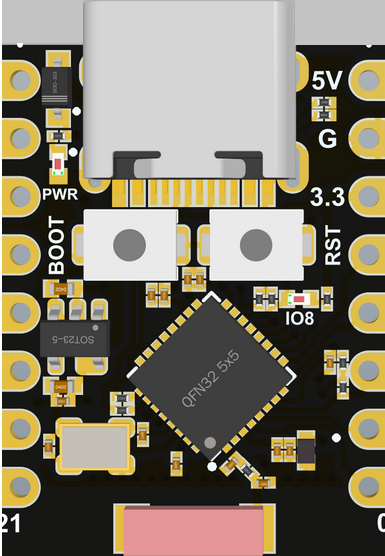
 Design with ESP32C3 Supermini in Cirkit Designer
Introduction
The ESP32C3 Supermini, manufactured by Generi, is a compact, low-power microcontroller designed for Internet of Things (IoT) applications. It integrates Wi-Fi and Bluetooth capabilities, making it a versatile choice for smart devices and embedded systems. With its dual-core processor, ample GPIO pins, and support for various communication protocols, the ESP32C3 Supermini is ideal for applications requiring wireless connectivity, efficient processing, and compact design.
Explore Projects Built with ESP32C3 Supermini
 Open Project in Cirkit Designer
 Open Project in Cirkit Designer
 Open Project in Cirkit Designer
 Open Project in Cirkit Designer
Explore Projects Built with ESP32C3 Supermini
Open Project in Cirkit DesignerOpen Project in Cirkit DesignerOpen Project in Cirkit DesignerOpen Project in Cirkit DesignerCommon Applications
- Smart home devices (e.g., smart lights, thermostats)
- Wearable technology
- Industrial IoT systems
- Wireless sensor networks
- Robotics and automation
- Prototyping and development of connected devices
Technical Specifications
Key Technical Details
| Parameter | Specification |
|---|---|
| Manufacturer | Generi |
| Part ID | ESP32C3 Supermini |
| Processor | 32-bit RISC-V single-core processor |
| Clock Speed | Up to 160 MHz |
| Flash Memory | 4 MB |
| SRAM | 400 KB |
| Wi-Fi Standard | 802.11 b/g/n (2.4 GHz) |
| Bluetooth Version | Bluetooth 5.0 (LE) |
| GPIO Pins | 22 |
| Operating Voltage | 3.3V |
| Power Consumption | Ultra-low power (deep sleep: ~5 µA) |
| Communication Protocols | UART, SPI, I2C, I2S, PWM |
| Dimensions | 18 mm x 25 mm |
Pin Configuration and Descriptions
The ESP32C3 Supermini features 22 GPIO pins, which can be configured for various functions. Below is the pinout description:
| Pin Number | Pin Name | Functionality |
|---|---|---|
| 1 | GND | Ground |
| 2 | 3V3 | 3.3V Power Supply |
| 3 | GPIO0 | General Purpose I/O, Boot Mode Select |
| 4 | GPIO1 | General Purpose I/O |
| 5 | GPIO2 | General Purpose I/O |
| 6 | GPIO3 | General Purpose I/O |
| 7 | GPIO4 | General Purpose I/O |
| 8 | GPIO5 | General Purpose I/O |
| 9 | GPIO6 | General Purpose I/O |
| 10 | GPIO7 | General Purpose I/O |
| 11 | GPIO8 | General Purpose I/O |
| 12 | GPIO9 | General Purpose I/O |
| 13 | GPIO10 | General Purpose I/O |
| 14 | GPIO11 | General Purpose I/O |
| 15 | GPIO12 | General Purpose I/O |
| 16 | GPIO13 | General Purpose I/O |
| 17 | GPIO14 | General Purpose I/O |
| 18 | GPIO15 | General Purpose I/O |
| 19 | GPIO16 | General Purpose I/O |
| 20 | GPIO17 | General Purpose I/O |
| 21 | RXD | UART Receive |
| 22 | TXD | UART Transmit |
Usage Instructions
How to Use the ESP32C3 Supermini in a Circuit
- Power Supply: Connect the 3V3 pin to a 3.3V power source and the GND pin to ground.
- Programming: Use a USB-to-UART adapter to connect the RXD and TXD pins to your computer for programming.
- GPIO Configuration: Configure the GPIO pins as input or output based on your application. The pins can also be used for communication protocols like I2C, SPI, or UART.
- Wi-Fi and Bluetooth: Use the integrated Wi-Fi and Bluetooth modules for wireless communication. Libraries like
WiFi.handBluetoothSerial.hcan simplify development. - Deep Sleep Mode: To conserve power, enable the deep sleep mode when the device is idle.
Important Considerations
- Voltage Levels: Ensure all connected peripherals operate at 3.3V logic levels to avoid damaging the ESP32C3 Supermini.
- Boot Mode: To enter bootloader mode, hold GPIO0 low while resetting the device.
- Antenna Placement: For optimal wireless performance, ensure the onboard antenna is not obstructed by metal or other conductive materials.
Example Code for Arduino UNO Integration
Below is an example of using the ESP32C3 Supermini to connect to a Wi-Fi network and send data to a server:
#include <WiFi.h> // Include the Wi-Fi library

// Replace with your network credentials
const char* ssid = "Your_SSID";
const char* password = "Your_PASSWORD";

void setup() {
  Serial.begin(115200); // Initialize serial communication
  WiFi.begin(ssid, password); // Connect to Wi-Fi network

  // Wait for connection
  while (WiFi.status() != WL_CONNECTED) {
    delay(1000);
    Serial.println("Connecting to Wi-Fi...");
  }

  Serial.println("Connected to Wi-Fi!");
}

void loop() {
  // Example: Print the IP address
  Serial.print("IP Address: ");
  Serial.println(WiFi.localIP());

  delay(5000); // Wait 5 seconds before repeating
}
Troubleshooting and FAQs
Common Issues and Solutions
Device Not Connecting to Wi-Fi:
- Ensure the SSID and password are correct.
- Check if the Wi-Fi network is operating on the 2.4 GHz band (not 5 GHz).
- Verify that the antenna is unobstructed and properly positioned.
Programming Errors:
- Ensure the correct COM port is selected in your IDE.
- Check that the USB-to-UART adapter is functioning properly.
- Hold GPIO0 low while resetting the device to enter bootloader mode.
Overheating:
- Verify that the power supply is stable and within the recommended voltage range.
- Avoid overloading the GPIO pins with excessive current.
Bluetooth Not Pairing:
- Ensure the device is discoverable and within range.
- Check for interference from other Bluetooth devices.
FAQs
Q: Can the ESP32C3 Supermini operate on battery power?
A: Yes, the ESP32C3 Supermini is designed for low-power operation and can run on a 3.7V LiPo battery with a voltage regulator.
Q: How do I update the firmware?
A: Use the ESP-IDF or Arduino IDE to upload new firmware via the UART interface.
Q: Can I use the ESP32C3 Supermini for audio applications?
A: Yes, the ESP32C3 supports I2S for audio input/output, making it suitable for basic audio processing tasks.
This concludes the documentation for the ESP32C3 Supermini. For further assistance, refer to the official datasheet or contact Generi support.