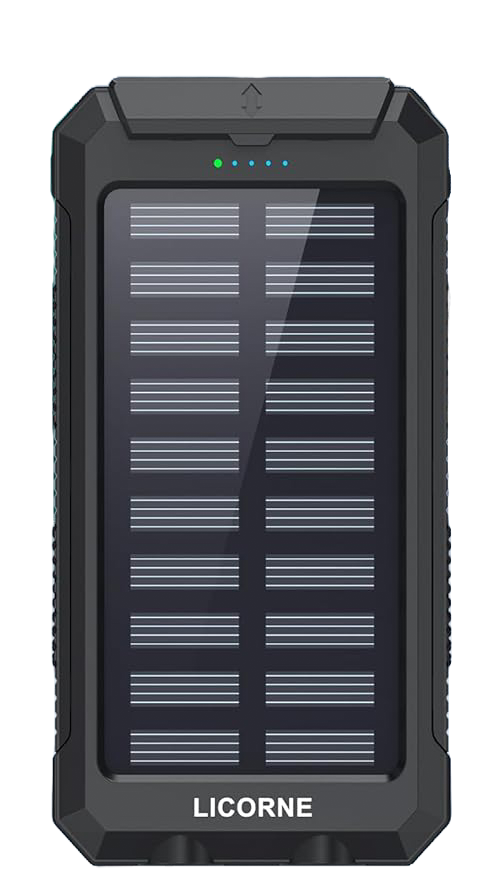
The LICORNE Solar Charger Power Bank is a portable energy storage device designed to harness solar power for charging electronic devices. This eco-friendly charger is ideal for outdoor enthusiasts, travelers, and anyone needing a reliable power source when away from the grid. It can charge smartphones, tablets, cameras, and other USB-powered devices.
Explore Projects Built with Solar Charger Power Bank
Use Cirkit Designer to design, explore, and prototype these projects online. Some projects support real-time simulation. Click "Open Project" to start designing instantly!
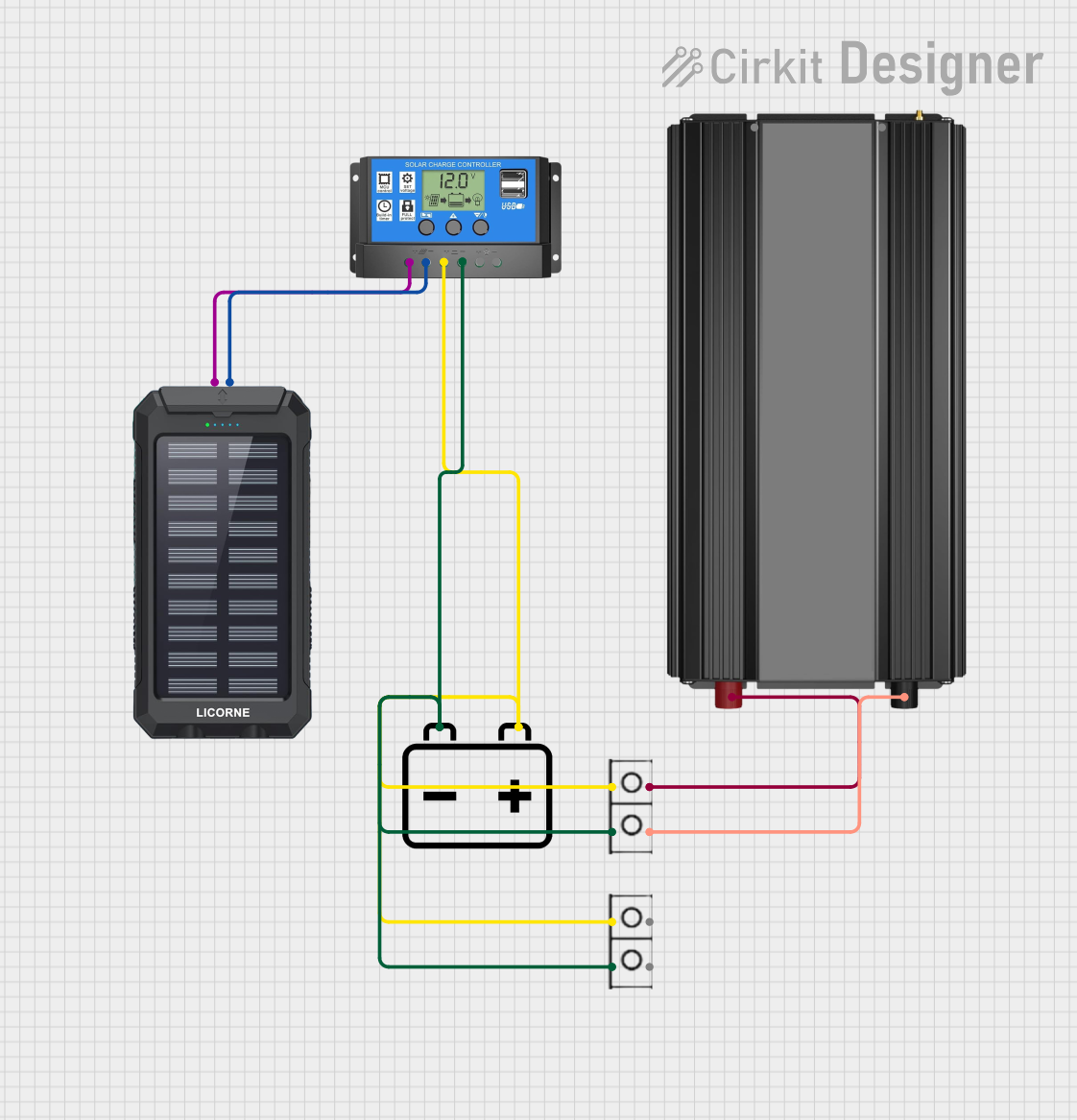
This circuit is designed to charge a 12v battery using a solar charger power bank, with a solar charge controller managing the charging process to protect the battery from overcharging. The charged battery is then connected to a power inverter, which converts the 12v DC from the battery to AC power for use with standard electrical devices. Wire connectors are used to interconnect the components and ensure proper electrical flow between them.
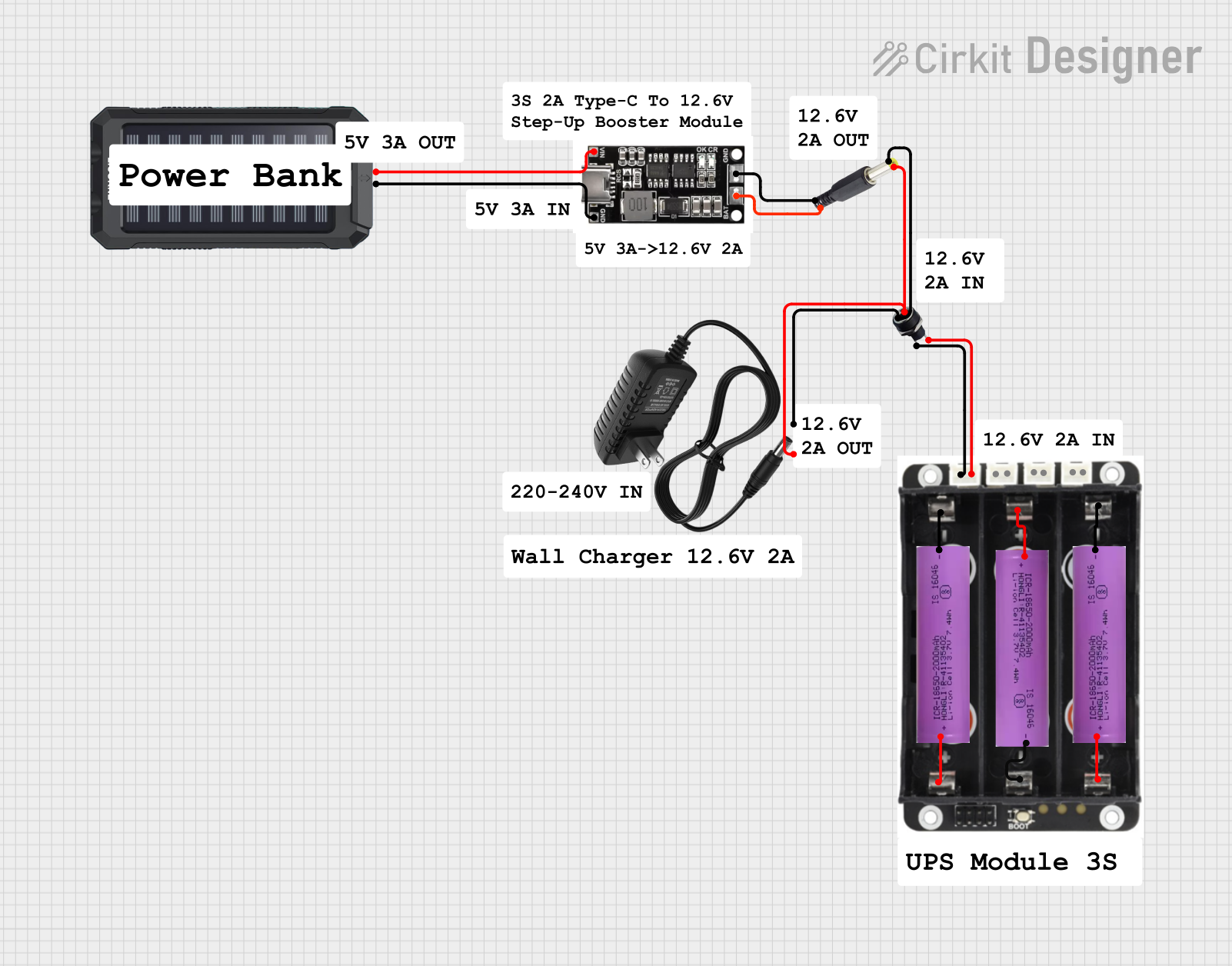
This circuit is a power management system that integrates a 12V power supply, a solar charger power bank, and multiple Li-ion batteries to provide a stable power output. The Waveshare UPS 3S manages the input from the power sources and batteries, ensuring continuous power delivery. The MRB045 module is used to interface the solar charger with the rest of the system.
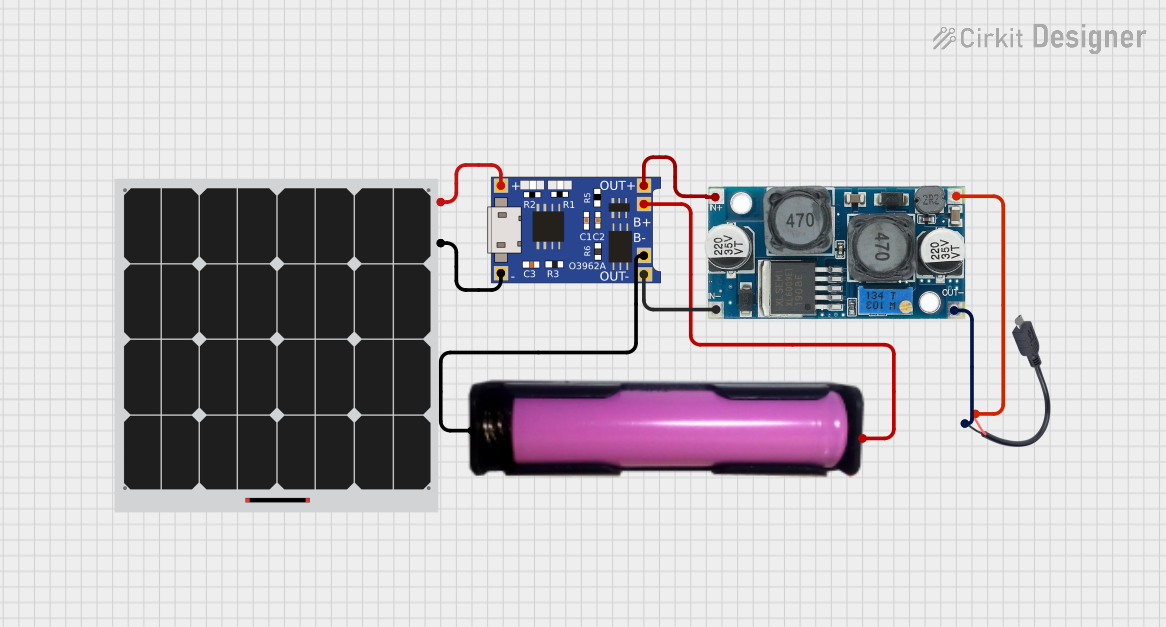
This circuit is a solar-powered battery charging system. It uses a solar panel to provide input power to a TP4056 charging module, which charges a 18650 battery. The output from the TP4056 is regulated by an XL6009 voltage regulator to provide a stable voltage to a connected device via a Micro USB cable.
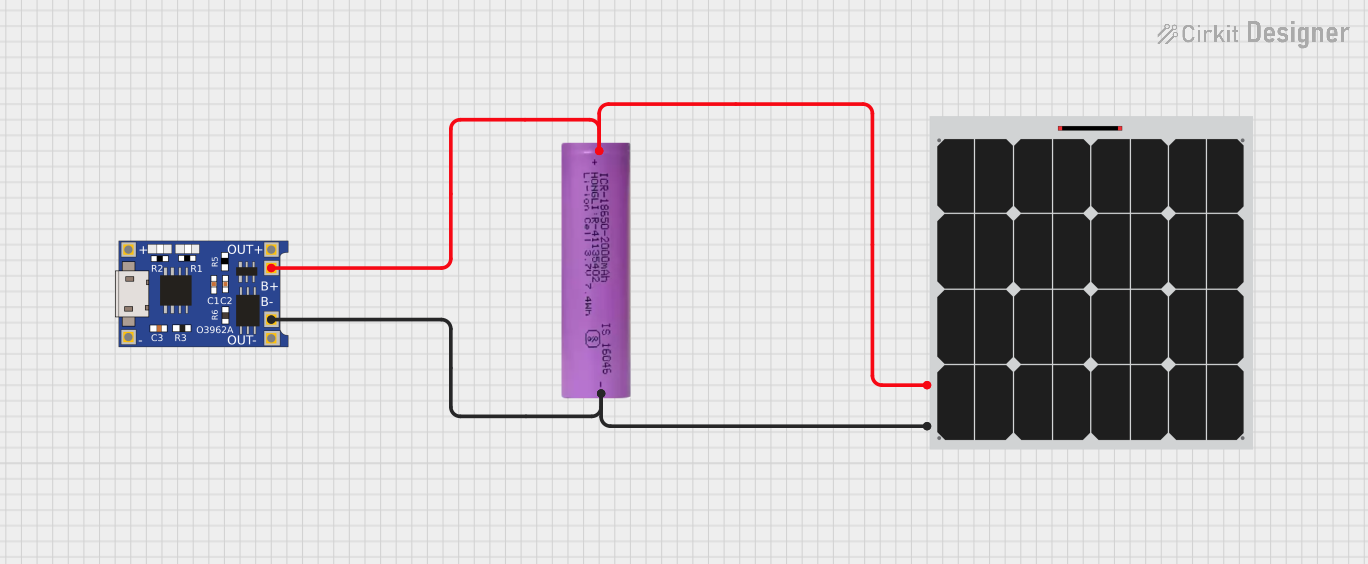
This circuit consists of a solar panel, a Li-ion battery, and a TP4056 charging module. The solar panel charges the Li-ion battery through the TP4056 module, which manages the charging process to ensure safe and efficient charging of the battery.
Charging devices in areas with limited access to electricity
Technical Specifications
General Specifications
Specification
Detail
Battery Capacity
Specified in mAh (e.g., 10000mAh)
Solar Panel Output
Specified in W (e.g., 5W)
Input
Micro USB, 5V
Output
USB-A ports, 5V
Charging Time
Solar charging time varies based on sunlight intensity
Operating Temperature
Specified range (e.g., -10°C to 50°C)
Pin Configuration and Descriptions
Pin/Port
Description
Micro USB Input
Charging port for the power bank using a conventional power source
USB-A Output Port 1
Standard USB port for charging devices at 5V/1A
USB-A Output Port 2
Standard USB port for charging devices at 5V/2A
LED Indicators
Display battery level and charging status
Solar Panel
Integrated solar cells for charging the power bank
Usage Instructions
Charging the Power Bank
Using Solar Energy:
Place the Solar Charger Power Bank under direct sunlight.
The LED indicators will show the charging progress.
For optimal charging, angle the solar panel towards the sun.
Using a Wall Charger:
Connect the Micro USB cable to the power bank and a 5V USB charger.
Plug the charger into a wall outlet.
The LED indicators will light up, showing the charging status.
Charging Your Devices
Connect your device to one of the USB-A output ports using a compatible USB cable.
Press the power button to begin charging.
The device will charge as it would from any standard USB port.
Best Practices
For the first use, charge the power bank fully using the Micro USB input.
Regularly charge the power bank to maintain battery health.
Clean the solar panel with a soft cloth to ensure efficient solar charging.
Do not expose the power bank to extreme temperatures or moisture.
Troubleshooting and FAQs
Common Issues
Power Bank Not Charging:
Ensure the solar panel is in direct sunlight and not obstructed.
Check if the Micro USB cable or wall charger is functioning correctly.
Device Not Charging from Power Bank:
Verify that the USB cable is properly connected to both the device and the power bank.
Ensure the power bank has sufficient charge.
FAQs
Q: How long does it take to fully charge the power bank using solar energy?
A: Charging time varies based on sunlight intensity and panel exposure. It can take several hours to days.
Q: Can the power bank charge multiple devices simultaneously?
A: Yes, if it has multiple USB-A output ports, it can charge more than one device at a time.
Q: Is the Solar Charger Power Bank waterproof?
A: This depends on the specific model. Check the manufacturer's specifications for details on water resistance.
Q: How do I know if the power bank is fully charged?
A: The LED indicators will typically show when the power bank has reached full charge.
For any further assistance, please contact LICORNE customer support.
Example Arduino UNO Connection (Optional)
If you wish to monitor the charging status of the Solar Charger Power Bank using an Arduino UNO, you can connect the power bank's USB output to the Arduino's USB input. Here's a simple sketch to check if the Arduino is powered:
void setup() {
  Serial.begin(9600);
}

void loop() {
  // If powered via USB, the Arduino is receiving power from the power bank
  Serial.println("Arduino is powered and charging...");
  delay(1000); // Wait for 1 second before repeating the check
}
Remember to ensure that the power bank's output voltage and current are within the specifications for the Arduino UNO's USB input.

 Open Project in Cirkit Designer