
How to Use Red led: Examples, Pinouts, and Specs
 Design with Red led in Cirkit Designer
Introduction
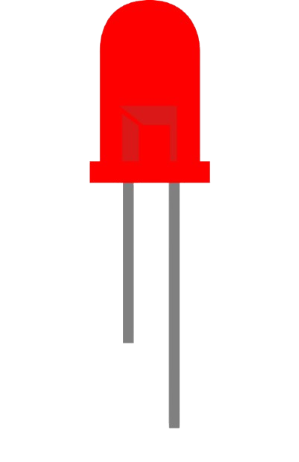
The Lina Red LED (Part ID: 1) is a light-emitting diode that emits red light when an electric current passes through it. This component is widely used in electronic circuits for visual indicators, status displays, and decorative lighting. Its compact size, low power consumption, and long lifespan make it an essential component in various applications.
Explore Projects Built with Red led
 Open Project in Cirkit Designer
 Open Project in Cirkit Designer
 Open Project in Cirkit Designer
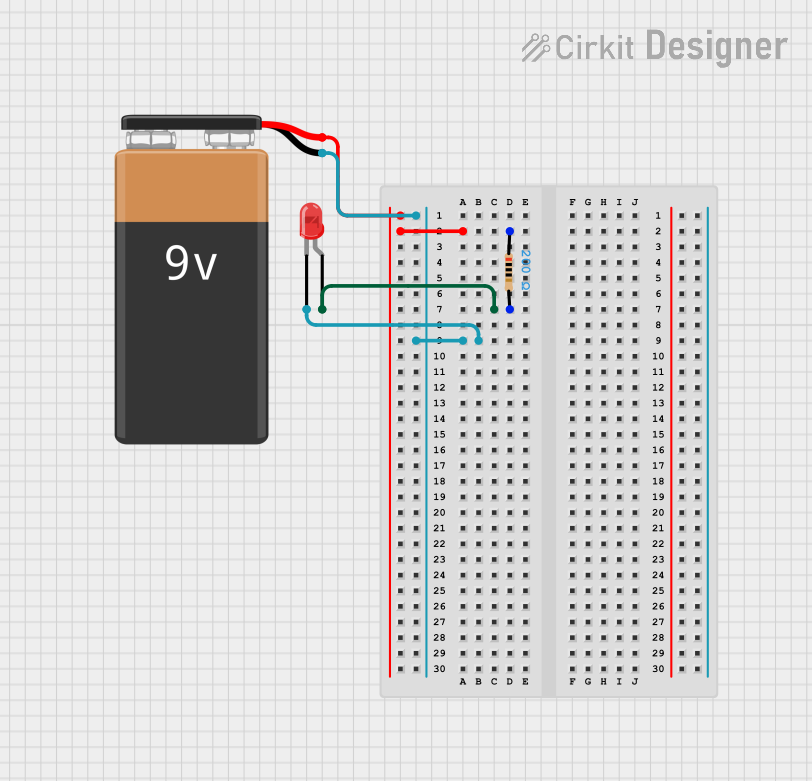 Open Project in Cirkit Designer
Explore Projects Built with Red led
Open Project in Cirkit DesignerOpen Project in Cirkit DesignerOpen Project in Cirkit DesignerOpen Project in Cirkit DesignerCommon Applications
- Power and status indicators in electronic devices
- Digital displays and signage
- Decorative and ambient lighting
- Circuit debugging and testing
- Educational and DIY electronics projects
Technical Specifications
Below are the key technical details for the Lina Red LED (Part ID: 1):
| Parameter | Value |
|---|---|
| Forward Voltage (Vf) | 1.8V to 2.2V |
| Forward Current (If) | 20mA (typical) |
| Maximum Current (Ifmax) | 30mA |
| Wavelength | 620nm to 630nm (red light) |
| Viewing Angle | 20° to 30° |
| Power Dissipation | 75mW (maximum) |
| Operating Temperature | -40°C to +85°C |
| Storage Temperature | -40°C to +100°C |
Pin Configuration
The Lina Red LED has two pins:
| Pin | Description |
|---|---|
| Anode (+) | Positive terminal (longer lead) |
| Cathode (-) | Negative terminal (shorter lead) |
Note: The longer lead is the anode, which connects to the positive side of the power supply, while the shorter lead is the cathode, which connects to the negative side.
Usage Instructions
How to Use the Red LED in a Circuit
Determine the Resistor Value: To prevent damage to the LED, always use a current-limiting resistor in series with the LED. The resistor value can be calculated using Ohm's Law: [ R = \frac{V_{supply} - V_f}{I_f} ] Where:
- ( V_{supply} ) is the supply voltage
- ( V_f ) is the forward voltage of the LED (1.8V to 2.2V)
- ( I_f ) is the desired forward current (typically 20mA)
For example, if ( V_{supply} = 5V ): [ R = \frac{5V - 2V}{0.02A} = 150\Omega ]
Connect the LED:
- Connect the anode (longer lead) to the positive terminal of the power supply through the resistor.
- Connect the cathode (shorter lead) to the ground.
Power the Circuit: Apply the appropriate voltage to the circuit. The LED will emit red light when powered correctly.
Important Considerations
- Polarity: LEDs are polarized components. Reversing the polarity may damage the LED.
- Current Limiting: Always use a resistor to limit the current through the LED.
- Brightness Control: Use a pulse-width modulation (PWM) signal to adjust the brightness of the LED.
- Heat Management: Avoid exceeding the maximum current and power dissipation to prevent overheating.
Example: Connecting the Red LED to an Arduino UNO
Below is an example of how to connect and control the Lina Red LED using an Arduino UNO:
Circuit Diagram
- Connect the anode of the LED to Arduino pin 9 through a 220Ω resistor.
- Connect the cathode of the LED to the Arduino GND pin.
Arduino Code
// Example code to blink a Lina Red LED connected to pin 9 of Arduino UNO

const int ledPin = 9; // Define the pin connected to the LED

void setup() {
  pinMode(ledPin, OUTPUT); // Set the LED pin as an output
}

void loop() {
  digitalWrite(ledPin, HIGH); // Turn the LED on
  delay(1000);               // Wait for 1 second
  digitalWrite(ledPin, LOW);  // Turn the LED off
  delay(1000);               // Wait for 1 second
}
Note: Adjust the resistor value based on your supply voltage and desired current.
Troubleshooting and FAQs
Common Issues
LED Does Not Light Up:
Cause: Incorrect polarity.
Solution: Ensure the anode is connected to the positive terminal and the cathode to the ground.
Cause: No current-limiting resistor or incorrect resistor value.
Solution: Verify the resistor value and ensure it is connected in series with the LED.
LED is Dim:
- Cause: Insufficient current.
- Solution: Check the resistor value and ensure the supply voltage is adequate.
LED Burns Out:
- Cause: Excessive current or voltage.
- Solution: Use a proper current-limiting resistor and ensure the supply voltage does not exceed the LED's rating.
Flickering LED:
- Cause: Unstable power supply or loose connections.
- Solution: Check the power supply and ensure all connections are secure.
FAQs
Q: Can I connect the LED directly to a 5V power supply?
A: No, always use a current-limiting resistor to prevent damage to the LED.Q: How do I adjust the brightness of the LED?
A: Use a PWM signal from a microcontroller like Arduino to control the brightness.Q: What happens if I reverse the polarity of the LED?
A: The LED will not light up, and prolonged reverse polarity may damage it.Q: Can I use the LED with a 3.3V power supply?
A: Yes, but ensure you calculate the appropriate resistor value for the lower voltage.
This documentation provides all the necessary details to effectively use the Lina Red LED (Part ID: 1) in your projects.