The HXJ8002 is a high-performance integrated circuit (IC) designed for use in a variety of electronic applications, including power management and signal processing. Manufactured by HXJ, this IC is known for its low power consumption and high efficiency, making it an ideal choice for battery-operated devices and portable electronics. Its compact design and robust functionality allow it to be used in a wide range of projects, from audio amplification to general-purpose signal processing.
Explore Projects Built with HXJ8002
Use Cirkit Designer to design, explore, and prototype these projects online. Some projects support real-time simulation. Click "Open Project" to start designing instantly!
This circuit features an Arduino Mega 2560 microcontroller interfaced with a SIM800L GSM module, two fingerprint scanners, an I2C LCD display, an IR sensor, and a piezo buzzer. Power management is handled by a PowerBoost 1000 Basic Pad USB, a TP4056 charging module, and a Li-ion 18650 battery, with an option to use a Mini AC-DC 110V-230V to 5V 700mA module for direct power supply. The primary functionality appears to be a security system with GSM communication capabilities, biometric access control, and visual/audible feedback.
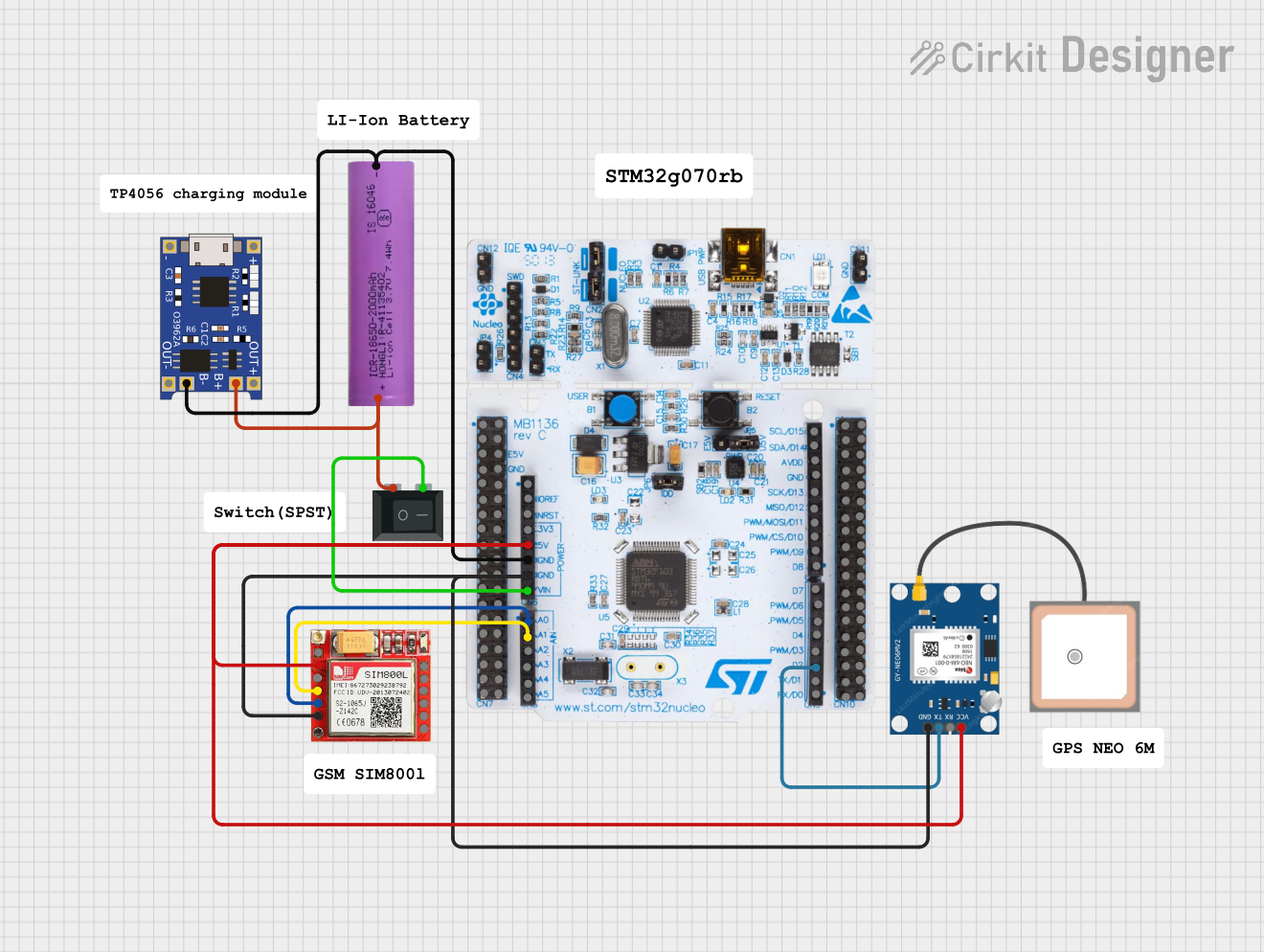
This circuit is an emergency alert system that uses a NUCLEO-F072RB microcontroller to send SMS alerts and make calls via a SIM800L GSM module, while obtaining location data from a GPS NEO 6M module. The system is powered by a Li-ion battery and includes a TP4056 module for battery charging and protection, with a rocker switch to control power to the microcontroller.
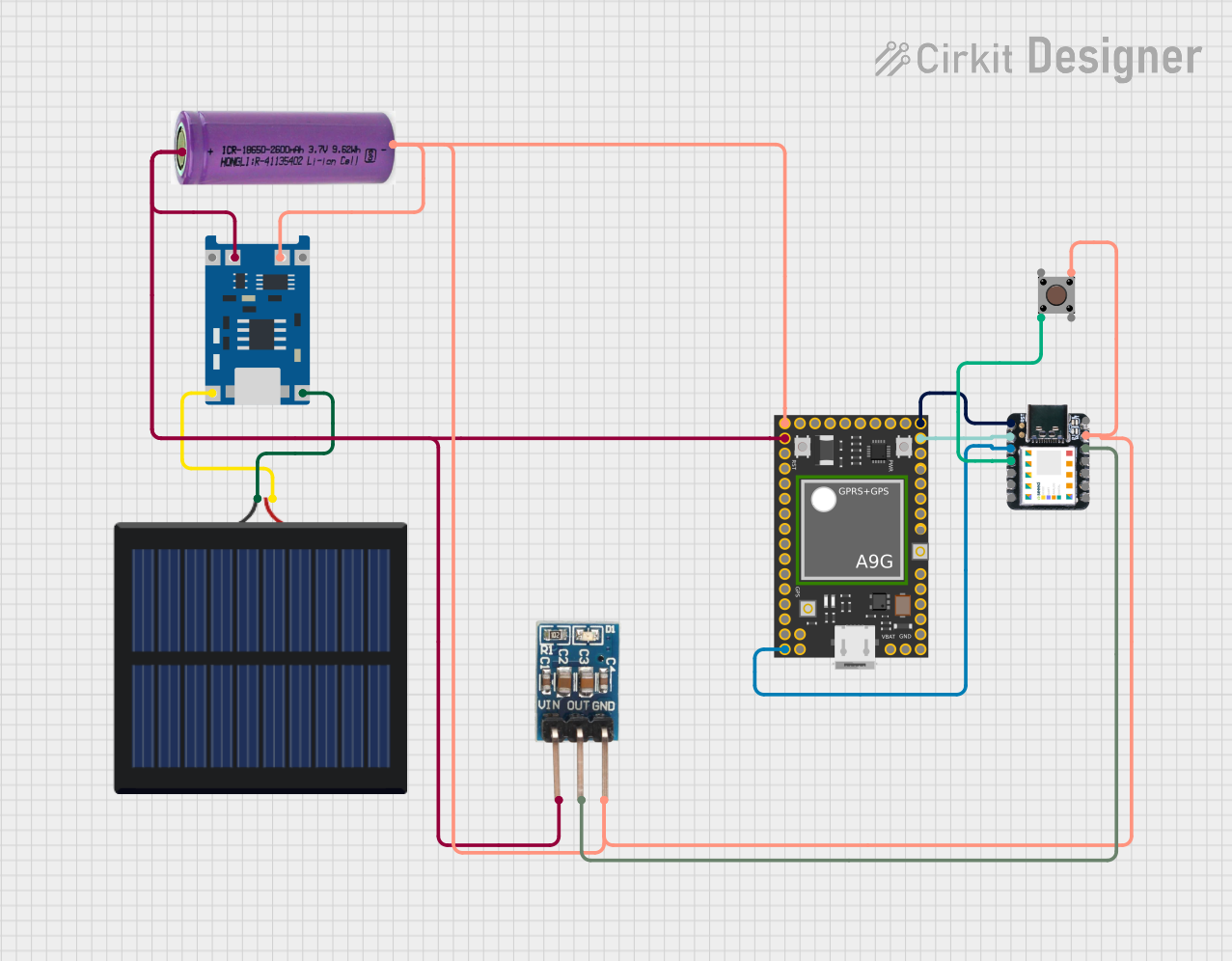
This circuit features an Ai Thinker A9G development board for GSM/GPRS and GPS/BDS connectivity, interfaced with a Seeeduino XIAO microcontroller for control and data processing. A solar cell, coupled with a TP4056 charging module, charges a 3.3V battery, which powers the system through a 3.3V regulator ensuring stable operation. The circuit likely serves for remote data communication and location tracking, with the capability to be powered by renewable energy and interfaced with additional sensors or input devices via the Seeeduino XIAO.
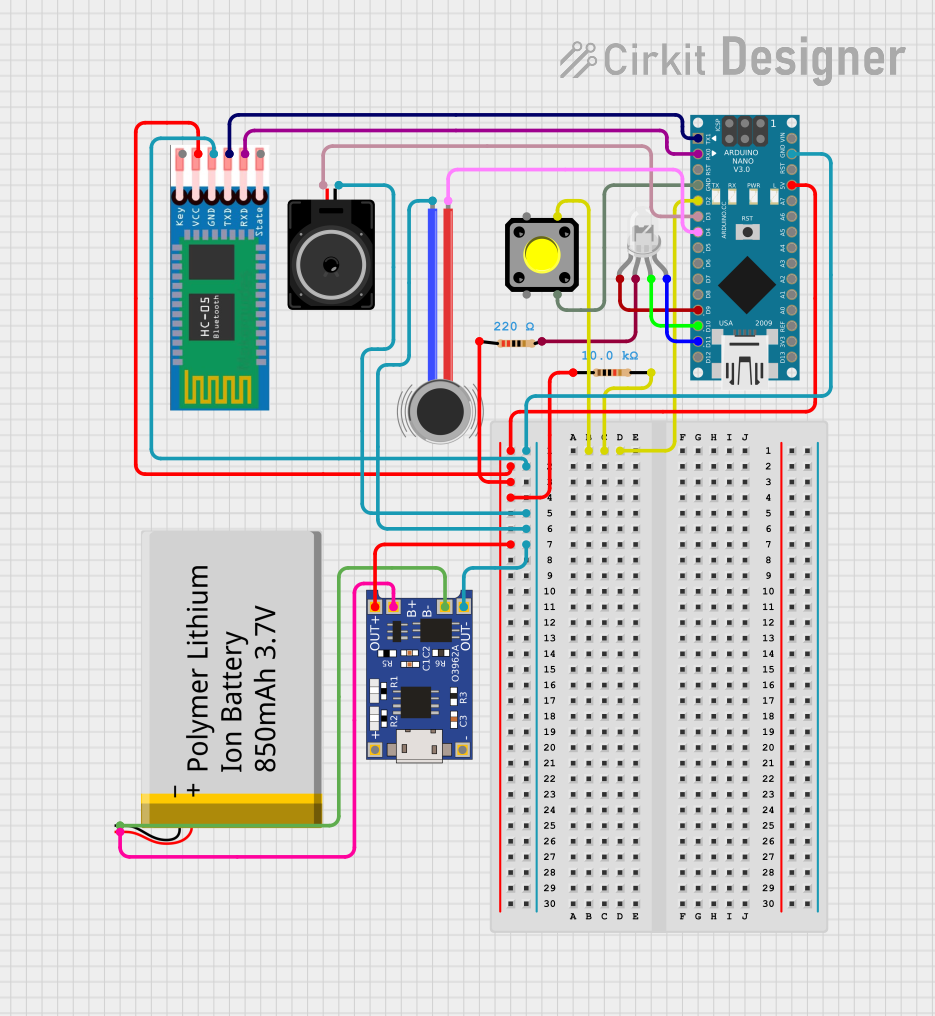
This is a portable, microcontroller-driven interactive device featuring Bluetooth connectivity, visual (RGB LED), auditory (loudspeaker), and haptic (vibration motor) feedback, user input (pushbutton), and a rechargeable power system (TP4056 with Li-ion battery).
The HXJ8002 is designed to deliver reliable performance while maintaining low power consumption. Below are the key technical specifications:
Parameter
Value
Operating Voltage
2.0V to 5.5V
Output Power
3W (at 10% THD, 4Ω load, 5V)
Efficiency
Up to 90%
Quiescent Current
< 10mA
Shutdown Current
< 1µA
Load Impedance
4Ω to 8Ω
Total Harmonic Distortion (THD)
< 0.1% (1W, 4Ω, 1kHz)
Operating Temperature
-40°C to +85°C
Package Type
SOP-8
Pin Configuration and Descriptions
The HXJ8002 is typically available in an 8-pin SOP (Small Outline Package). Below is the pinout and description:
Pin Number
Pin Name
Description
1
IN+
Non-inverting input for the audio signal
2
IN-
Inverting input for the audio signal
3
VDD
Positive power supply (2.0V to 5.5V)
4
NC
No connection (leave unconnected)
5
OUT-
Negative output for the amplified signal
6
OUT+
Positive output for the amplified signal
7
GND
Ground connection
8
SHDN
Shutdown control (active low, pull high to enable)
Usage Instructions
The HXJ8002 is straightforward to use in a circuit. Below are the steps and considerations for integrating it into your design:
Basic Circuit Setup
Power Supply: Connect the VDD pin to a stable power source within the range of 2.0V to 5.5V. Connect the GND pin to the ground of the circuit.
Audio Input: Feed the audio signal to the IN+ and IN- pins. Use a coupling capacitor if necessary to block DC components.
Output Load: Connect the OUT+ and OUT- pins to the load (e.g., a speaker). Ensure the load impedance is within the recommended range (4Ω to 8Ω).
Shutdown Control: To enable the IC, pull the SHDN pin high. Pull it low to place the IC in shutdown mode, reducing power consumption to less than 1µA.
Important Considerations
Decoupling Capacitors: Place a decoupling capacitor (e.g., 0.1µF) close to the VDD pin to stabilize the power supply and reduce noise.
Thermal Management: Ensure adequate ventilation or heat dissipation if the IC operates at high power levels.
Input Signal: Avoid exceeding the maximum input voltage range to prevent distortion or damage to the IC.
Shutdown Pin: If the shutdown feature is not used, connect the SHDN pin to VDD to keep the IC active.
Example: Using HXJ8002 with Arduino UNO
The HXJ8002 can be used with an Arduino UNO to amplify audio signals. Below is an example of how to control the shutdown pin using the Arduino:
// Example: Controlling HXJ8002 Shutdown Pin with Arduino UNO

const int shutdownPin = 7; // Connect SHDN pin of HXJ8002 to Arduino pin 7

void setup() {
  pinMode(shutdownPin, OUTPUT); // Set pin 7 as an output
  digitalWrite(shutdownPin, HIGH); // Enable the HXJ8002 (pull SHDN high)
}

void loop() {
  // Example: Toggle shutdown mode every 5 seconds
  digitalWrite(shutdownPin, LOW); // Disable HXJ8002 (pull SHDN low)
  delay(5000); // Wait for 5 seconds
  digitalWrite(shutdownPin, HIGH); // Enable HXJ8002 (pull SHDN high)
  delay(5000); // Wait for 5 seconds
}
Troubleshooting and FAQs
Common Issues
No Output Signal
Cause: The SHDN pin is not properly connected.
Solution: Ensure the SHDN pin is pulled high to enable the IC.
Distorted Audio
Cause: Input signal voltage is too high or load impedance is too low.
Solution: Verify that the input signal is within the recommended range and the load impedance is between 4Ω and 8Ω.
Excessive Heat
Cause: High output power or insufficient ventilation.
Solution: Reduce the output power or improve heat dissipation.
High Noise Levels
Cause: Insufficient decoupling or noisy power supply.
Solution: Add a decoupling capacitor near the VDD pin and use a stable power source.
FAQs
Q1: Can the HXJ8002 drive a 2Ω load?
A1: No, the HXJ8002 is designed for load impedances of 4Ω to 8Ω. Using a 2Ω load may cause overheating or damage.
Q2: What happens if the SHDN pin is left floating?
A2: If the SHDN pin is left floating, the IC may not operate reliably. Always pull it high to enable the IC or low to disable it.
Q3: Can I use the HXJ8002 for stereo audio applications?
A3: The HXJ8002 is a mono amplifier. For stereo applications, you will need two HXJ8002 ICs, one for each channel.
Q4: Is the HXJ8002 suitable for battery-powered devices?
A4: Yes, the HXJ8002 is highly efficient and consumes very low power, making it ideal for battery-operated devices.



 Open Project in Cirkit Designer