
How to Use TP4056: Examples, Pinouts, and Specs
 Design with TP4056 in Cirkit Designer
Introduction
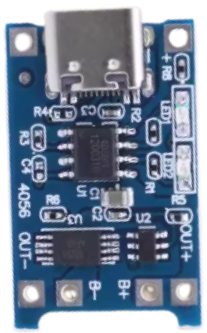
The TP4056 is a lithium battery charger IC designed to provide a constant current/constant voltage (CC/CV) charging profile for single-cell lithium-ion batteries. It is widely used in battery-powered devices due to its compact size, high efficiency, and integrated safety features. The TP4056 simplifies the charging process by offering built-in thermal regulation, over-voltage protection, and an easy-to-use interface for monitoring charging status.
Explore Projects Built with TP4056
 Open Project in Cirkit Designer
 Open Project in Cirkit Designer
 Open Project in Cirkit Designer
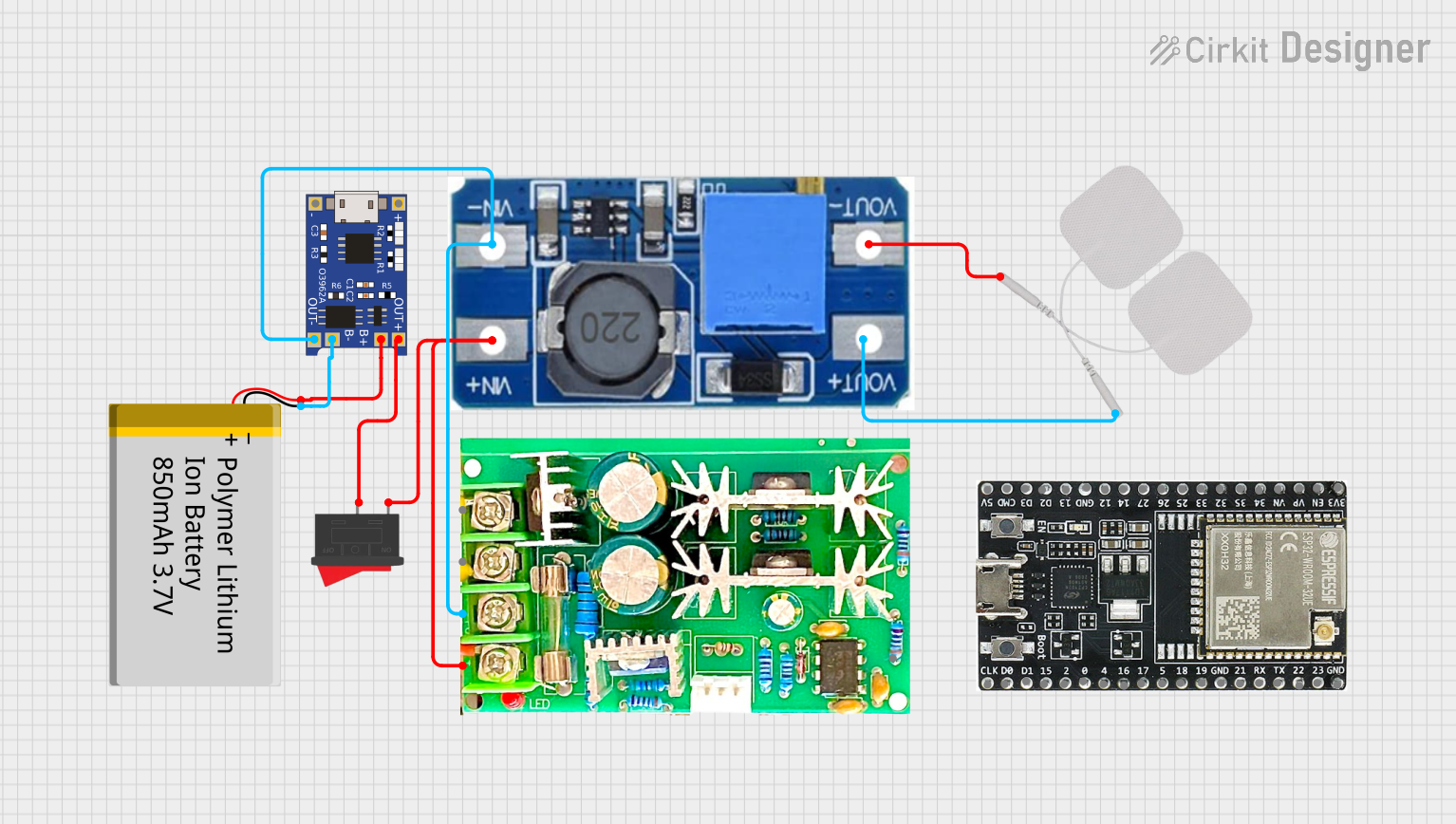 Open Project in Cirkit Designer
Explore Projects Built with TP4056
Open Project in Cirkit DesignerOpen Project in Cirkit DesignerOpen Project in Cirkit DesignerOpen Project in Cirkit DesignerCommon Applications
- Charging single-cell lithium-ion or lithium-polymer batteries
- Power banks and portable chargers
- Wearable devices and IoT gadgets
- DIY electronics projects
- Battery management systems
Technical Specifications
The TP4056 is a highly versatile IC with the following key specifications:
| Parameter | Value |
|---|---|
| Input Voltage Range | 4.0V to 8.0V |
| Charging Voltage | 4.2V ± 1% |
| Maximum Charging Current | Programmable up to 1A |
| Charging Method | Constant Current/Constant Voltage (CC/CV) |
| Operating Temperature | -40°C to +85°C |
| Standby Current | < 2µA |
| Thermal Regulation | Automatically reduces current at high temps |
| Protection Features | Over-voltage, over-temperature, reverse polarity |
Pin Configuration and Descriptions
The TP4056 IC typically comes in an 8-pin SOP package. Below is the pinout and description:
| Pin Name | Pin Number | Description |
|---|---|---|
| BAT | 1 | Battery connection pin. Connect to the positive terminal of the lithium battery. |
| GND | 2 | Ground pin. Connect to the system ground. |
| VCC | 3 | Input voltage pin. Connect to a 4.0V-8.0V power source. |
| PROG | 4 | Charging current programming pin. Connect a resistor to set the charge current. |
| TEMP | 5 | Temperature monitoring pin. Connect to an NTC thermistor for battery safety. |
| STAT1 | 6 | Status indicator pin 1. Used for LED indication of charging status. |
| STAT2 | 7 | Status indicator pin 2. Used for LED indication of charging status. |
| CE | 8 | Chip enable pin. Active low; pull low to enable charging. |
Usage Instructions
How to Use the TP4056 in a Circuit
- Power Supply: Connect a 5V DC power source (e.g., USB) to the VCC pin. Ensure the input voltage is within the 4.0V-8.0V range.
- Battery Connection: Connect the positive terminal of the lithium-ion battery to the BAT pin and the negative terminal to GND.
- Programming Charging Current: Use a resistor (Rprog) between the PROG pin and GND to set the charging current. The formula is: [ I_{CHARGE} = \frac{1000}{R_{PROG}} ] For example, a 1.2kΩ resistor sets the charging current to approximately 833mA.
- Status LEDs: Connect LEDs to the STAT1 and STAT2 pins for visual charging status:
- STAT1 ON, STAT2 OFF: Charging in progress.
- STAT1 OFF, STAT2 ON: Charging complete.
- Both OFF: No battery connected or standby mode.
- Thermal Regulation: The TP4056 automatically reduces the charging current if the IC temperature exceeds safe limits.
Important Considerations
- Battery Safety: Always use a single-cell lithium-ion battery with a built-in protection circuit to prevent overcharging or deep discharge.
- Heat Dissipation: Ensure proper heat dissipation by using a PCB with adequate thermal pads or copper areas.
- Input Voltage: Avoid exceeding the maximum input voltage of 8.0V to prevent damage to the IC.
- Thermistor: For enhanced safety, connect an NTC thermistor to the TEMP pin to monitor battery temperature.
Example: Using TP4056 with Arduino UNO
The TP4056 can be used alongside an Arduino UNO to monitor battery voltage. Below is an example code snippet:
// Example: Monitor battery voltage using Arduino UNO
const int batteryPin = A0; // Analog pin connected to battery via voltage divider
float voltageDividerRatio = 2.0; // Adjust based on your resistor values

void setup() {
  Serial.begin(9600); // Initialize serial communication
}

void loop() {
  int rawValue = analogRead(batteryPin); // Read analog value
  float batteryVoltage = (rawValue * 5.0 / 1023.0) * voltageDividerRatio;

  // Print battery voltage to the Serial Monitor
  Serial.print("Battery Voltage: ");
  Serial.print(batteryVoltage);
  Serial.println(" V");

  delay(1000); // Wait for 1 second before next reading
}
Note: Use a voltage divider to scale down the battery voltage to within the Arduino's 0-5V ADC range.
Troubleshooting and FAQs
Common Issues and Solutions
No Charging Current
- Cause: Incorrect Rprog resistor value or damaged IC.
- Solution: Verify the Rprog resistor value and ensure it matches the desired charging current. Check for proper connections.
Overheating
- Cause: Insufficient heat dissipation or high ambient temperature.
- Solution: Improve PCB thermal design or reduce the charging current.
LEDs Not Working
- Cause: Incorrect LED connections or damaged LEDs.
- Solution: Verify LED polarity and connections to STAT1/STAT2 pins.
Battery Not Charging
- Cause: Faulty battery or incorrect wiring.
- Solution: Test the battery with a multimeter and ensure proper connections to the BAT and GND pins.
FAQs
Can I use the TP4056 to charge multiple batteries in series?
- No, the TP4056 is designed for single-cell lithium-ion batteries only.
What happens if the input voltage exceeds 8.0V?
- The IC may be permanently damaged. Always ensure the input voltage is within the specified range.
Can I disable charging temporarily?
- Yes, pull the CE pin high to disable charging.
Is the TP4056 suitable for fast charging?
- The maximum charging current is 1A, which is sufficient for most single-cell batteries but may not qualify as "fast charging" for larger batteries.
By following this documentation, you can effectively integrate the TP4056 into your projects and ensure safe and efficient battery charging.