
How to Use HC-05: Examples, Pinouts, and Specs
 Design with HC-05 in Cirkit Designer
Introduction
The HC-05 is a Bluetooth module that allows for wireless communication between devices. It operates using the Bluetooth 2.0 protocol and is designed for serial communication. The module is widely used in embedded systems and IoT applications to enable data transfer over short distances. Its ease of use and compatibility with microcontrollers like Arduino make it a popular choice for hobbyists and professionals alike.
Explore Projects Built with HC-05
 Open Project in Cirkit Designer
 Open Project in Cirkit Designer
 Open Project in Cirkit Designer
 Open Project in Cirkit Designer
Explore Projects Built with HC-05
Open Project in Cirkit DesignerOpen Project in Cirkit DesignerOpen Project in Cirkit DesignerOpen Project in Cirkit DesignerCommon Applications and Use Cases
- Wireless communication between microcontrollers and smartphones
- Remote control of devices (e.g., robots, home automation systems)
- Data logging and monitoring applications
- Wireless sensor networks
- Serial cable replacement
Technical Specifications
The HC-05 module is a versatile and reliable Bluetooth device. Below are its key technical details:
Key Technical Details
- Bluetooth Protocol: Bluetooth 2.0 + EDR (Enhanced Data Rate)
- Operating Voltage: 3.3V to 5V
- Operating Current: 30mA (typical)
- Communication: UART (Universal Asynchronous Receiver-Transmitter)
- Baud Rate: Default 9600 bps (configurable from 1200 to 1382400 bps)
- Range: Up to 10 meters (line of sight)
- Modes: Master and Slave
- Dimensions: 37.5mm x 15.2mm x 3.5mm
- Default PIN Code: 1234
Pin Configuration and Descriptions
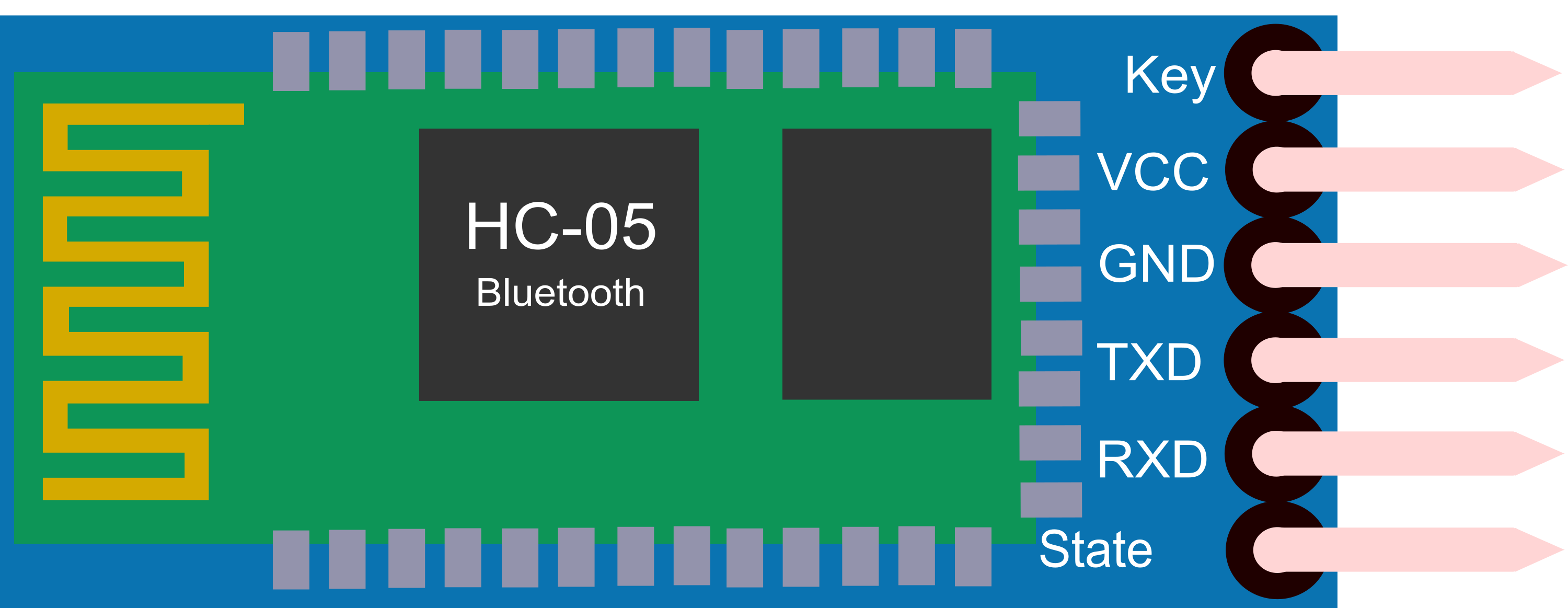
The HC-05 module typically has 6 pins. Below is the pinout and description:
| Pin | Name | Description |
|---|---|---|
| 1 | EN/KEY | Enables AT command mode when HIGH. Used for configuration. |
| 2 | VCC | Power supply input (3.3V to 5V). |
| 3 | GND | Ground connection. |
| 4 | TXD | Transmit data pin. Sends serial data to the connected device. |
| 5 | RXD | Receive data pin. Receives serial data from the connected device. |
| 6 | STATE | Indicates the connection status (HIGH when connected, LOW when disconnected). |
Usage Instructions
How to Use the HC-05 in a Circuit
- Powering the Module: Connect the VCC pin to a 5V power source and the GND pin to ground.
- Serial Communication:
- Connect the TXD pin of the HC-05 to the RX pin of your microcontroller.
- Connect the RXD pin of the HC-05 to the TX pin of your microcontroller. Use a voltage divider if the microcontroller operates at 5V logic levels to avoid damaging the HC-05.
- AT Command Mode:
- To configure the module, set the EN/KEY pin HIGH and power cycle the module. The module will enter AT command mode, allowing you to change settings like the baud rate, name, and PIN code.
- Pairing:
- Search for the HC-05 on your Bluetooth-enabled device. Use the default PIN code
1234to pair.
- Search for the HC-05 on your Bluetooth-enabled device. Use the default PIN code
Important Considerations and Best Practices
- Voltage Levels: The RXD pin is not 5V tolerant. Use a voltage divider or level shifter if your microcontroller operates at 5V logic.
- Antenna Placement: Ensure the module's antenna is not obstructed by metal objects to maintain a strong signal.
- Baud Rate: Match the baud rate of the HC-05 with your microcontroller for proper communication.
- Connection Status: Use the STATE pin to monitor the connection status in your application.
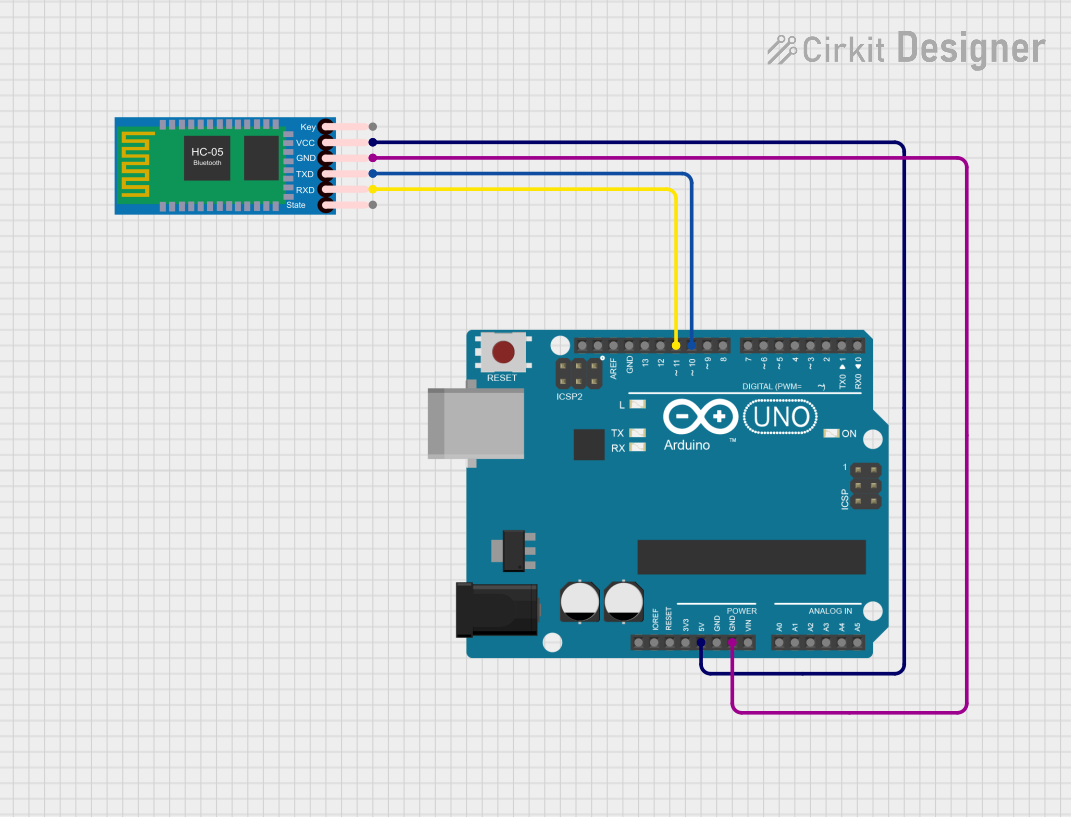
Example: Connecting HC-05 to Arduino UNO
Below is an example of how to use the HC-05 with an Arduino UNO to send and receive data:
#include <SoftwareSerial.h>

// Create a SoftwareSerial object for communication with HC-05
SoftwareSerial BTSerial(10, 11); // RX, TX

void setup() {
  Serial.begin(9600); // Start serial communication with the PC
  BTSerial.begin(9600); // Start serial communication with HC-05

  Serial.println("HC-05 Bluetooth Module Test");
  Serial.println("Type something in the Serial Monitor to send to HC-05");
}

void loop() {
  // Check if data is available from the PC
  if (Serial.available()) {
    char data = Serial.read(); // Read data from the PC
    BTSerial.write(data); // Send data to HC-05
  }

  // Check if data is available from HC-05
  if (BTSerial.available()) {
    char data = BTSerial.read(); // Read data from HC-05
    Serial.write(data); // Send data to the PC
  }
}
Notes:
- Connect the HC-05's TXD pin to Arduino pin 10 (RX of SoftwareSerial).
- Connect the HC-05's RXD pin to Arduino pin 11 (TX of SoftwareSerial) using a voltage divider.
Troubleshooting and FAQs
Common Issues and Solutions
HC-05 Not Pairing with Device:
- Ensure the module is powered and the LED is blinking.
- Verify the default PIN code (
1234) is entered correctly. - Check if the device supports Bluetooth 2.0.
No Data Transmission:
- Confirm the baud rate of the HC-05 matches the microcontroller's settings.
- Verify the TXD and RXD connections are correct.
- Use a voltage divider for the RXD pin if the microcontroller operates at 5V logic.
AT Commands Not Working:
- Ensure the EN/KEY pin is HIGH before powering the module.
- Use a serial terminal with the correct baud rate (default: 38400 bps in AT mode).
Weak Signal or Connection Drops:
- Avoid placing the module near metal objects or other sources of interference.
- Ensure the module is within the 10-meter range.
FAQs
Can the HC-05 work with 5V logic?
- The TXD pin can output 5V logic, but the RXD pin is not 5V tolerant. Use a voltage divider for safe operation.
How do I reset the HC-05 to factory settings?
- Enter AT command mode and send the
AT+ORGLcommand to reset the module.
- Enter AT command mode and send the
Can the HC-05 act as both Master and Slave?
- Yes, the HC-05 can be configured as either Master or Slave using AT commands.
What is the difference between HC-05 and HC-06?
- The HC-05 supports both Master and Slave modes, while the HC-06 only supports Slave mode.
By following this documentation, you can effectively integrate the HC-05 Bluetooth module into your projects and troubleshoot common issues.