
How to Use ARDUINO UNO R3 USB C 9V: Examples, Pinouts, and Specs
 Design with ARDUINO UNO R3 USB C 9V in Cirkit Designer
Introduction
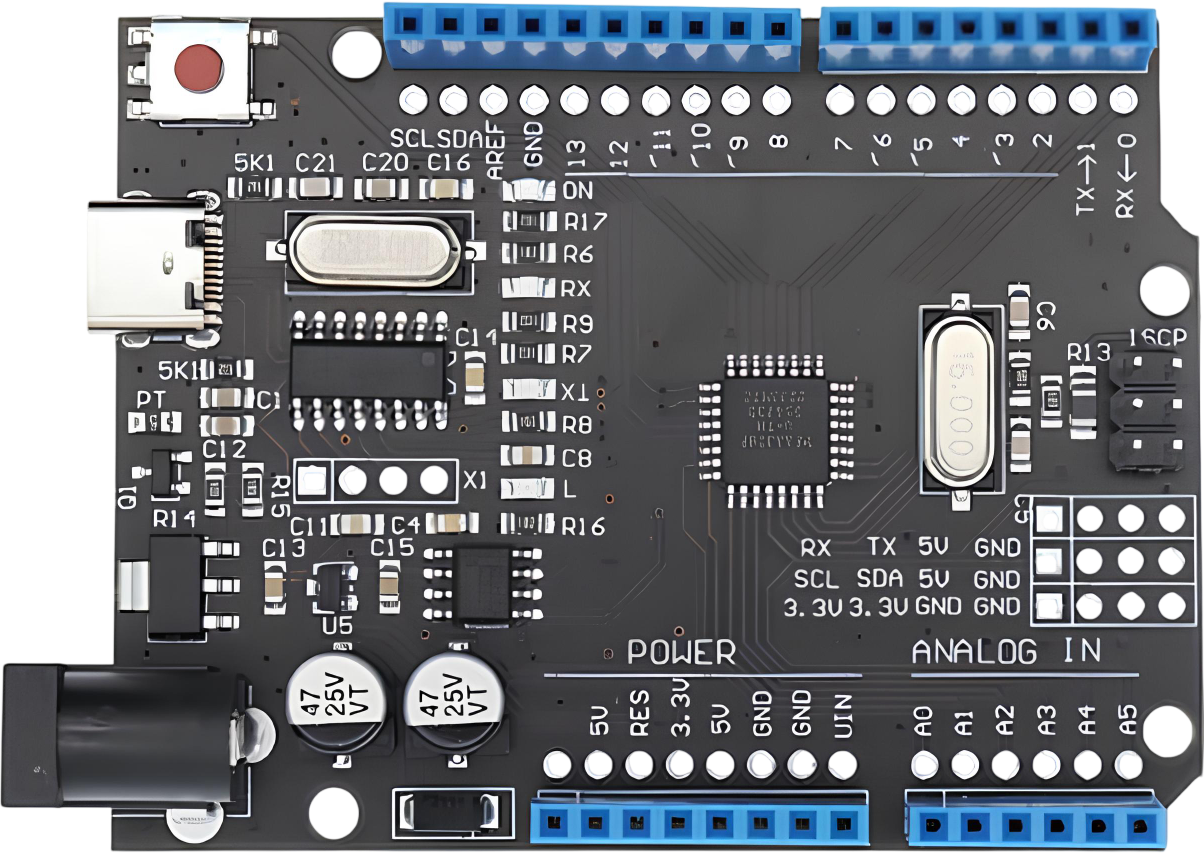
The Arduino UNO R3 USB C 9V is a microcontroller board developed by Arduino, designed for ease of use in a wide range of electronic projects. It is an updated version of the classic Arduino UNO R3, featuring a USB-C connector for modern connectivity and a 9V power input option for enhanced flexibility. This board is based on the ATmega328P microcontroller and is ideal for beginners and professionals alike, offering a robust platform for prototyping, learning, and developing embedded systems.
Explore Projects Built with ARDUINO UNO R3 USB C 9V
 Open Project in Cirkit Designer
 Open Project in Cirkit Designer
 Open Project in Cirkit Designer
 Open Project in Cirkit Designer
Explore Projects Built with ARDUINO UNO R3 USB C 9V
Open Project in Cirkit DesignerOpen Project in Cirkit DesignerOpen Project in Cirkit DesignerOpen Project in Cirkit DesignerCommon Applications and Use Cases
- Prototyping and testing electronic circuits
- IoT (Internet of Things) projects
- Robotics and automation systems
- Educational tools for learning programming and electronics
- Sensor data acquisition and processing
- Home automation and DIY projects
Technical Specifications
The Arduino UNO R3 USB C 9V retains the core features of the original UNO R3 while introducing modern enhancements. Below are the key technical details:
Key Technical Details
- Microcontroller: ATmega328P
- Operating Voltage: 5V
- Input Voltage (recommended): 7-12V
- Input Voltage (limit): 6-20V
- Digital I/O Pins: 14 (6 provide PWM output)
- Analog Input Pins: 6
- DC Current per I/O Pin: 20 mA
- Flash Memory: 32 KB (0.5 KB used by bootloader)
- SRAM: 2 KB
- EEPROM: 1 KB
- Clock Speed: 16 MHz
- USB Connector: USB-C
- Power Connector: Barrel jack (9V input supported)
- Dimensions: 68.6 mm x 53.4 mm
- Weight: 25 g
Pin Configuration and Descriptions
The Arduino UNO R3 USB C 9V features a standard pin layout. Below is a detailed description of the pins:
Digital Pins
| Pin Number | Function | Description |
|---|---|---|
| 0 (RX) | UART Receive | Serial communication receive pin |
| 1 (TX) | UART Transmit | Serial communication transmit pin |
| 2-13 | Digital I/O | General-purpose digital input/output pins |
| 3, 5, 6, 9, 10, 11 | PWM Output | Pulse-width modulation capable pins |
Analog Pins
| Pin Number | Function | Description |
|---|---|---|
| A0-A5 | Analog Input | Read analog signals (0-5V) |
Power Pins
| Pin Name | Function | Description |
|---|---|---|
| VIN | Input Voltage | External power input (7-12V recommended) |
| 5V | Regulated 5V Output | Powers external components |
| 3.3V | Regulated 3.3V Output | Powers low-voltage components |
| GND | Ground | Common ground for the circuit |
| IOREF | I/O Reference Voltage | Provides voltage reference for I/O pins |
| RESET | Reset | Resets the microcontroller |
Usage Instructions
The Arduino UNO R3 USB C 9V is straightforward to use and compatible with the Arduino IDE. Follow these steps to get started:
Step 1: Powering the Board
- Connect the board to your computer using a USB-C cable for power and programming.
- Alternatively, use a 9V DC adapter with the barrel jack for standalone operation.
Step 2: Installing the Arduino IDE
- Download and install the Arduino IDE from the official Arduino website.
- Ensure the correct drivers are installed for the USB-C interface.
Step 3: Writing and Uploading Code
- Open the Arduino IDE and select Tools > Board > Arduino UNO.
- Select the appropriate Port under the Tools menu.
- Write your code or use an example sketch.
- Click the Upload button to program the board.
Example Code: Blinking an LED
The following code demonstrates how to blink an LED connected to pin 13:
// This example code blinks the onboard LED connected to pin 13
// The LED will turn on for 1 second and off for 1 second repeatedly

void setup() {
  pinMode(13, OUTPUT); // Set pin 13 as an output
}

void loop() {
  digitalWrite(13, HIGH); // Turn the LED on
  delay(1000);            // Wait for 1 second
  digitalWrite(13, LOW);  // Turn the LED off
  delay(1000);            // Wait for 1 second
}
Important Considerations and Best Practices
- Avoid exceeding the maximum current rating (20 mA) for I/O pins to prevent damage.
- Use external pull-up or pull-down resistors for stable digital input signals.
- Ensure proper grounding when interfacing with external components.
- Use a regulated power supply to avoid voltage fluctuations.
Troubleshooting and FAQs
Common Issues and Solutions
Board Not Detected by Computer
- Ensure the USB-C cable is data-capable (not just a charging cable).
- Check that the correct drivers are installed for the Arduino UNO R3 USB C.
Code Upload Fails
- Verify the correct board and port are selected in the Arduino IDE.
- Press the RESET button on the board before uploading.
LED Not Blinking
- Confirm the LED is connected to the correct pin (pin 13 in the example).
- Check for loose connections or damaged components.
Power Issues
- Ensure the input voltage is within the recommended range (7-12V).
- Check the power source and connections.
FAQs
Q: Can I power the board using both USB-C and the barrel jack simultaneously?
A: Yes, but the board will prioritize the external power source (barrel jack) if both are connected.Q: Is the Arduino UNO R3 USB C 9V compatible with shields designed for the original UNO R3?
A: Yes, it maintains the same form factor and pin layout as the original UNO R3.Q: Can I use the board for 3.3V logic components?
A: Yes, the board provides a 3.3V output pin for powering low-voltage components.
By following this documentation, you can effectively utilize the Arduino UNO R3 USB C 9V for your projects.