
How to Use MCCB 3P: Examples, Pinouts, and Specs
 Design with MCCB 3P in Cirkit Designer
Introduction
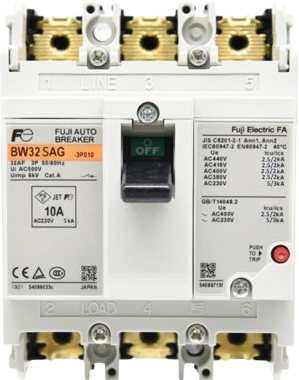
The Fuji BW32-SAG is a three-pole Molded Case Circuit Breaker (MCCB) designed to provide reliable protection for electrical circuits. It safeguards against overloads, short circuits, and other electrical faults, ensuring the safety and longevity of connected equipment. This MCCB is suitable for both industrial and commercial applications, offering manual operation and reset functionality.
Explore Projects Built with MCCB 3P
 Open Project in Cirkit Designer
 Open Project in Cirkit Designer
 Open Project in Cirkit Designer
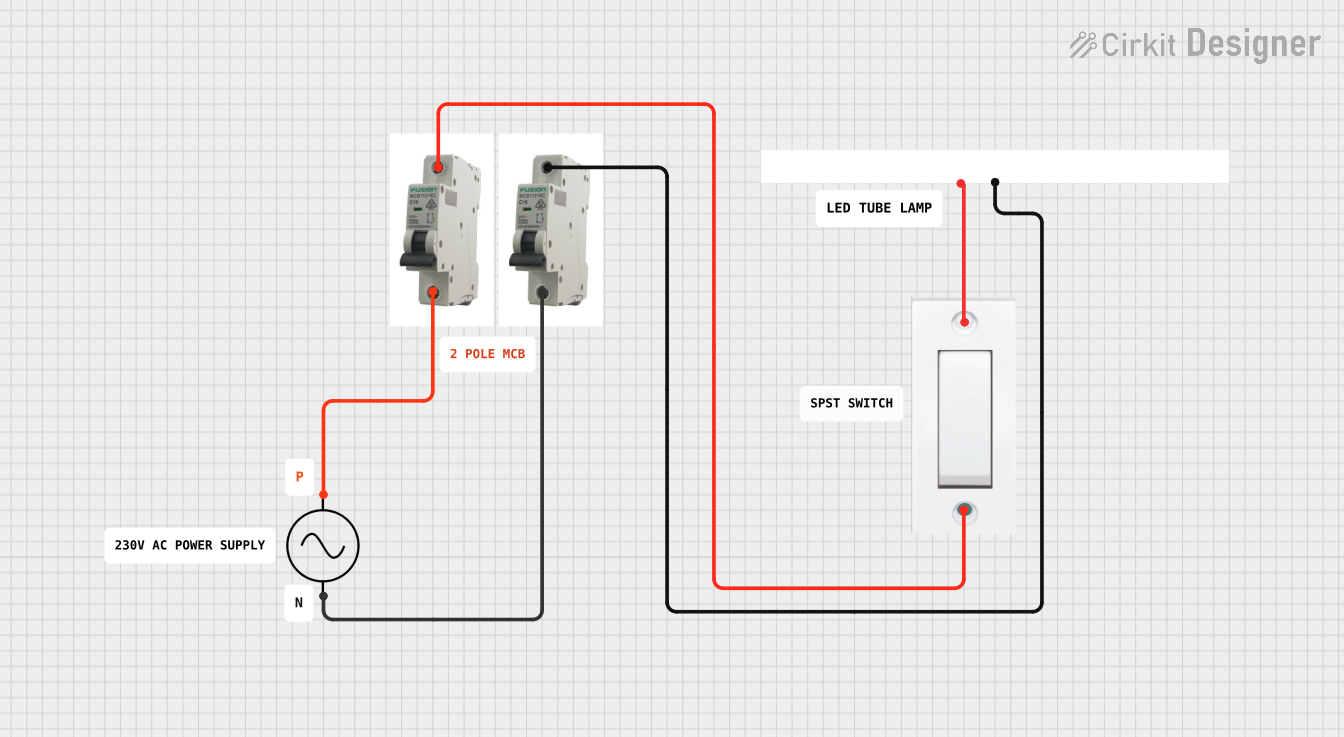 Open Project in Cirkit Designer
Explore Projects Built with MCCB 3P
Open Project in Cirkit DesignerOpen Project in Cirkit DesignerOpen Project in Cirkit DesignerOpen Project in Cirkit DesignerCommon Applications and Use Cases
- Protection of industrial machinery and equipment
- Circuit protection in commercial buildings
- Overload and short-circuit protection in power distribution systems
- Backup protection for motor control centers and switchgear
Technical Specifications
The Fuji BW32-SAG MCCB is engineered to meet high-performance standards. Below are its key technical specifications:
| Parameter | Specification |
|---|---|
| Manufacturer | Fuji Electric |
| Part Number | BW32-SAG |
| Number of Poles | 3 |
| Rated Current (In) | 32 A |
| Rated Voltage (Ue) | 415 V AC |
| Breaking Capacity (Icu) | 10 kA at 415 V AC |
| Frequency | 50/60 Hz |
| Operating Temperature | -5°C to +40°C |
| Mounting Type | DIN rail or panel-mounted |
| Trip Mechanism | Thermal-magnetic |
| Standards Compliance | IEC 60947-2 |
Pin Configuration and Descriptions
The Fuji BW32-SAG MCCB has three input terminals and three output terminals, corresponding to its three poles. Below is the terminal configuration:
| Terminal | Description |
|---|---|
| L1 (Input) | Line 1 input (phase 1) |
| L2 (Input) | Line 2 input (phase 2) |
| L3 (Input) | Line 3 input (phase 3) |
| T1 (Output) | Line 1 output (phase 1) |
| T2 (Output) | Line 2 output (phase 2) |
| T3 (Output) | Line 3 output (phase 3) |
Usage Instructions
How to Use the MCCB in a Circuit
Mounting the MCCB:
- Secure the MCCB to a DIN rail or directly onto a panel using screws.
- Ensure the MCCB is mounted in a vertical position for optimal performance.
Wiring:
- Connect the input terminals (L1, L2, L3) to the power source.
- Connect the output terminals (T1, T2, T3) to the load.
- Use appropriately rated cables to handle the current and voltage.
Operation:
- Switch the MCCB to the "ON" position to allow current flow.
- In case of an overload or short circuit, the MCCB will trip automatically.
- After resolving the fault, reset the MCCB by switching it to the "OFF" position and then back to "ON."
Important Considerations and Best Practices
- Ensure the MCCB's rated current matches the load requirements to avoid nuisance tripping.
- Regularly inspect the MCCB for signs of wear, damage, or overheating.
- Do not exceed the breaking capacity (Icu) of 10 kA at 415 V AC.
- Maintain proper clearance around the MCCB for ventilation and heat dissipation.
- Always disconnect power before performing maintenance or wiring.
Arduino Integration
While MCCBs like the Fuji BW32-SAG are not directly controlled by microcontrollers such as the Arduino UNO, they can be monitored using current sensors. Below is an example of how to monitor the current flowing through the MCCB using an ACS712 current sensor and an Arduino UNO:
// Example code to monitor current using ACS712 and Arduino UNO
#include <ACS712.h>

// Initialize ACS712 sensor (e.g., 30A version connected to A0 pin)
ACS712 sensor(ACS712_30A, A0);

void setup() {
  Serial.begin(9600); // Start serial communication
  sensor.calibrate(); // Calibrate the sensor
  Serial.println("ACS712 Current Sensor Initialized");
}

void loop() {
  float current = sensor.getCurrentAC(); // Get AC current in Amperes
  Serial.print("Current: ");
  Serial.print(current);
  Serial.println(" A");

  // Add logic to trigger an alert if current exceeds MCCB rating
  if (current > 32.0) { // MCCB rated current is 32A
    Serial.println("Warning: Current exceeds MCCB rating!");
  }

  delay(1000); // Wait for 1 second before next reading
}
Troubleshooting and FAQs
Common Issues and Solutions
| Issue | Solution |
|---|---|
| MCCB trips frequently without a fault | Verify that the load current does not exceed the MCCB's rated current (32 A). |
| MCCB does not trip during a fault | Check the trip mechanism for damage or malfunction. |
| Overheating of MCCB | Ensure proper ventilation and verify that the connected load is within limits. |
| Difficulty in resetting the MCCB | Ensure the fault condition is resolved before attempting to reset. |
FAQs
Can the MCCB be used for DC circuits?
- No, the Fuji BW32-SAG is designed for AC circuits only.
What is the lifespan of the MCCB?
- The lifespan depends on the operating conditions but typically exceeds 10,000 operations under normal use.
Can the MCCB be used in outdoor environments?
- The MCCB is not weatherproof. Use it in a protected enclosure for outdoor applications.
How do I test the MCCB's functionality?
- Use a test kit designed for MCCBs to simulate overload and short-circuit conditions.
By following this documentation, users can effectively utilize the Fuji BW32-SAG MCCB for reliable circuit protection.