
How to Use Schottky Diode: Examples, Pinouts, and Specs

 Design with Schottky Diode in Cirkit Designer
Introduction
A Schottky diode is a semiconductor device that allows current to flow in one direction with a low forward voltage drop and fast switching speeds. Unlike standard diodes, Schottky diodes use a metal-semiconductor junction instead of a p-n junction, which gives them their unique characteristics. These diodes are widely used in applications requiring high efficiency, low power loss, and fast switching.
Explore Projects Built with Schottky Diode
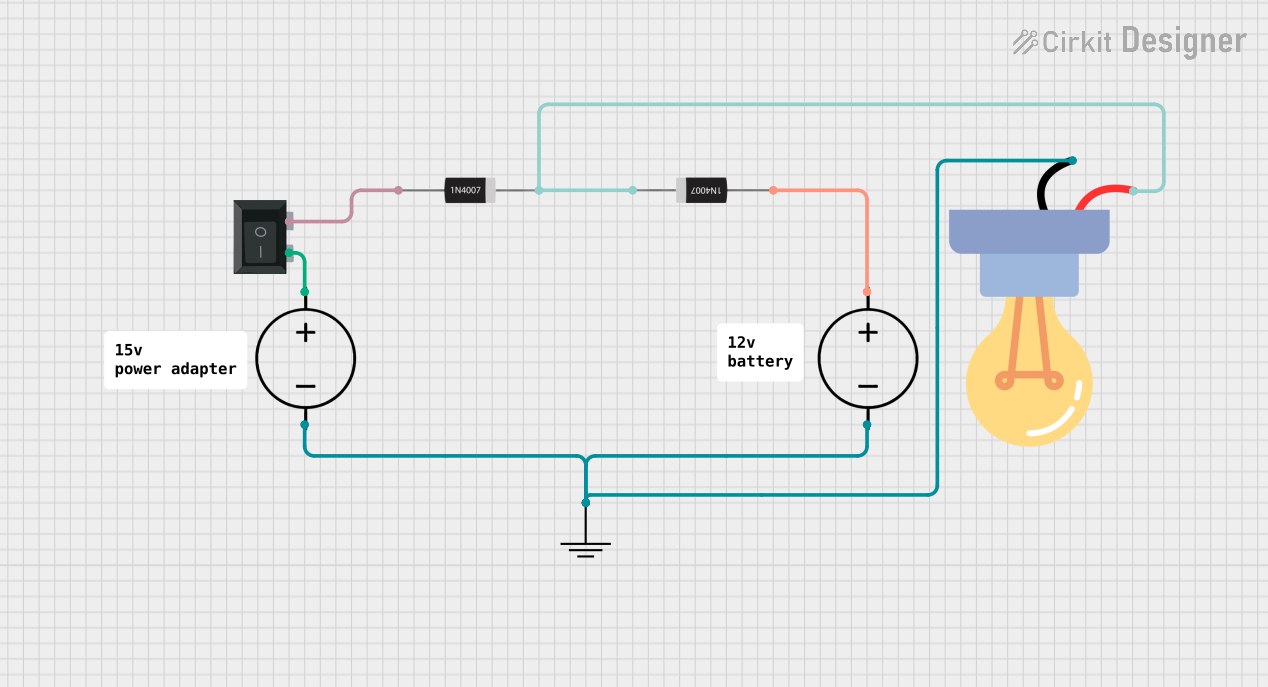 Open Project in Cirkit Designer
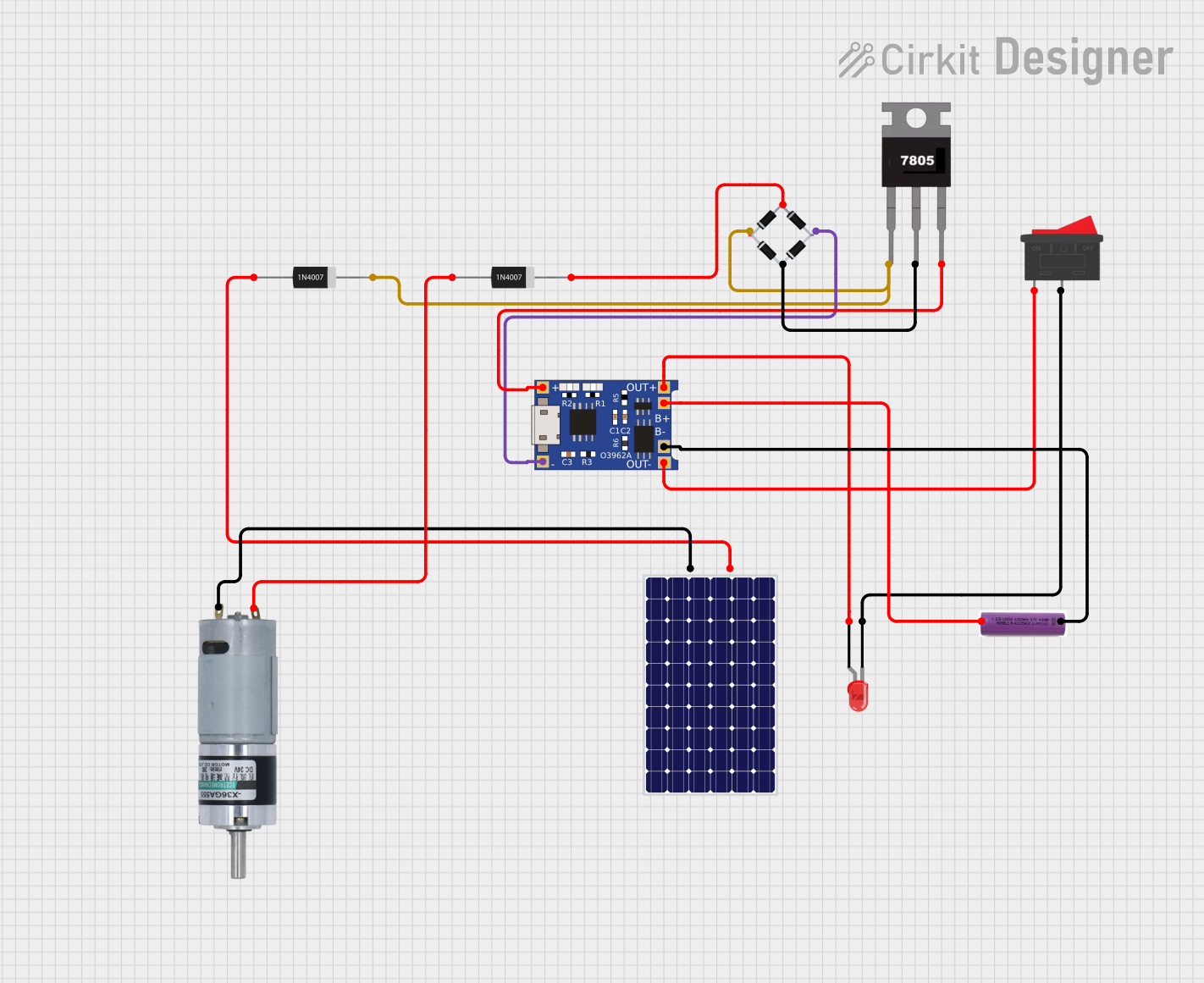 Open Project in Cirkit Designer
 Open Project in Cirkit Designer
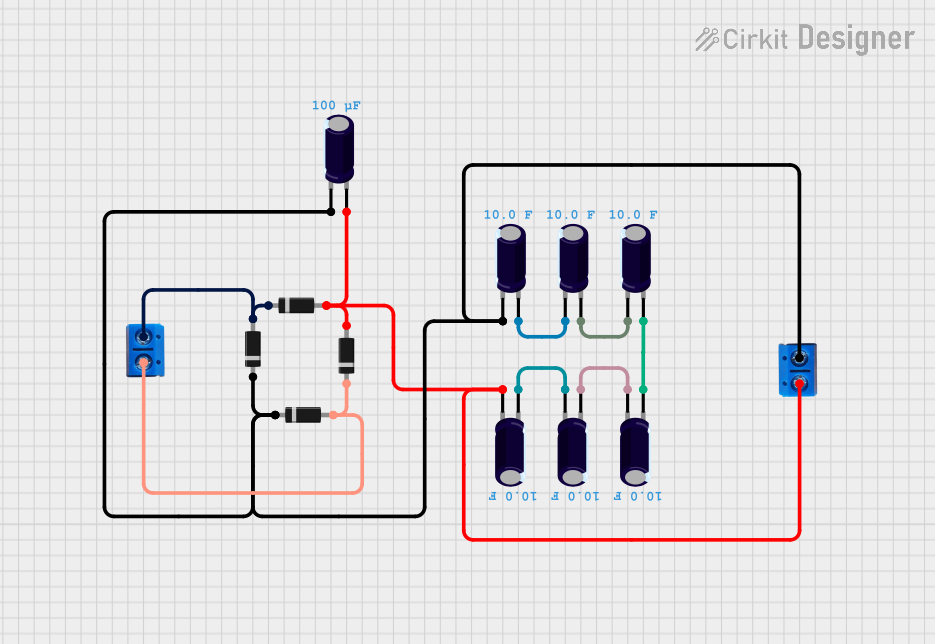 Open Project in Cirkit Designer
Explore Projects Built with Schottky Diode
Open Project in Cirkit DesignerOpen Project in Cirkit DesignerOpen Project in Cirkit DesignerOpen Project in Cirkit DesignerCommon Applications and Use Cases
- Power rectification in power supplies
- High-frequency circuits, such as RF and microwave systems
- Voltage clamping and protection circuits
- Solar panel bypass diodes
- Low-voltage, high-efficiency DC-DC converters
Technical Specifications
Below are the general technical specifications for a typical Schottky diode. Note that specific values may vary depending on the model and manufacturer.
Key Technical Details
- Forward Voltage Drop (Vf): Typically 0.2V to 0.45V
- Reverse Leakage Current (Ir): Low, but higher than standard diodes
- Maximum Reverse Voltage (Vr): Commonly ranges from 20V to 200V
- Maximum Forward Current (If): Typically ranges from 1A to 50A
- Switching Speed: Extremely fast, in the nanosecond range
- Junction Temperature (Tj): Typically up to 150°C or 175°C
Pin Configuration and Descriptions
Schottky diodes are typically packaged in two-terminal configurations. Below is a table describing the pins:
| Pin Name | Description |
|---|---|
| Anode | Positive terminal; current enters here in forward bias. |
| Cathode | Negative terminal; current exits here in forward bias. |
For surface-mount packages (e.g., SOD-123, SOT-23) or through-hole packages (e.g., DO-41), the pin layout may vary slightly, but the anode and cathode are always clearly marked.
Usage Instructions
How to Use the Component in a Circuit
- Identify the Anode and Cathode: The cathode is usually marked with a stripe or band on the diode body.
- Connect in Forward Bias for Rectification: Ensure the anode is connected to the positive voltage and the cathode to the negative voltage.
- Use in High-Frequency Circuits: Schottky diodes are ideal for high-speed switching applications due to their low forward voltage drop and fast recovery time.
- Add a Series Resistor if Necessary: To limit current through the diode, especially in low-voltage circuits.
- Consider Heat Dissipation: For high-current applications, ensure proper heat sinking or thermal management.
Important Considerations and Best Practices
- Reverse Voltage: Ensure the reverse voltage rating of the diode is not exceeded to prevent breakdown.
- Power Dissipation: Calculate power dissipation using ( P = I_f \times V_f ) and ensure it is within the diode's limits.
- Parasitic Capacitance: In high-frequency circuits, consider the diode's capacitance, as it may affect performance.
- Polarity: Always double-check the polarity before powering the circuit to avoid damage.
Example: Using a Schottky Diode with an Arduino UNO
Below is an example of using a Schottky diode for reverse polarity protection in an Arduino UNO circuit:
/*
 * Example: Reverse Polarity Protection with a Schottky Diode
 * This circuit protects the Arduino UNO from damage if the power supply
 * is connected with reversed polarity.
 */

void setup() {
  // No specific code is required for the diode itself.
  // The diode is connected in series with the power supply.
}

void loop() {
  // Your main Arduino code goes here.
  // The Schottky diode ensures the circuit is protected.
}
Circuit Description:
- Place the Schottky diode in series with the Arduino's power input.
- Connect the anode to the positive terminal of the power supply.
- Connect the cathode to the Arduino's VIN pin.
- The diode will block current if the power supply is connected in reverse.
Troubleshooting and FAQs
Common Issues Users Might Face
Excessive Heat Generation:
- Cause: High forward current or insufficient heat dissipation.
- Solution: Use a diode with a higher current rating or add a heat sink.
High Reverse Leakage Current:
- Cause: Operating the diode near its maximum reverse voltage.
- Solution: Choose a diode with a higher reverse voltage rating.
Circuit Not Working as Expected:
- Cause: Incorrect polarity or damaged diode.
- Solution: Verify the anode and cathode connections and test the diode with a multimeter.
Voltage Drop Too High:
- Cause: Using a standard diode instead of a Schottky diode.
- Solution: Replace with a Schottky diode to achieve a lower forward voltage drop.
FAQs
Q: Can I use a Schottky diode in place of a standard diode?
A: Yes, but only if the circuit can tolerate the higher reverse leakage current and lower reverse voltage rating of the Schottky diode.
Q: Why is the forward voltage drop of a Schottky diode lower than a standard diode?
A: The metal-semiconductor junction in a Schottky diode has a lower barrier potential compared to the p-n junction in a standard diode.
Q: Can Schottky diodes handle high currents?
A: Yes, many Schottky diodes are designed for high-current applications, but always check the datasheet for the specific current rating.
Q: Are Schottky diodes suitable for AC rectification?
A: Yes, they are commonly used in rectifier circuits, especially in high-frequency AC applications.
By following this documentation, users can effectively integrate Schottky diodes into their electronic designs while avoiding common pitfalls.