
How to Use 2 x 18650 in case: Examples, Pinouts, and Specs
 Design with 2 x 18650 in case in Cirkit Designer
Introduction
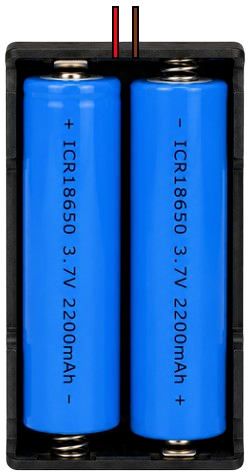
The 2 x 18650 Battery Holder is a compact and durable enclosure designed to securely hold two 18650 lithium-ion batteries. It provides a convenient way to power electronic circuits and devices, offering a stable and portable power source. This holder is commonly used in DIY electronics, robotics, IoT projects, and portable devices where a reliable power supply is essential.
Explore Projects Built with 2 x 18650 in case
 Open Project in Cirkit Designer
 Open Project in Cirkit Designer
 Open Project in Cirkit Designer
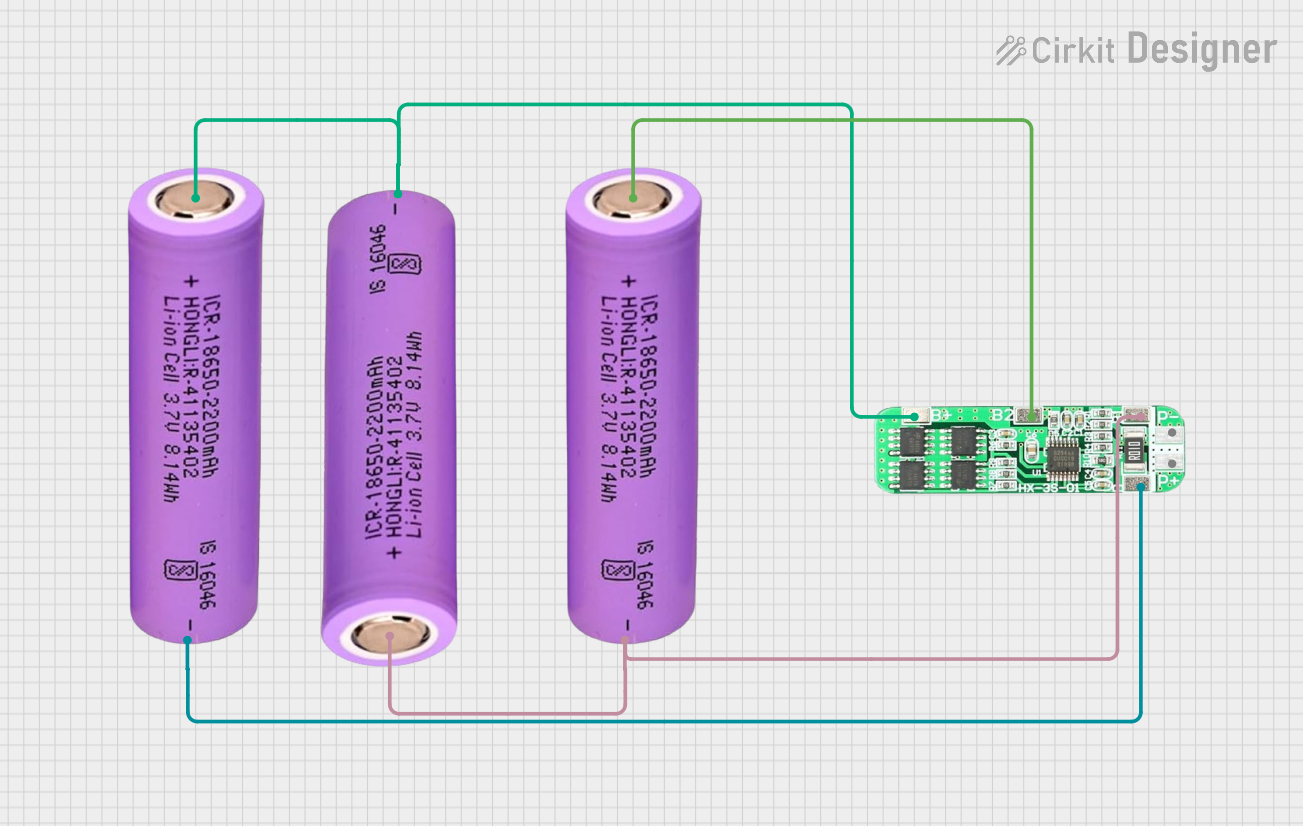 Open Project in Cirkit Designer
Explore Projects Built with 2 x 18650 in case
Open Project in Cirkit DesignerOpen Project in Cirkit DesignerOpen Project in Cirkit DesignerOpen Project in Cirkit DesignerCommon Applications
- Powering Arduino, Raspberry Pi, and other microcontroller-based projects
- Robotics and motorized systems
- Portable electronic devices
- IoT and wireless sensor networks
- LED lighting systems
Technical Specifications
The following table outlines the key technical details of the 2 x 18650 Battery Holder:
| Specification | Details |
|---|---|
| Battery Type | 18650 lithium-ion rechargeable batteries |
| Number of Batteries | 2 |
| Output Voltage | 3.7V (single battery) or 7.4V (two batteries in series, depending on wiring) |
| Maximum Current | Depends on the battery's discharge rating (typically 5A to 20A per cell) |
| Material | ABS plastic with metal spring contacts |
| Dimensions | ~75mm x 40mm x 20mm (varies by manufacturer) |
| Weight | ~20g (without batteries) |
| Wiring Configuration | Series or parallel (varies by model) |
Pin Configuration and Descriptions
The battery holder typically has two wires for connection:
| Wire Color | Description |
|---|---|
| Red | Positive terminal (+) |
| Black | Negative terminal (-) |
Ensure proper polarity when connecting the wires to your circuit to avoid damage to components.
Usage Instructions
How to Use the 2 x 18650 Battery Holder in a Circuit
- Insert Batteries: Place two 18650 lithium-ion batteries into the holder, ensuring correct polarity. The positive and negative terminals of the batteries should align with the "+" and "-" markings on the holder.
- Connect Wires: Use the red (positive) and black (negative) wires to connect the holder to your circuit. Ensure the connections are secure.
- Choose Wiring Configuration:
- If the holder is wired in series, the output voltage will be the sum of the two batteries (e.g., 7.4V for two 3.7V batteries).
- If the holder is wired in parallel, the output voltage will remain the same as a single battery (e.g., 3.7V), but the capacity (mAh) will double.
- Add Protection Circuitry: For safety, consider adding a battery management system (BMS) or a protection circuit to prevent overcharging, over-discharging, and short circuits.
Important Considerations and Best Practices
- Battery Selection: Use only high-quality, protected 18650 batteries to ensure safety and performance.
- Polarity Check: Always double-check the polarity of the batteries and connections before powering your circuit.
- Heat Management: Avoid overloading the batteries, as excessive current draw can cause overheating.
- Storage: Remove the batteries from the holder when not in use for extended periods to prevent leakage or discharge.
Example: Connecting to an Arduino UNO
To power an Arduino UNO using the 2 x 18650 Battery Holder, follow these steps:
- Insert two 18650 batteries into the holder.
- Connect the red wire (positive) to the VIN pin on the Arduino UNO.
- Connect the black wire (negative) to the GND pin on the Arduino UNO.
Here is a simple Arduino sketch to blink an LED while powered by the battery holder:
// Simple LED Blink Example
// This code blinks an LED connected to pin 13 of the Arduino UNO.
// Ensure the Arduino is powered by the 2 x 18650 Battery Holder.

void setup() {
  pinMode(13, OUTPUT); // Set pin 13 as an output
}

void loop() {
  digitalWrite(13, HIGH); // Turn the LED on
  delay(1000);            // Wait for 1 second
  digitalWrite(13, LOW);  // Turn the LED off
  delay(1000);            // Wait for 1 second
}
Troubleshooting and FAQs
Common Issues
No Power Output
- Cause: Batteries are inserted incorrectly or are depleted.
- Solution: Check the polarity of the batteries and replace them if necessary.
Overheating
- Cause: Excessive current draw or short circuit.
- Solution: Ensure the circuit's current requirements are within the battery's discharge rating. Check for short circuits.
Loose Connections
- Cause: Wires or battery contacts are not secure.
- Solution: Ensure the wires are firmly connected and the batteries are seated properly.
Voltage Drop
- Cause: Batteries are nearing depletion or have a high internal resistance.
- Solution: Replace the batteries with fully charged ones or use high-quality cells.
FAQs
Q: Can I use the holder with only one 18650 battery?
A: Yes, but the output voltage will be limited to the voltage of a single battery (3.7V nominal).
Q: Is the holder waterproof?
A: No, the holder is not waterproof. Avoid exposing it to moisture or water.
Q: Can I charge the batteries while they are in the holder?
A: Only if the holder is connected to a compatible charging circuit. Otherwise, remove the batteries and charge them using a dedicated charger.
Q: What is the maximum current the holder can handle?
A: The maximum current depends on the quality of the holder's contacts and the batteries used. Typically, it can handle up to 20A with high-quality batteries.
By following this documentation, you can safely and effectively use the 2 x 18650 Battery Holder in your electronic projects.