
How to Use 220 fan: Examples, Pinouts, and Specs
 Design with 220 fan in Cirkit Designer
Introduction
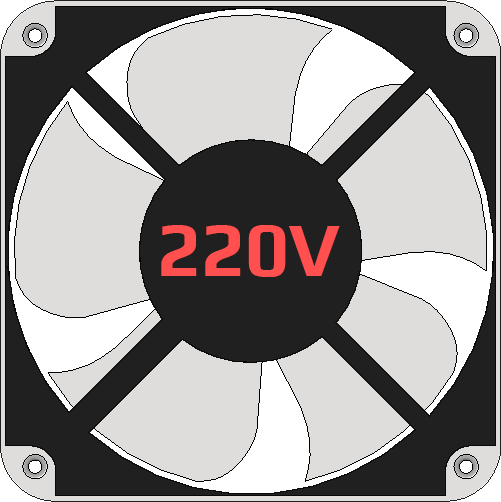
A 220V fan is an electric fan designed to operate on a 220-volt AC power supply. It is commonly used for cooling and ventilation purposes in a wide range of applications, including industrial equipment, home appliances, and electronic enclosures. These fans are reliable, efficient, and capable of maintaining airflow to prevent overheating of components or to improve air circulation in confined spaces.
Explore Projects Built with 220 fan
 Open Project in Cirkit Designer
 Open Project in Cirkit Designer
 Open Project in Cirkit Designer
 Open Project in Cirkit Designer
Explore Projects Built with 220 fan
Open Project in Cirkit DesignerOpen Project in Cirkit DesignerOpen Project in Cirkit DesignerOpen Project in Cirkit DesignerCommon Applications and Use Cases
- Cooling electronic devices and enclosures
- Ventilation in industrial machinery
- Air circulation in HVAC systems
- Heat dissipation in power supplies and transformers
- General-purpose cooling in household appliances
Technical Specifications
Below are the key technical details of a typical 220V fan. Note that specific models may vary slightly in their specifications.
General Specifications
| Parameter | Value |
|---|---|
| Operating Voltage | 220V AC |
| Frequency | 50/60 Hz |
| Power Consumption | 10W to 50W (varies by model) |
| Airflow | 50 to 200 CFM (Cubic Feet/Minute) |
| Speed | 1500 to 3000 RPM |
| Noise Level | 25 to 50 dB |
| Operating Temperature | -10°C to 70°C |
| Lifespan | 30,000 to 50,000 hours |
Pin Configuration and Descriptions
Most 220V fans have a simple two-wire or three-wire configuration. Below is a table describing the typical wiring:
| Pin/Wire Color | Description |
|---|---|
| Live (Brown) | Connects to the live terminal of the 220V AC supply. |
| Neutral (Blue) | Connects to the neutral terminal of the 220V AC supply. |
| Ground (Green/Yellow) | Optional; connects to the ground for safety. |
Note: Always verify the wiring diagram provided by the manufacturer for your specific fan model.
Usage Instructions
How to Use the 220V Fan in a Circuit
- Safety First: Ensure the power supply is turned off before making any connections. Use insulated tools and wear protective gear when working with high-voltage components.
- Wiring:
- Connect the Live (Brown) wire of the fan to the live terminal of the 220V AC power source.
- Connect the Neutral (Blue) wire of the fan to the neutral terminal of the power source.
- If the fan has a Ground (Green/Yellow) wire, connect it to the ground terminal for safety.
- Mounting: Secure the fan in place using screws or brackets. Ensure there is adequate clearance for airflow.
- Testing: After completing the wiring, turn on the power supply and verify that the fan operates correctly.
Important Considerations and Best Practices
- Voltage Compatibility: Ensure the fan is rated for 220V AC. Using it with an incorrect voltage can damage the fan or pose safety risks.
- Airflow Direction: Check the airflow direction indicated on the fan housing and install it accordingly.
- Overcurrent Protection: Use a fuse or circuit breaker to protect the fan and circuit from overcurrent conditions.
- Noise Reduction: If noise is a concern, consider using vibration-dampening mounts or selecting a fan with a lower noise rating.
- Maintenance: Periodically clean the fan blades and housing to prevent dust buildup, which can reduce efficiency and lifespan.
Example: Controlling a 220V Fan with a Relay and Arduino UNO
While a 220V fan cannot be directly powered by an Arduino UNO, you can control it using a relay module. Below is an example circuit and code:
Circuit Description
- Use a 5V relay module to switch the 220V fan on and off.
- Connect the relay's control pin to a digital output pin on the Arduino.
- Ensure proper isolation between the high-voltage and low-voltage sides of the circuit.
Arduino Code
// This code demonstrates how to control a 220V fan using a relay module
// connected to an Arduino UNO. The fan will turn on for 5 seconds, then off
// for 5 seconds in a loop.

const int relayPin = 7; // Pin connected to the relay module

void setup() {
  pinMode(relayPin, OUTPUT); // Set the relay pin as an output
  digitalWrite(relayPin, LOW); // Ensure the relay is off at startup
}

void loop() {
  digitalWrite(relayPin, HIGH); // Turn the relay (and fan) on
  delay(5000); // Wait for 5 seconds
  digitalWrite(relayPin, LOW); // Turn the relay (and fan) off
  delay(5000); // Wait for 5 seconds
}
Warning: Always exercise caution when working with high-voltage components. Ensure proper insulation and isolation to prevent electric shock or damage to the circuit.
Troubleshooting and FAQs
Common Issues and Solutions
| Issue | Possible Cause | Solution |
|---|---|---|
| Fan does not turn on | No power supply or incorrect wiring | Check the power source and wiring. |
| Fan is noisy | Dust buildup or loose mounting | Clean the fan and tighten the screws. |
| Fan overheats | Blocked airflow or overvoltage | Ensure proper ventilation and verify voltage. |
| Fan vibrates excessively | Imbalanced blades or improper mounting | Inspect and balance the blades; secure the fan. |
FAQs
Can I use a 220V fan with a 110V power supply?
- No, a 220V fan is designed specifically for 220V AC. Using it with a lower voltage will result in insufficient performance or failure to operate.
Is it safe to run a 220V fan continuously?
- Yes, most 220V fans are designed for continuous operation. However, ensure proper ventilation and regular maintenance to maximize lifespan.
Can I control the speed of a 220V fan?
- Yes, you can use a compatible fan speed controller or a triac-based dimmer circuit to adjust the speed.
What should I do if the fan stops working suddenly?
- Check the power supply, wiring, and any protective devices (e.g., fuses). If the issue persists, the fan may need to be replaced.
By following this documentation, you can safely and effectively use a 220V fan in your projects or applications.