
How to Use CD4026 IC: Examples, Pinouts, and Specs
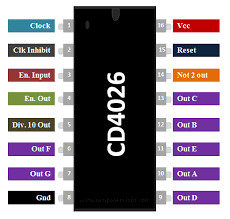
 Design with CD4026 IC in Cirkit Designer
Introduction
The CD4026 IC, manufactured by IC, is a versatile decade counter and display driver designed to drive 7-segment displays directly. It is capable of counting from 0 to 9 and is widely used in applications requiring numerical displays, such as digital clocks, frequency counters, and event counters. The IC integrates both counting and display-driving functionalities, making it a compact and efficient solution for numerical display systems.
Explore Projects Built with CD4026 IC
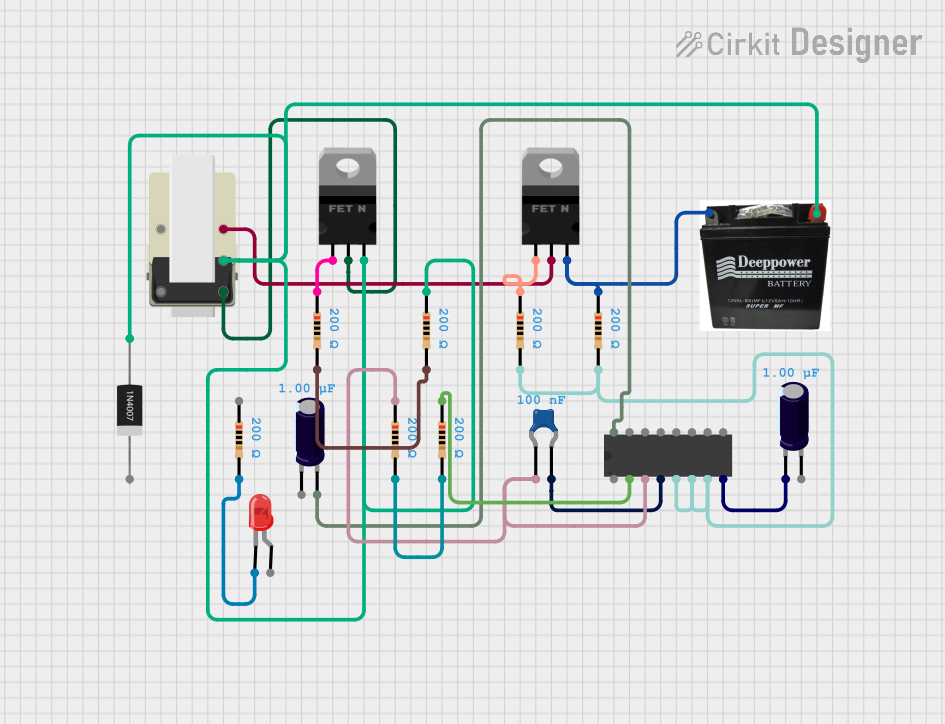 Open Project in Cirkit Designer
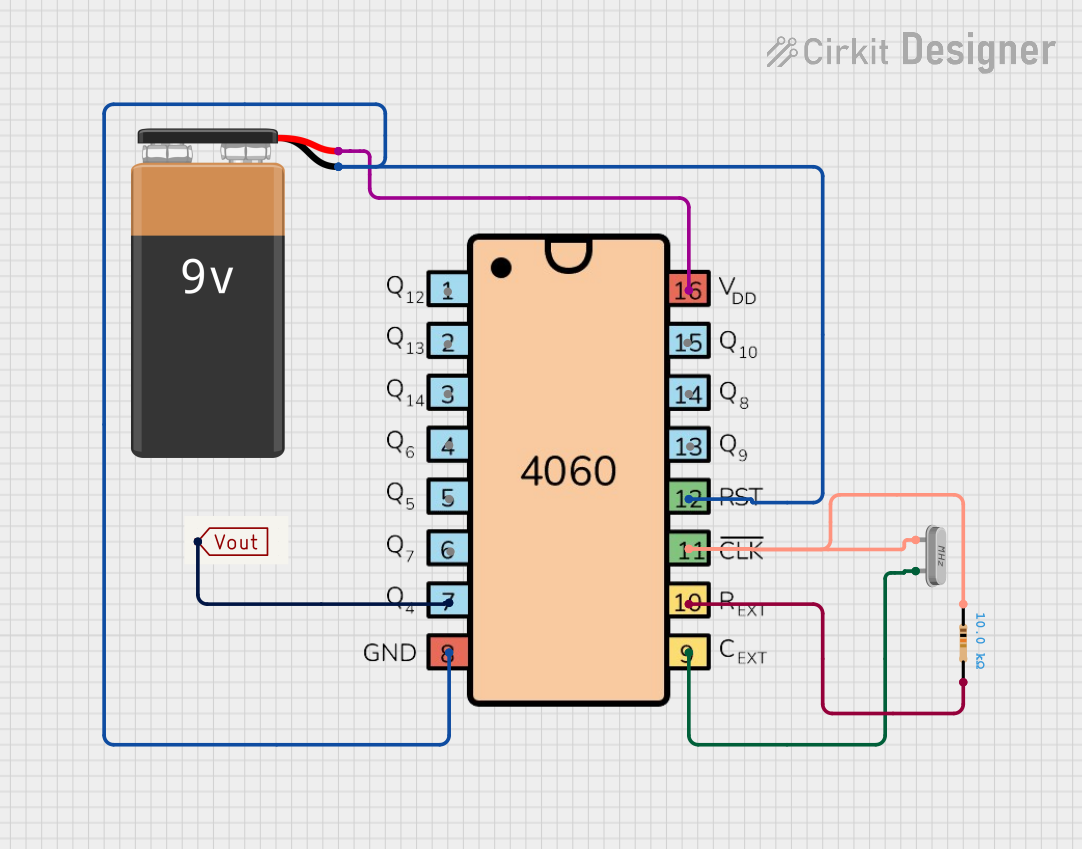 Open Project in Cirkit Designer
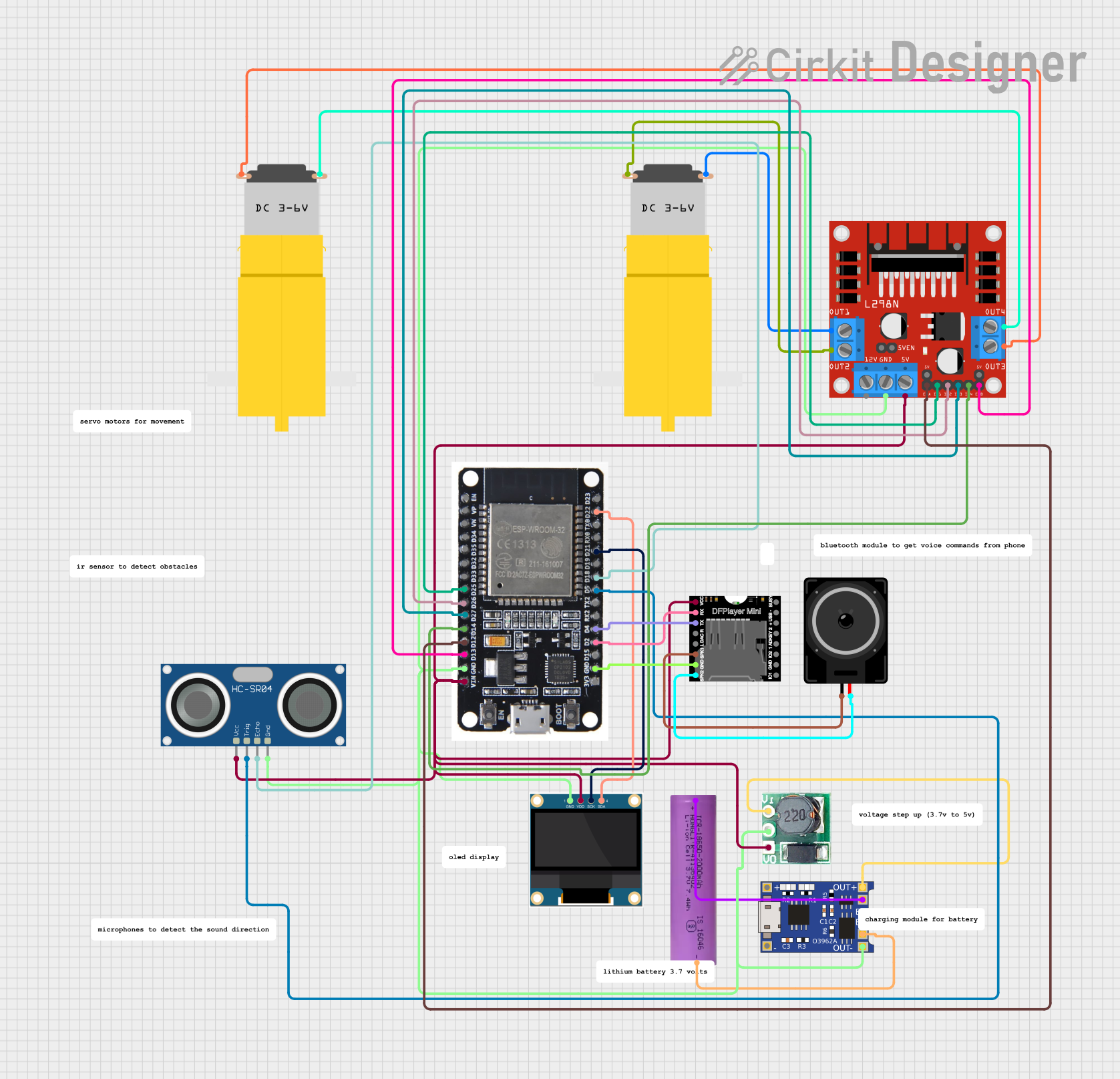 Open Project in Cirkit Designer
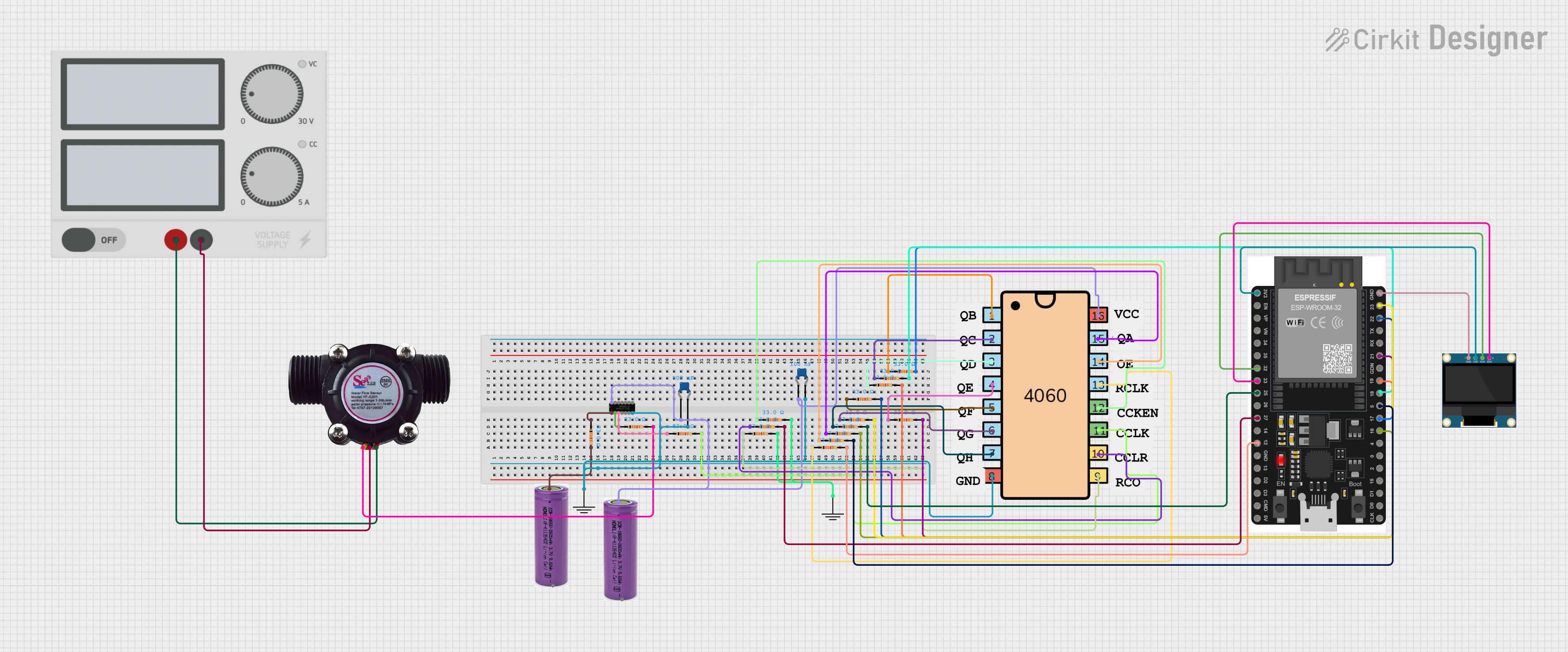 Open Project in Cirkit Designer
Explore Projects Built with CD4026 IC
Open Project in Cirkit DesignerOpen Project in Cirkit DesignerOpen Project in Cirkit DesignerOpen Project in Cirkit DesignerCommon Applications
- Digital clocks
- Frequency counters
- Event counters
- Scoreboards
- Timer circuits
Technical Specifications
The CD4026 IC is a CMOS-based device with low power consumption and high noise immunity. Below are its key technical specifications:
| Parameter | Value |
|---|---|
| Supply Voltage (Vdd) | 3V to 15V |
| Maximum Input Voltage | Vdd |
| Output Current (per pin) | 3.4mA (typical) |
| Operating Temperature | -40°C to +85°C |
| Maximum Clock Frequency | 6 MHz (at 10V supply) |
| Power Dissipation | 500mW |
Pin Configuration and Descriptions
The CD4026 IC comes in a 16-pin Dual Inline Package (DIP). Below is the pinout and description:
| Pin Number | Pin Name | Description |
|---|---|---|
| 1 | Clock (CLK) | Input pin for clock signal; increments the counter on a rising edge. |
| 2 | Enable Input (EN) | Enables or disables the clock input. Active HIGH. |
| 3 | Display Enable | Enables or disables the 7-segment display output. Active HIGH. |
| 4 | Unused | Not connected internally. Leave unconnected or grounded. |
| 5 | Unused | Not connected internally. Leave unconnected or grounded. |
| 6 | Segment F | Drives segment F of the 7-segment display. |
| 7 | Segment G | Drives segment G of the 7-segment display. |
| 8 | Ground (GND) | Connect to the negative terminal of the power supply. |
| 9 | Segment E | Drives segment E of the 7-segment display. |
| 10 | Segment D | Drives segment D of the 7-segment display. |
| 11 | Segment C | Drives segment C of the 7-segment display. |
| 12 | Segment B | Drives segment B of the 7-segment display. |
| 13 | Segment A | Drives segment A of the 7-segment display. |
| 14 | Carry Out (CO) | Outputs a carry signal for cascading multiple ICs. |
| 15 | Reset (RST) | Resets the counter to 0. Active HIGH. |
| 16 | Vdd | Connect to the positive terminal of the power supply. |
Usage Instructions
How to Use the CD4026 in a Circuit
- Power Supply: Connect pin 16 (Vdd) to the positive terminal of the power supply (3V to 15V) and pin 8 (GND) to the negative terminal.
- Clock Input: Provide a clock signal to pin 1 (CLK). Each rising edge of the clock signal increments the counter by 1.
- Reset: To reset the counter to 0, apply a HIGH signal to pin 15 (RST).
- Display Enable: To enable the 7-segment display output, apply a HIGH signal to pin 3 (Display Enable).
- Cascading: Use pin 14 (Carry Out) to cascade multiple CD4026 ICs for counting beyond 9.
Important Considerations
- Ensure the supply voltage does not exceed the maximum rating of 15V.
- Use a current-limiting resistor for each segment of the 7-segment display to prevent damage.
- Debounce the clock signal if using a mechanical switch to avoid erratic counting.
- For higher counting ranges, cascade multiple CD4026 ICs using the Carry Out (CO) pin.
Example: Connecting CD4026 to Arduino UNO
Below is an example of how to connect and control the CD4026 IC with an Arduino UNO to drive a 7-segment display.
Circuit Connections
- Connect pin 16 (Vdd) to the Arduino's 5V pin.
- Connect pin 8 (GND) to the Arduino's GND.
- Connect pin 1 (CLK) to Arduino digital pin 2.
- Connect pin 15 (RST) to Arduino digital pin 3.
- Connect the 7-segment display segments (A-G) to the corresponding pins (13, 12, 11, 10, 9, 6, 7) of the CD4026 IC.
Arduino Code
// Define pin connections
const int clockPin = 2;  // Clock input to CD4026
const int resetPin = 3;  // Reset input to CD4026

void setup() {
  pinMode(clockPin, OUTPUT);  // Set clock pin as output
  pinMode(resetPin, OUTPUT);  // Set reset pin as output

  // Initialize pins
  digitalWrite(clockPin, LOW);
  digitalWrite(resetPin, LOW);
}

void loop() {
  // Reset the counter
  digitalWrite(resetPin, HIGH);  // Send HIGH signal to reset pin
  delay(10);                     // Wait for 10ms
  digitalWrite(resetPin, LOW);   // Set reset pin back to LOW

  // Increment the counter
  for (int i = 0; i < 10; i++) { // Count from 0 to 9
    digitalWrite(clockPin, HIGH);  // Send HIGH signal to clock pin
    delay(1000);                   // Wait for 1 second
    digitalWrite(clockPin, LOW);   // Set clock pin back to LOW
    delay(1000);                   // Wait for 1 second
  }
}
Troubleshooting and FAQs
Common Issues and Solutions
The 7-segment display does not light up.
- Ensure the Display Enable pin (pin 3) is HIGH.
- Check the connections between the CD4026 IC and the 7-segment display.
- Verify that the power supply voltage is within the specified range.
The counter skips numbers or behaves erratically.
- Debounce the clock signal if using a mechanical switch.
- Check for loose or faulty connections in the circuit.
The counter does not reset to 0.
- Ensure the Reset pin (pin 15) is momentarily set to HIGH to reset the counter.
- Verify that the Reset pin is not left floating.
The IC overheats.
- Check for short circuits or excessive current draw.
- Ensure current-limiting resistors are used for the 7-segment display.
FAQs
Q: Can I cascade multiple CD4026 ICs for higher counts?
A: Yes, you can connect the Carry Out (CO) pin of one IC to the Clock (CLK) pin of the next IC to cascade them.
Q: What type of 7-segment display can I use with the CD4026?
A: The CD4026 is designed to drive common cathode 7-segment displays.
Q: Can I use the CD4026 with a 3.3V power supply?
A: Yes, the CD4026 operates with supply voltages as low as 3V. However, ensure the connected 7-segment display is compatible with 3.3V operation.