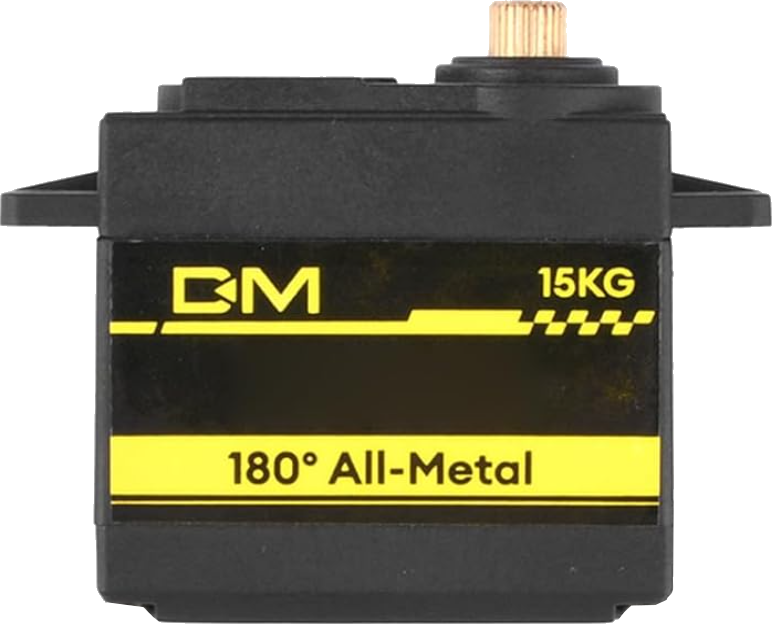
The Servo DM 15kg is a high-torque servo motor designed for applications requiring precise control of angular position. With a torque rating of up to 15 kg-cm, this servo is ideal for demanding tasks in robotics, automation, RC vehicles, and industrial machinery. Its robust design and high torque output make it suitable for moving heavy loads with accuracy and reliability.
Explore Projects Built with Servo DM 15kg
Use Cirkit Designer to design, explore, and prototype these projects online. Some projects support real-time simulation. Click "Open Project" to start designing instantly!
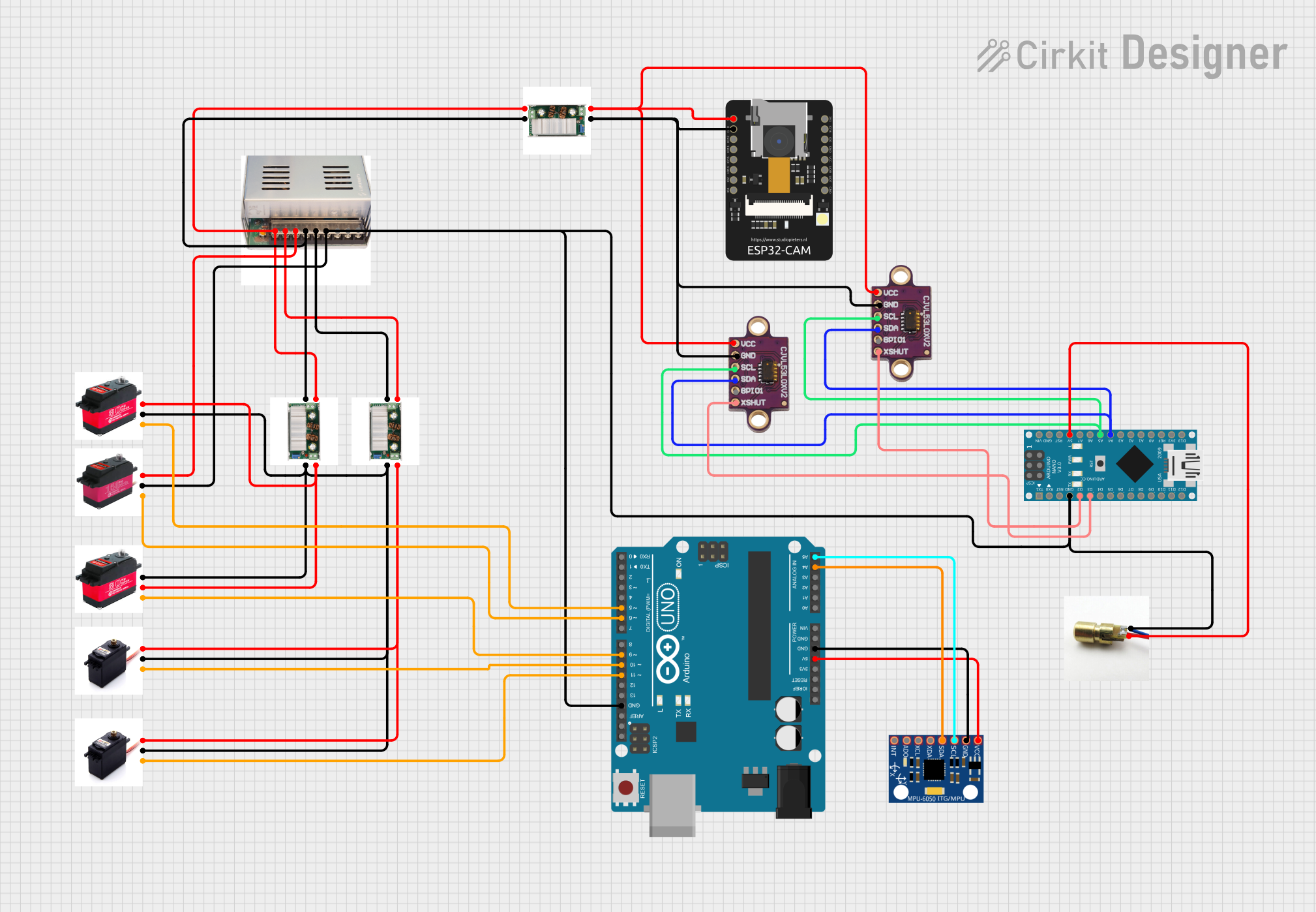
This circuit appears to be a servo motor control system with multiple servo motors of different torque ratings, powered by a 12V/30A DC power supply through DC-to-DC converters. It includes an Arduino UNO and an Arduino Nano for control logic, interfaced with an MPU-6050 for motion sensing and two vl53l0xv2 sensors for distance measurement. Additionally, there is an ESP32-CAM module for image capture and a laser diode, likely for positioning or targeting, all orchestrated by embedded code running on the microcontrollers.
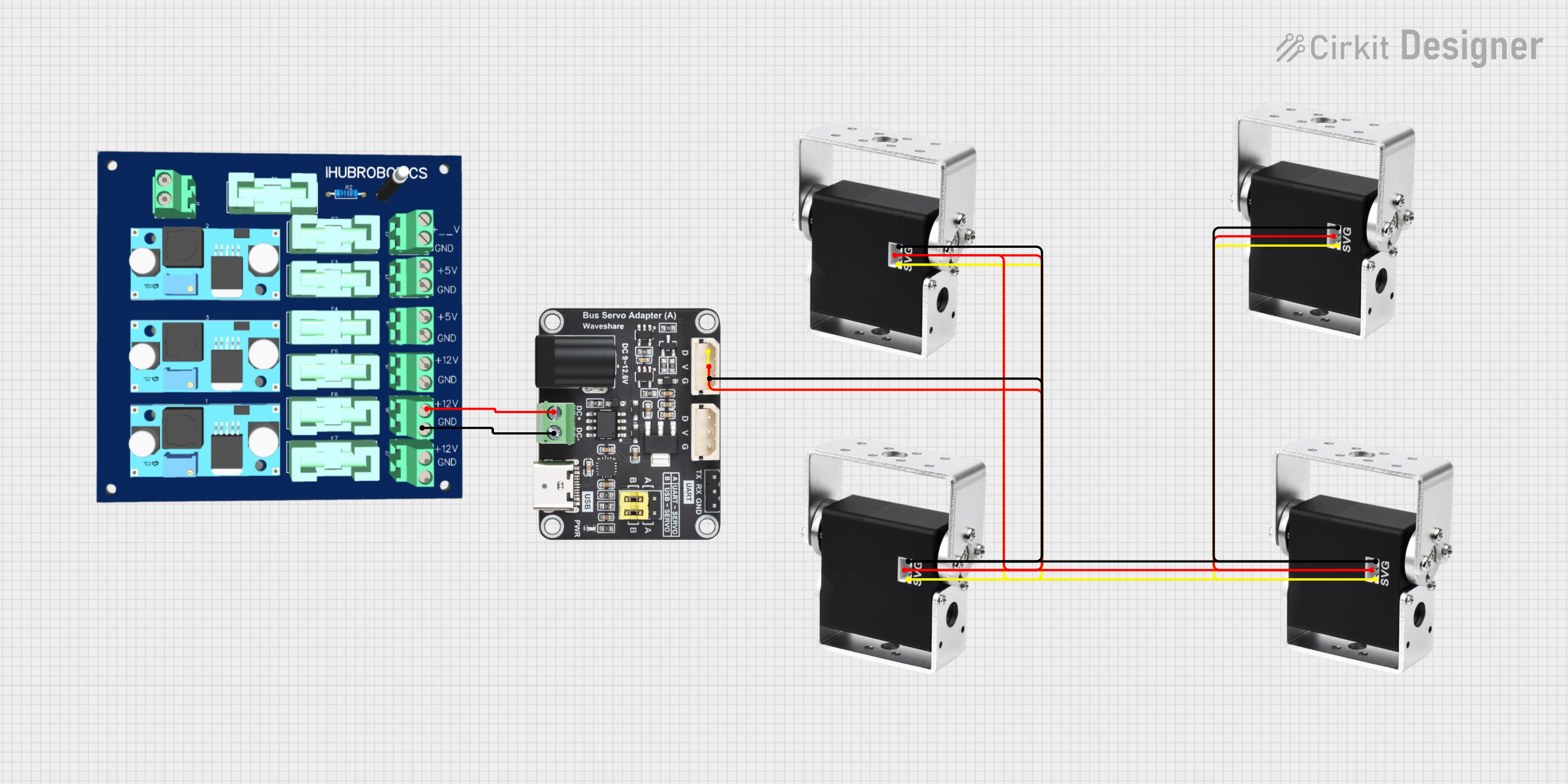
This circuit controls multiple high-torque bus servos using a bus servo adaptor, which is powered by a 6-channel power module. The servos receive their control signals and power through the adaptor, enabling synchronized movement for applications requiring precise and powerful actuation.
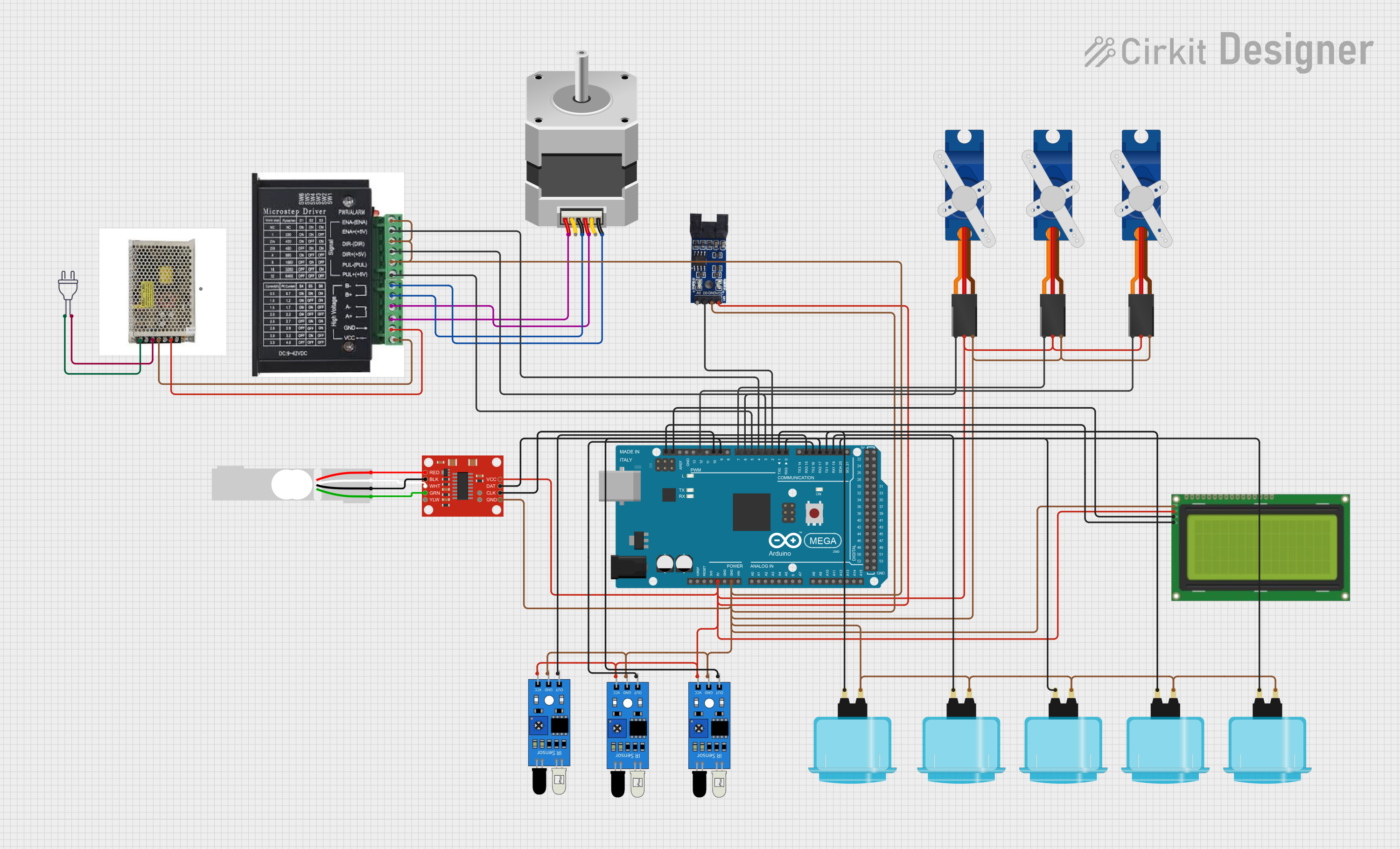
This is an automated control system featuring an Arduino Mega 2560 that manages a stepper motor, servos, IR sensors, and a load cell. It is designed for precise motion control, object detection, and weight measurement, suitable for applications such as robotics or automated machinery. The system includes an LCD for user interface or status display and is powered by a 24VDC supply derived from 220VAC.
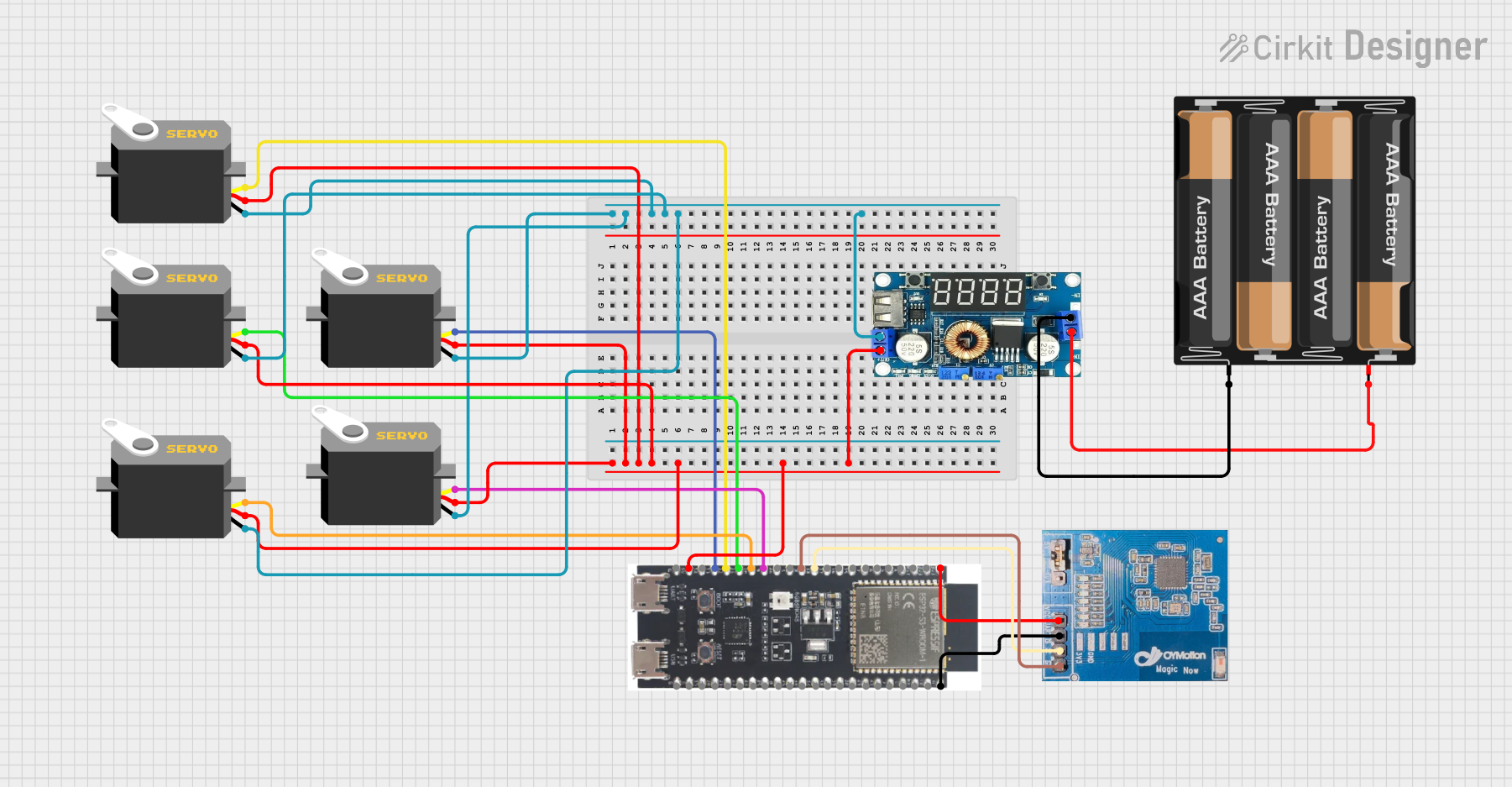
This circuit is a servo control system powered by a 4 x AAA battery pack, regulated by a step-down DC regulator. An ESP32-S3 microcontroller controls five servos and communicates with a gForceJoint UART sensor, enabling precise servo movements based on sensor inputs.
Below are the key technical details of the Servo DM 15kg:
Parameter
Value
Operating Voltage
4.8V - 6.8V
Stall Torque
15 kg-cm @ 6.8V
Operating Speed
0.16 sec/60° @ 4.8V, 0.14 sec/60° @ 6.8V
Control Signal
PWM (Pulse Width Modulation)
PWM Pulse Range
500 µs - 2500 µs
Angle Range
0° - 180°
Gear Material
Metal
Motor Type
Coreless
Dimensions
40.5 x 20 x 38 mm
Weight
60 g
Pin Configuration
The Servo DM 15kg has a standard 3-pin connector. The pinout is as follows:
Pin
Wire Color
Function
1
Brown
Ground (GND)
2
Red
Power (VCC)
3
Orange
Signal (PWM Input)
Usage Instructions
Connecting the Servo
Power Supply: Ensure the servo is powered with a voltage between 4.8V and 6.8V. A regulated power supply or a 5V/6V battery pack is recommended.
Wiring:
Connect the Brown wire to the ground (GND) of your power source or microcontroller.
Connect the Red wire to the positive terminal (VCC) of your power source.
Connect the Orange wire to the PWM output pin of your microcontroller (e.g., Arduino).
Controlling the Servo with Arduino UNO
The Servo DM 15kg can be controlled using the Arduino Servo library. Below is an example code to rotate the servo to specific angles:
#include <Servo.h> // Include the Servo library

Servo myServo; // Create a Servo object

void setup() {
  myServo.attach(9); // Attach the servo to pin 9 on the Arduino
}

void loop() {
  myServo.write(0); // Move the servo to 0 degrees
  delay(1000);      // Wait for 1 second

  myServo.write(90); // Move the servo to 90 degrees
  delay(1000);       // Wait for 1 second

  myServo.write(180); // Move the servo to 180 degrees
  delay(1000);        // Wait for 1 second
}
Important Considerations
Power Supply: Avoid powering the servo directly from the Arduino's 5V pin, as the current draw may exceed the Arduino's capacity. Use an external power source capable of supplying sufficient current (at least 2A).
PWM Signal: Ensure the PWM signal is within the specified range (500 µs to 2500 µs) to avoid damaging the servo.
Mechanical Load: Do not exceed the torque rating of 15 kg-cm to prevent overheating or damage to the motor.
Troubleshooting and FAQs
Common Issues and Solutions
Servo Not Moving
Cause: Incorrect wiring or insufficient power supply.
Solution: Double-check the wiring and ensure the power supply meets the voltage and current requirements.
Servo Jittering or Vibrating
Cause: Electrical noise or unstable PWM signal.
Solution: Use a decoupling capacitor (e.g., 100 µF) across the power supply terminals and ensure the PWM signal is stable.
Servo Overheating
Cause: Excessive load or prolonged operation at stall torque.
Solution: Reduce the mechanical load and avoid operating the servo at stall torque for extended periods.
Limited Range of Motion
Cause: PWM signal out of range or mechanical obstruction.
Solution: Verify the PWM signal is within the 500 µs to 2500 µs range and check for any physical obstructions.
FAQs
Q: Can I use the Servo DM 15kg with a Raspberry Pi?
A: Yes, but you will need a PWM driver (e.g., PCA9685) or a software PWM library to generate the required signal.
Q: What is the maximum current draw of the servo?
A: The maximum current draw can reach up to 2.5A under heavy load. Ensure your power supply can handle this.
Q: Can the servo rotate beyond 180°?
A: No, the Servo DM 15kg is designed for a range of 0° to 180°. For continuous rotation, consider a continuous rotation servo.
Q: How do I mount the servo?
A: The servo comes with mounting brackets and screws. Use these to securely attach the servo to your project.
By following this documentation, you can effectively integrate the Servo DM 15kg into your projects and troubleshoot common issues with ease.

 Open Project in Cirkit Designer