
How to Use Thermocouple: Examples, Pinouts, and Specs

 Design with Thermocouple in Cirkit Designer
Introduction
A thermocouple is a temperature sensor that consists of two dissimilar metal wires joined at one end. It operates on the principle of the Seebeck effect, where a voltage is generated proportional to the temperature difference between the joined end (hot junction) and the other ends (cold junction). This voltage can be measured and converted into a temperature reading.
Thermocouples are widely used in various applications due to their simplicity, durability, and wide temperature range. Common use cases include:
- Industrial temperature monitoring in furnaces, kilns, and engines.
- Household appliances like ovens and water heaters.
- Scientific experiments requiring precise temperature measurements.
- HVAC systems for environmental control.
Explore Projects Built with Thermocouple
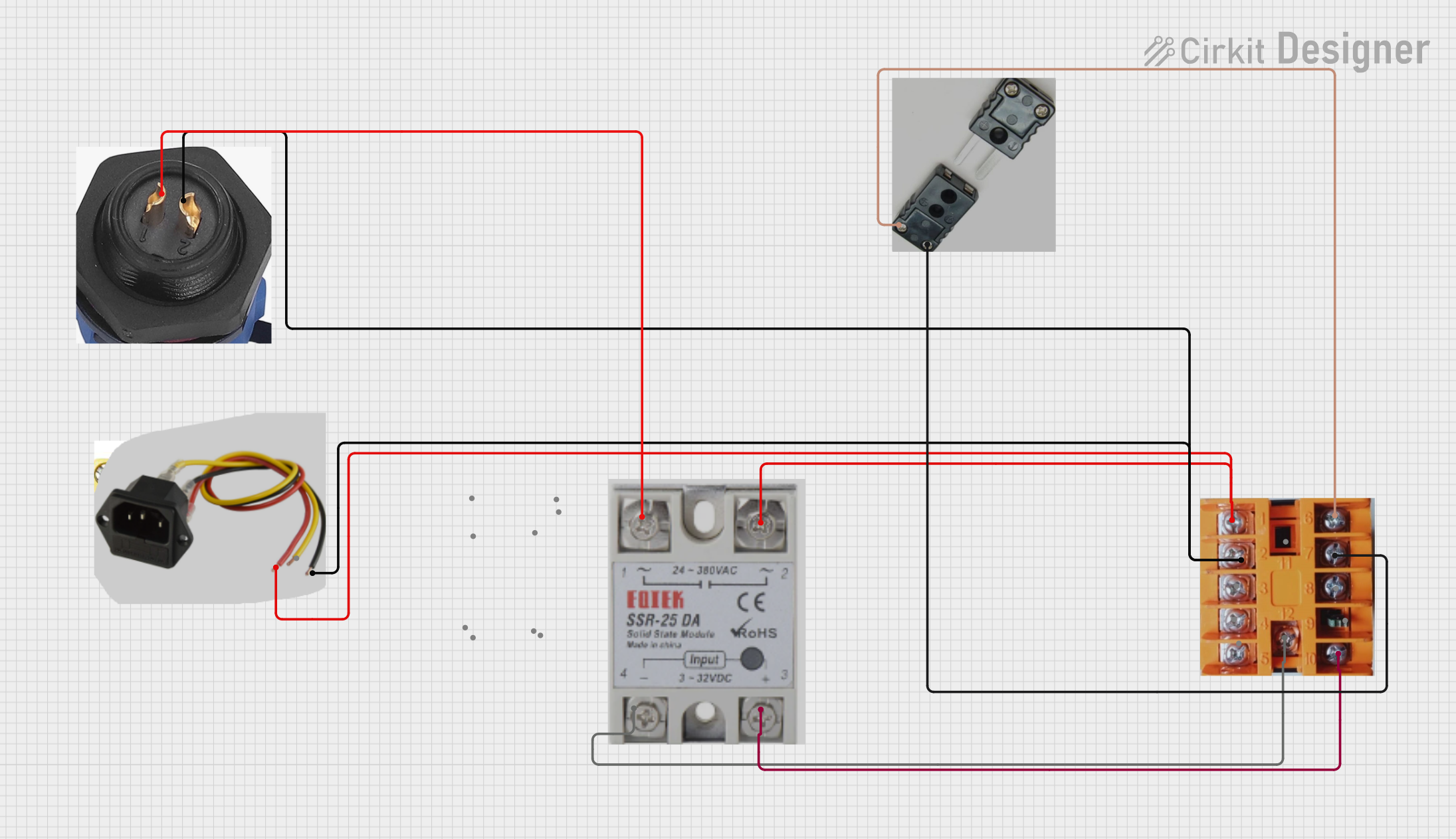 Open Project in Cirkit Designer
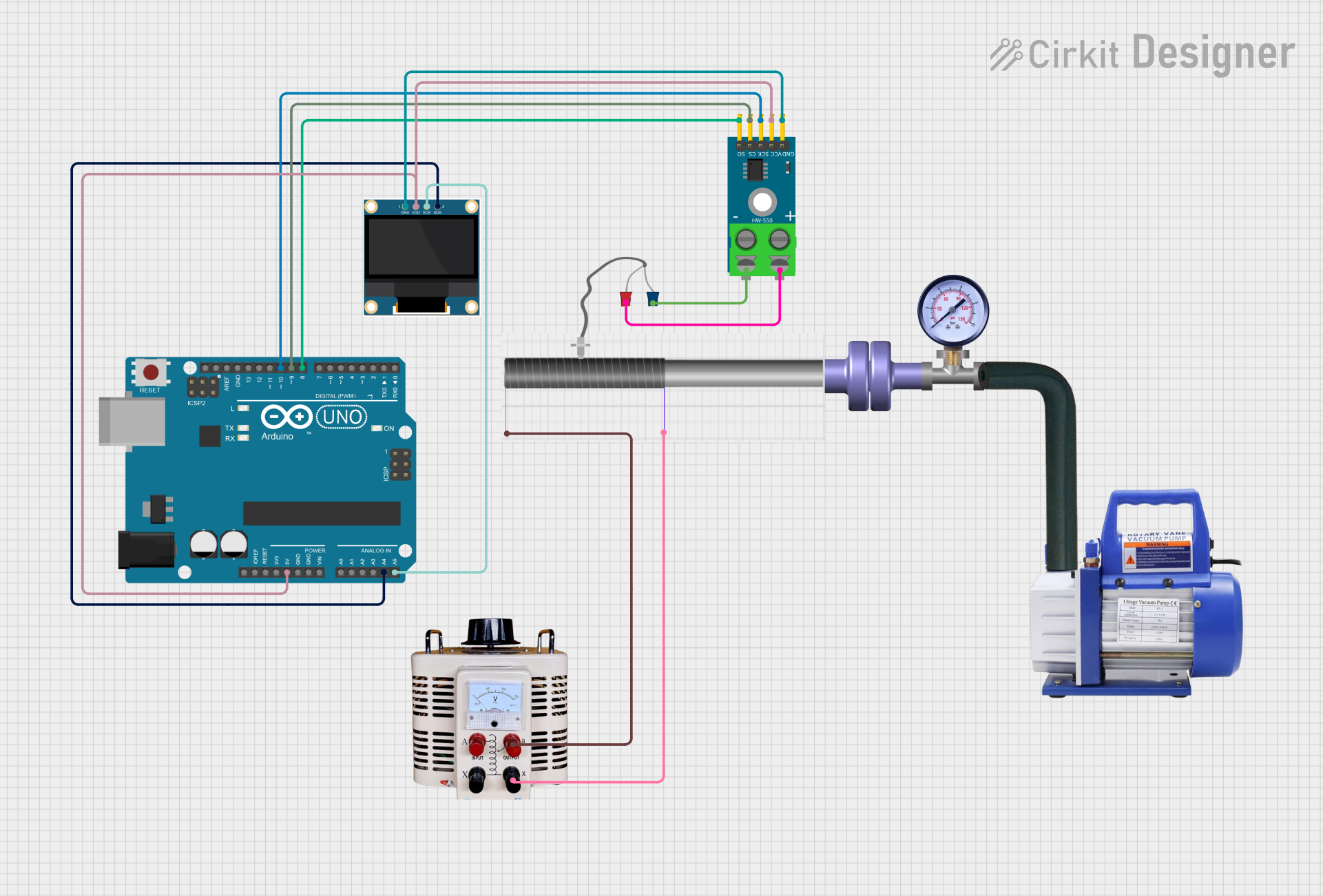 Open Project in Cirkit Designer
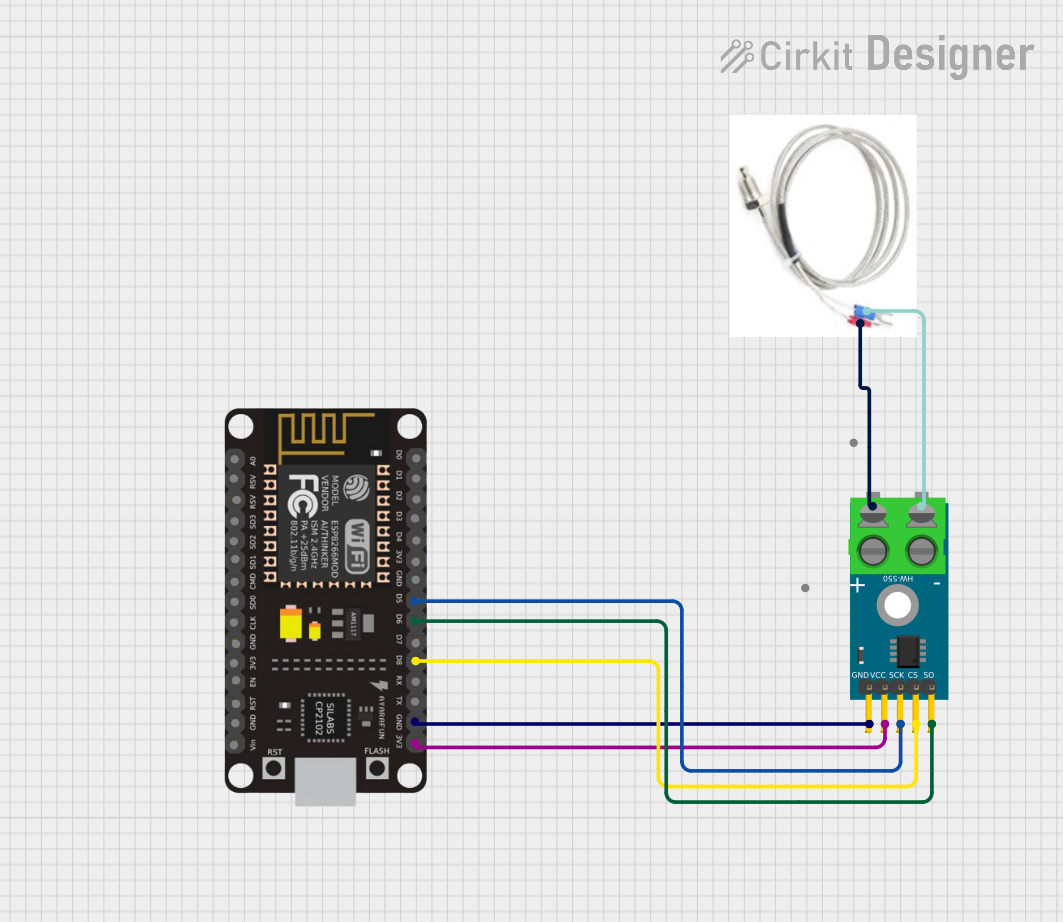 Open Project in Cirkit Designer
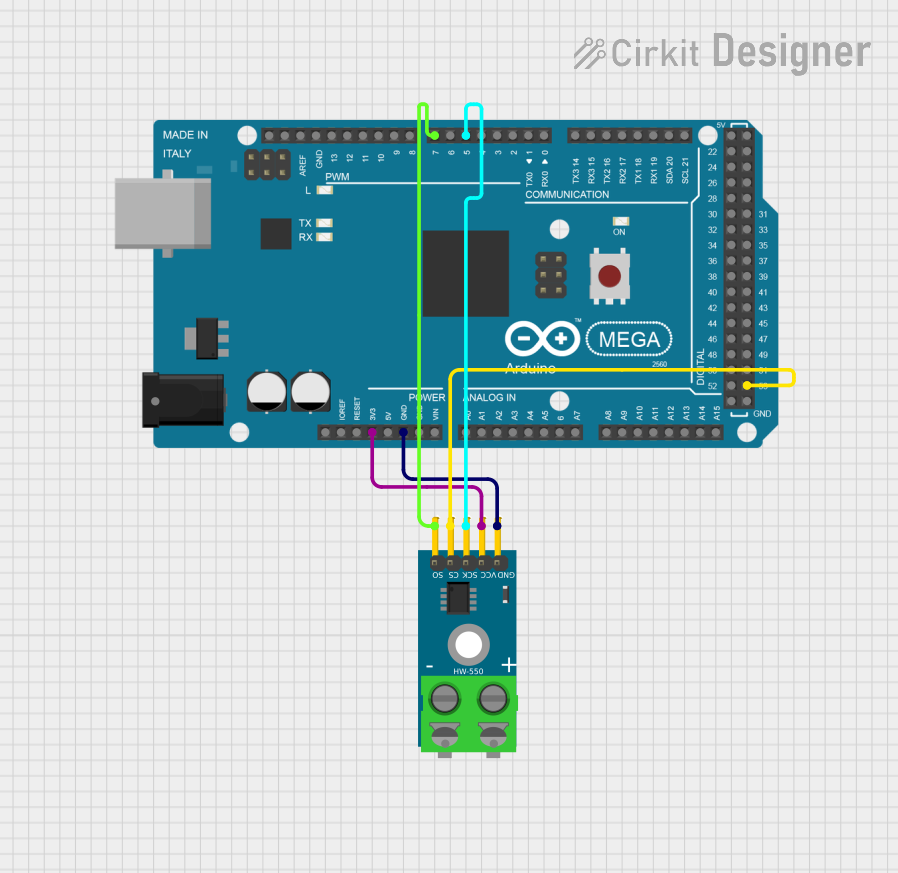 Open Project in Cirkit Designer
Explore Projects Built with Thermocouple
Open Project in Cirkit DesignerOpen Project in Cirkit DesignerOpen Project in Cirkit DesignerOpen Project in Cirkit DesignerTechnical Specifications
- Temperature Range: Depends on the thermocouple type (e.g., Type K: -200°C to 1,260°C).
- Accuracy: Typically ±1°C to ±2°C, depending on the type and calibration.
- Output Voltage: Microvolts per degree Celsius (varies by type).
- Response Time: Fast, typically in milliseconds.
- Durability: Resistant to high temperatures and harsh environments.
Common Thermocouple Types
| Type | Metals Used | Temperature Range | Sensitivity (µV/°C) |
|---|---|---|---|
| Type K | Chromel (+) / Alumel (-) | -200°C to 1,260°C | ~41 |
| Type J | Iron (+) / Constantan (-) | -40°C to 750°C | ~55 |
| Type T | Copper (+) / Constantan (-) | -200°C to 350°C | ~43 |
| Type E | Chromel (+) / Constantan (-) | -200°C to 900°C | ~68 |
Pin Configuration and Descriptions
Thermocouples do not have a standard "pin" configuration but consist of two wires:
| Wire Color (Type K) | Description |
|---|---|
| Yellow | Positive (Chromel) |
| Red | Negative (Alumel) |
Note: Wire colors may vary by region or manufacturer. Always refer to the datasheet.
Usage Instructions
How to Use a Thermocouple in a Circuit
- Connect the Thermocouple: Attach the positive and negative wires to the appropriate input terminals of a thermocouple amplifier or data acquisition system.
- Amplify the Signal: Since thermocouples generate very small voltages, use an amplifier (e.g., MAX31855 or MAX6675) to condition the signal.
- Cold Junction Compensation (CJC): Use a thermocouple amplifier with built-in CJC to account for the temperature at the reference junction.
- Read the Output: The amplifier outputs a signal (digital or analog) that corresponds to the temperature. This can be read by a microcontroller or other processing unit.
Important Considerations and Best Practices
- Calibration: Ensure the thermocouple is properly calibrated for accurate readings.
- Shielding: Use shielded cables to minimize noise interference in high-EMI environments.
- Polarity: Always connect the positive and negative wires correctly to avoid incorrect readings.
- Placement: Place the thermocouple tip directly in the medium being measured for accurate results.
- Avoid Mechanical Stress: Do not bend or twist the thermocouple excessively, as this can damage the wires.
Example: Using a Type K Thermocouple with Arduino UNO
To interface a Type K thermocouple with an Arduino UNO, you can use a MAX6675 thermocouple amplifier module. Below is an example code:
#include <SPI.h>
#include "Adafruit_MAX6675.h"

// Define the pins for the MAX6675 module
int thermoDO = 4;  // Data Out pin
int thermoCS = 5;  // Chip Select pin
int thermoCLK = 6; // Clock pin

// Create an instance of the MAX6675 library
Adafruit_MAX6675 thermocouple(thermoCLK, thermoCS, thermoDO);

void setup() {
  Serial.begin(9600); // Initialize serial communication
  Serial.println("Thermocouple Test");
  delay(500); // Allow time for the sensor to stabilize
}

void loop() {
  // Read the temperature from the thermocouple
  double temperature = thermocouple.readCelsius();

  // Check if the reading is valid
  if (isnan(temperature)) {
    Serial.println("Error: Failed to read temperature!");
  } else {
    Serial.print("Temperature: ");
    Serial.print(temperature);
    Serial.println(" °C");
  }

  delay(1000); // Wait 1 second before the next reading
}
Notes:
- Ensure the MAX6675 module is connected to the correct pins on the Arduino.
- The library
Adafruit_MAX6675must be installed in the Arduino IDE.
Troubleshooting and FAQs
Common Issues
Incorrect Temperature Readings
- Cause: Reversed polarity of the thermocouple wires.
- Solution: Verify and correct the wire connections.
No Output or Erratic Readings
- Cause: Loose connections or damaged wires.
- Solution: Check all connections and inspect the thermocouple for physical damage.
High Noise in Readings
- Cause: Electromagnetic interference (EMI).
- Solution: Use shielded cables and ensure proper grounding.
Amplifier Not Working
- Cause: Incorrect wiring or power supply issues.
- Solution: Double-check the amplifier connections and ensure it is powered correctly.
FAQs
Q: Can I extend the thermocouple wires?
A: Yes, but use thermocouple extension wires made of the same materials to avoid introducing errors.
Q: How do I choose the right thermocouple type?
A: Select a type based on the temperature range, sensitivity, and environmental conditions of your application.
Q: Do thermocouples require calibration?
A: Yes, periodic calibration ensures accurate readings, especially in critical applications.
Q: Can I use a thermocouple without an amplifier?
A: Not typically. The voltage generated by a thermocouple is very small and requires amplification for accurate measurement.