
How to Use USB Type-C 5V 2A Step-Up Boost Converter: Examples, Pinouts, and Specs
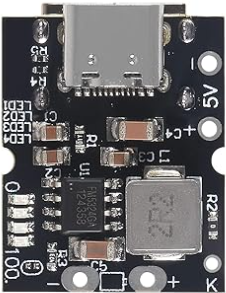
 Design with USB Type-C 5V 2A Step-Up Boost Converter in Cirkit Designer
Introduction
The USB Type-C 5V 2A Step-Up Boost Converter is a compact and efficient device designed to increase a lower input voltage to a stable 5V output while delivering up to 2A of current. This component is commonly used to power USB devices, such as smartphones, tablets, and microcontrollers, from lower voltage sources like batteries or solar panels. Its small size and high efficiency make it ideal for portable and embedded applications.
Explore Projects Built with USB Type-C 5V 2A Step-Up Boost Converter
 Open Project in Cirkit Designer
 Open Project in Cirkit Designer
 Open Project in Cirkit Designer
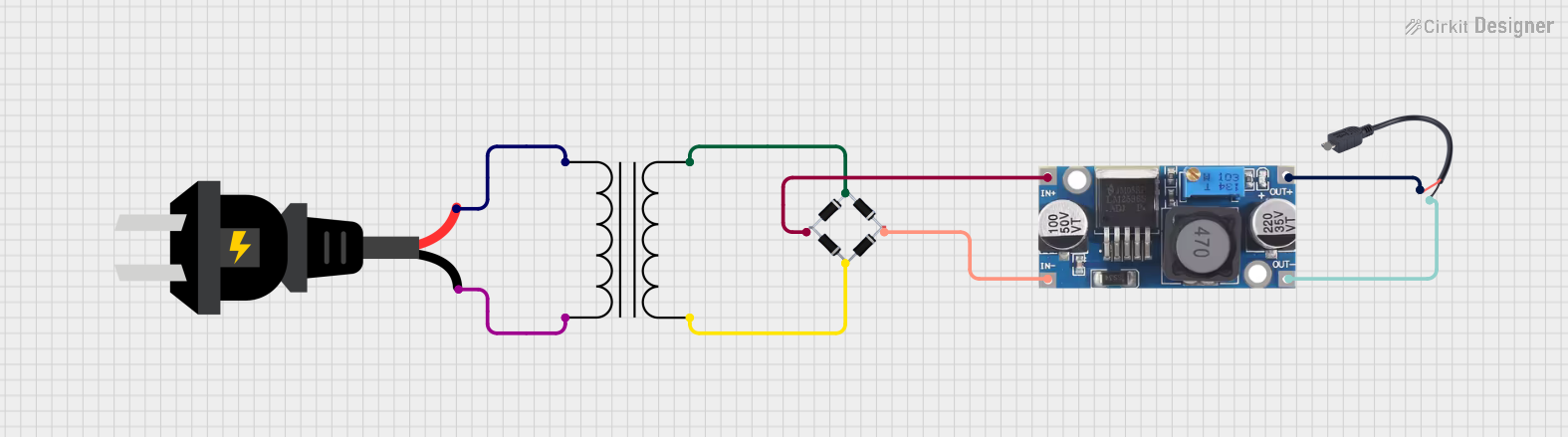 Open Project in Cirkit Designer
Explore Projects Built with USB Type-C 5V 2A Step-Up Boost Converter
Open Project in Cirkit DesignerOpen Project in Cirkit DesignerOpen Project in Cirkit DesignerOpen Project in Cirkit DesignerCommon Applications and Use Cases
- Powering USB devices from 3.7V lithium-ion batteries.
- Boosting voltage from solar panels for USB-powered devices.
- Providing a stable 5V output for microcontroller-based projects.
- Portable power banks and DIY charging solutions.
Technical Specifications
Key Technical Details
- Input Voltage Range: 2.5V to 4.5V
- Output Voltage: 5V (regulated)
- Maximum Output Current: 2A
- Efficiency: Up to 92% (depending on input voltage and load)
- Connector Type: USB Type-C (output)
- Dimensions: Typically 25mm x 15mm x 5mm (varies by manufacturer)
- Operating Temperature: -40°C to 85°C
Pin Configuration and Descriptions
The USB Type-C 5V 2A Step-Up Boost Converter typically has the following pins or terminals:
| Pin/Terminal | Label | Description |
|---|---|---|
| 1 | VIN (+) | Positive input voltage terminal (connect to the positive side of the power source). |
| 2 | GND (-) | Ground terminal (connect to the negative side of the power source). |
| 3 | USB Type-C Port | Output port providing 5V regulated power. |
Usage Instructions
How to Use the Component in a Circuit
- Connect the Input Voltage Source:
- Attach the positive terminal of your power source (e.g., a 3.7V lithium-ion battery) to the
VIN (+)pin. - Connect the negative terminal of the power source to the
GND (-)pin.
- Attach the positive terminal of your power source (e.g., a 3.7V lithium-ion battery) to the
- Connect the Load:
- Plug your USB-powered device into the USB Type-C port of the converter.
- Power On:
- Ensure the input voltage is within the specified range (2.5V to 4.5V).
- The converter will automatically boost the input voltage to a stable 5V output.
Important Considerations and Best Practices
- Input Voltage Range: Ensure the input voltage does not exceed the specified range to avoid damaging the converter.
- Current Limitations: Do not exceed the maximum output current of 2A to prevent overheating or failure.
- Heat Dissipation: If operating at high currents for extended periods, consider adding heat sinks or ensuring proper ventilation.
- Polarity: Double-check the polarity of the input connections to avoid damaging the component.
- Load Compatibility: Verify that the connected USB device does not draw more than 2A.
Example: Using with an Arduino UNO
The USB Type-C 5V 2A Step-Up Boost Converter can be used to power an Arduino UNO from a 3.7V lithium-ion battery. Below is an example setup:
- Connect the battery's positive terminal to the
VIN (+)pin and the negative terminal to theGND (-)pin of the converter. - Plug the Arduino UNO into the USB Type-C port of the converter using a USB cable.
- The converter will provide a stable 5V to power the Arduino UNO.
Here is an example Arduino sketch to blink an LED:
// This sketch blinks an LED connected to pin 13 of the Arduino UNO.
// Ensure the USB Type-C 5V 2A Step-Up Boost Converter is properly connected
// to provide stable power to the Arduino.

void setup() {
  pinMode(13, OUTPUT); // Set pin 13 as an output pin
}

void loop() {
  digitalWrite(13, HIGH); // Turn the LED on
  delay(1000);            // Wait for 1 second
  digitalWrite(13, LOW);  // Turn the LED off
  delay(1000);            // Wait for 1 second
}
Troubleshooting and FAQs
Common Issues and Solutions
No Output Voltage:
- Cause: Input voltage is too low or improperly connected.
- Solution: Verify the input voltage is within the 2.5V to 4.5V range and check the polarity of the connections.
Overheating:
- Cause: Excessive current draw or poor ventilation.
- Solution: Ensure the load does not exceed 2A and improve airflow around the converter.
Device Not Charging:
- Cause: Incompatible USB device or insufficient current.
- Solution: Check the device's power requirements and ensure they are within the converter's specifications.
Fluctuating Output Voltage:
- Cause: Unstable input voltage or excessive load.
- Solution: Use a stable power source and reduce the load if necessary.
FAQs
Q1: Can I use this converter with a 1.5V AA battery?
A1: No, the input voltage must be at least 2.5V for the converter to function properly.
Q2: Is the USB Type-C port compatible with all USB devices?
A2: Yes, as long as the device requires 5V and does not draw more than 2A.
Q3: Can I use this converter to charge a lithium-ion battery?
A3: No, this converter is designed to provide a stable 5V output and is not suitable for charging batteries directly.
Q4: What happens if I exceed the 2A current limit?
A4: The converter may overheat, shut down, or become permanently damaged. Always ensure the load stays within the specified limits.