
How to Use Digital Compass: Examples, Pinouts, and Specs
 Design with Digital Compass in Cirkit Designer
Introduction
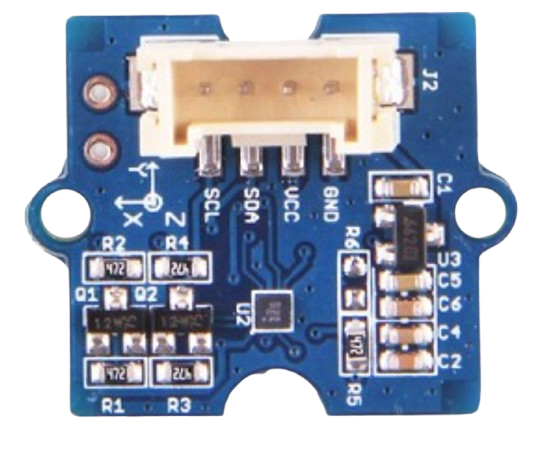
The Grove Digital Compass is an electronic device designed to determine the direction of magnetic north using built-in magnetic field sensors. It provides heading information in degrees, making it an essential component for navigation systems, robotics, and orientation-based applications. The compact design and ease of integration make it suitable for use in smartphones, outdoor equipment, and Arduino-based projects.
Explore Projects Built with Digital Compass
 Open Project in Cirkit Designer
 Open Project in Cirkit Designer
 Open Project in Cirkit Designer
 Open Project in Cirkit Designer
Explore Projects Built with Digital Compass
Open Project in Cirkit DesignerOpen Project in Cirkit DesignerOpen Project in Cirkit DesignerOpen Project in Cirkit DesignerCommon Applications and Use Cases
- Navigation systems for vehicles and drones
- Robotics for orientation and pathfinding
- Wearable devices and outdoor equipment
- Educational projects and prototyping
- Smartphone and tablet orientation sensing
Technical Specifications
The following table outlines the key technical details of the Grove Digital Compass:
| Parameter | Value |
|---|---|
| Operating Voltage | 3.3V to 5V |
| Operating Current | < 10mA |
| Communication Protocol | I2C |
| Measurement Range | 0° to 360° |
| Accuracy | ±1° to ±2° |
| Dimensions | 20mm x 20mm |
| Operating Temperature | -40°C to 85°C |
Pin Configuration and Descriptions
The Grove Digital Compass uses a standard Grove 4-pin interface. The pin configuration is as follows:
| Pin | Name | Description |
|---|---|---|
| 1 | VCC | Power supply pin (3.3V to 5V) |
| 2 | GND | Ground pin |
| 3 | SDA | I2C data line for communication |
| 4 | SCL | I2C clock line for communication |
Usage Instructions
How to Use the Component in a Circuit
Connect the Grove Digital Compass to a Microcontroller:
- Use a Grove Base Shield or directly connect the pins to the microcontroller.
- Ensure the VCC and GND pins are connected to the appropriate power supply and ground.
- Connect the SDA and SCL pins to the corresponding I2C pins on the microcontroller.
Install Required Libraries:
- For Arduino, install the
Wirelibrary (pre-installed in most Arduino IDE setups). - If using a specific Grove library, download and install it from the official Grove documentation or GitHub repository.
- For Arduino, install the
Write and Upload Code:
- Use the provided example code below to read heading data from the compass.
Example Code for Arduino UNO
#include <Wire.h> // Include the Wire library for I2C communication

#define COMPASS_ADDRESS 0x1E // Default I2C address for the Grove Digital Compass

void setup() {
  Serial.begin(9600); // Initialize serial communication at 9600 baud
  Wire.begin();       // Initialize I2C communication
  initializeCompass(); // Call function to configure the compass
}

void loop() {
  int heading = readHeading(); // Read the heading from the compass
  Serial.print("Heading: ");
  Serial.print(heading);
  Serial.println("°"); // Print the heading in degrees
  delay(500); // Wait for 500ms before the next reading
}

void initializeCompass() {
  Wire.beginTransmission(COMPASS_ADDRESS); // Start communication with the compass
  Wire.write(0x00); // Select configuration register A
  Wire.write(0x70); // Set measurement mode to normal
  Wire.endTransmission();

  Wire.beginTransmission(COMPASS_ADDRESS);
  Wire.write(0x01); // Select configuration register B
  Wire.write(0xA0); // Set gain
  Wire.endTransmission();

  Wire.beginTransmission(COMPASS_ADDRESS);
  Wire.write(0x02); // Select mode register
  Wire.write(0x00); // Set continuous measurement mode
  Wire.endTransmission();
}

int readHeading() {
  Wire.beginTransmission(COMPASS_ADDRESS);
  Wire.write(0x03); // Select data output register
  Wire.endTransmission();

  Wire.requestFrom(COMPASS_ADDRESS, 6); // Request 6 bytes of data
  if (Wire.available() == 6) {
    int x = Wire.read() << 8 | Wire.read(); // Read X-axis data
    int z = Wire.read() << 8 | Wire.read(); // Read Z-axis data
    int y = Wire.read() << 8 | Wire.read(); // Read Y-axis data

    // Calculate heading in degrees
    float heading = atan2((float)y, (float)x) * 180 / PI;
    if (heading < 0) heading += 360; // Ensure heading is positive
    return (int)heading;
  }
  return -1; // Return -1 if data is not available
}
Important Considerations and Best Practices
- Avoid Magnetic Interference: Keep the compass away from strong magnetic fields or ferromagnetic materials, as they can distort readings.
- Calibrate the Compass: Perform a calibration routine to improve accuracy, especially in environments with magnetic interference.
- Power Supply Stability: Ensure a stable power supply to avoid fluctuations in readings.
- I2C Address Conflicts: If using multiple I2C devices, ensure they have unique addresses or use an I2C multiplexer.
Troubleshooting and FAQs
Common Issues and Solutions
No Data or Incorrect Readings:
- Ensure the SDA and SCL pins are correctly connected to the microcontroller.
- Verify the I2C address of the compass matches the code (default:
0x1E).
Fluctuating or Inaccurate Readings:
- Check for nearby magnetic interference and move the compass to a different location.
- Perform a calibration routine to improve accuracy.
Device Not Detected:
- Use an I2C scanner sketch to confirm the compass is detected on the I2C bus.
- Ensure the power supply voltage is within the specified range (3.3V to 5V).
FAQs
Q: Can the Grove Digital Compass be used with Raspberry Pi?
A: Yes, the compass can be used with Raspberry Pi via the I2C interface. Use libraries like smbus in Python for communication.
Q: How do I calibrate the compass?
A: Calibration typically involves rotating the compass in all directions to map the magnetic field. Refer to the Grove documentation for specific calibration routines.
Q: What is the maximum range of the compass?
A: The compass provides a full 360° heading range with an accuracy of ±1° to ±2°.
By following this documentation, you can effectively integrate and use the Grove Digital Compass in your projects.