
How to Use PZEM-004T V4 (10A): Examples, Pinouts, and Specs
 Design with PZEM-004T V4 (10A) in Cirkit Designer
Introduction
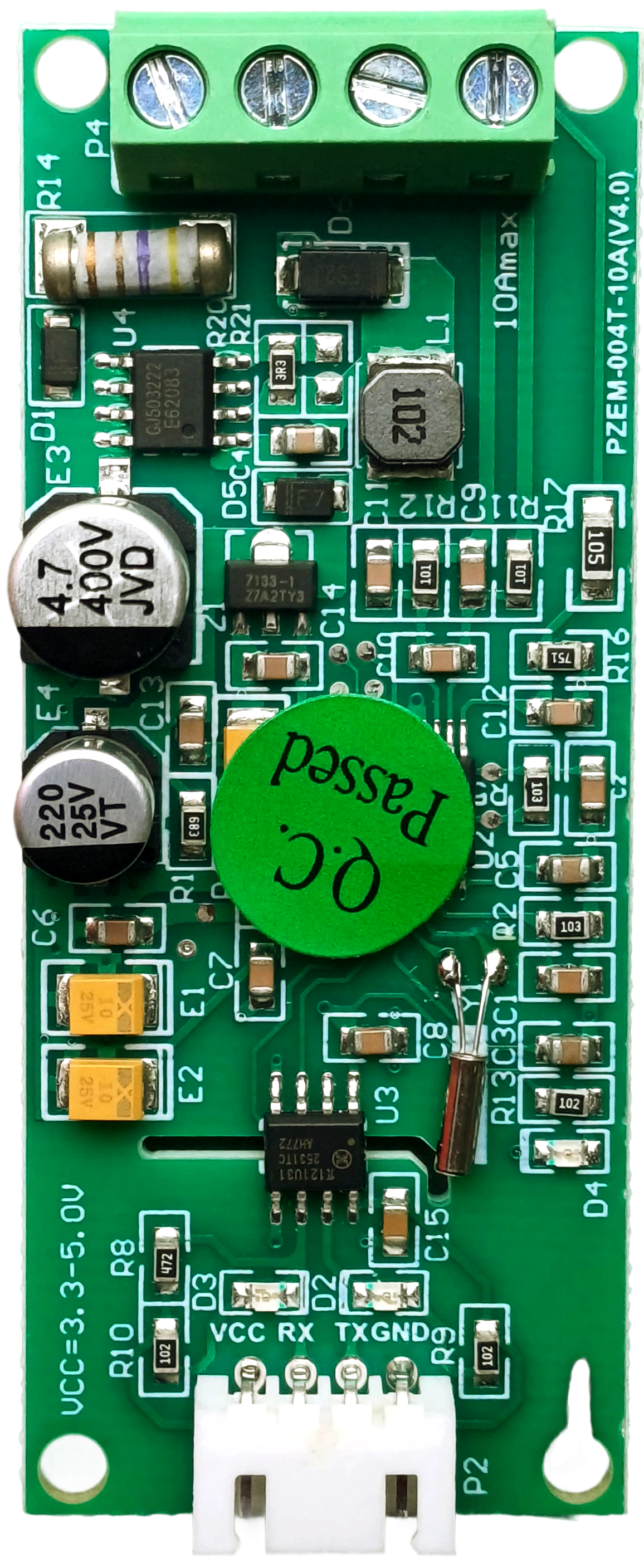
The PZEM-004T V4 (10A), manufactured by Peacefair (Part ID: PZEM-004T-10A), is a multifunctional energy monitoring module designed for AC circuits. It is capable of measuring key electrical parameters such as voltage, current, power, energy, frequency, and power factor. This module is widely used in applications requiring real-time energy monitoring, such as home automation, industrial equipment monitoring, and power management systems.
Explore Projects Built with PZEM-004T V4 (10A)
 Open Project in Cirkit Designer
 Open Project in Cirkit Designer
 Open Project in Cirkit Designer
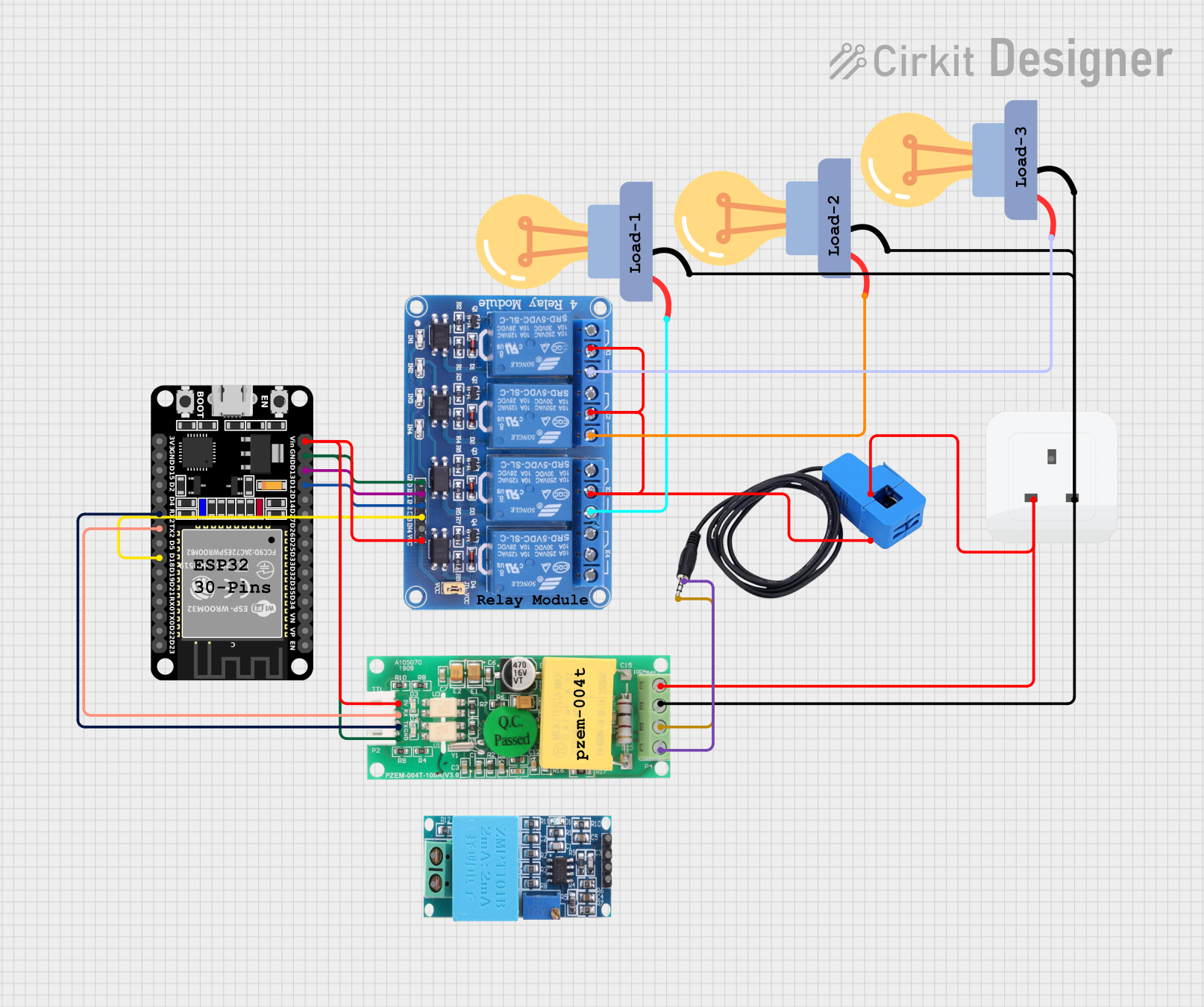 Open Project in Cirkit Designer
Explore Projects Built with PZEM-004T V4 (10A)
Open Project in Cirkit DesignerOpen Project in Cirkit DesignerOpen Project in Cirkit DesignerOpen Project in Cirkit DesignerCommon Applications
- Home energy monitoring systems
- Industrial equipment power usage tracking
- Renewable energy systems (e.g., solar inverters)
- IoT-based energy management solutions
- Laboratory and educational projects
Technical Specifications
Key Specifications
| Parameter | Value |
|---|---|
| Operating Voltage | 80V - 260V AC |
| Current Measurement | 0A - 10A |
| Power Measurement | 0W - 2.3kW |
| Energy Measurement | 0kWh - 9999kWh |
| Frequency Range | 45Hz - 65Hz |
| Power Factor Range | 0.00 - 1.00 |
| Communication Interface | TTL (3.3V logic level) |
| Baud Rate | 9600 bps |
| Accuracy | ±0.5% |
| Dimensions | 48mm x 23mm x 15mm |
Pin Configuration
The PZEM-004T V4 (10A) module has a 4-pin interface for communication and power. Below is the pin configuration:
| Pin Number | Pin Name | Description |
|---|---|---|
| 1 | VCC | Power supply input (5V DC) |
| 2 | GND | Ground connection |
| 3 | RX | UART Receive pin (connect to TX of microcontroller) |
| 4 | TX | UART Transmit pin (connect to RX of microcontroller) |
Usage Instructions
Connecting the PZEM-004T V4 (10A) to a Circuit
- Power Supply: Connect the
VCCpin to a 5V DC power source and theGNDpin to ground. - AC Input: Connect the AC live and neutral wires to the module's input terminals. Ensure proper insulation and safety precautions when handling AC connections.
- Communication: Use the
RXandTXpins to interface with a microcontroller (e.g., Arduino UNO) or a UART-to-USB converter for PC communication.
Important Considerations
- Safety First: Always ensure the module is disconnected from the AC mains while wiring.
- Current Limit: Do not exceed the 10A current rating to avoid damage to the module.
- Isolation: Use proper isolation techniques when interfacing with high-voltage AC circuits.
- Baud Rate: Ensure the UART communication is set to 9600 bps for proper data exchange.
Example: Using PZEM-004T V4 (10A) with Arduino UNO
Below is an example Arduino sketch to read data from the PZEM-004T V4 module:
#include <SoftwareSerial.h>

// Define RX and TX pins for SoftwareSerial
#define PZEM_RX 10  // Connect to TX pin of PZEM-004T
#define PZEM_TX 11  // Connect to RX pin of PZEM-004T

SoftwareSerial pzemSerial(PZEM_RX, PZEM_TX);

void setup() {
  Serial.begin(9600);  // Initialize Serial Monitor
  pzemSerial.begin(9600);  // Initialize communication with PZEM-004T

  Serial.println("PZEM-004T V4 Energy Monitor");
}

void loop() {
  // Request data from PZEM-004T
  byte request[] = {0xB0, 0xC0, 0xA8, 0x01, 0x01};  // Example request packet
  pzemSerial.write(request, sizeof(request));

  delay(100);  // Wait for response

  // Read response from PZEM-004T
  while (pzemSerial.available()) {
    byte response = pzemSerial.read();
    Serial.print(response, HEX);  // Print response in HEX format
    Serial.print(" ");
  }
  Serial.println();

  delay(1000);  // Wait 1 second before next request
}
Notes:
- Replace the request packet with the appropriate command based on the PZEM-004T V4 protocol.
- Use a logic level converter if interfacing with a 5V microcontroller, as the PZEM-004T operates at 3.3V logic levels.
Troubleshooting and FAQs
Common Issues
No Data Received:
- Ensure the RX and TX pins are correctly connected (crossed: RX to TX and TX to RX).
- Verify the baud rate is set to 9600 bps.
- Check the power supply to the module (5V DC).
Incorrect Readings:
- Ensure the AC input connections are secure and properly insulated.
- Verify that the current does not exceed the 10A limit.
- Check for electromagnetic interference from nearby devices.
Module Not Powering On:
- Confirm the
VCCpin is receiving 5V DC. - Check for loose or damaged wires.
- Confirm the
FAQs
Q1: Can the PZEM-004T V4 measure DC circuits?
A1: No, the module is designed specifically for AC circuits and cannot measure DC parameters.
Q2: Is it possible to reset the energy counter?
A2: Yes, the energy counter can be reset using a specific UART command as per the module's protocol.
Q3: Can I use the module with a Raspberry Pi?
A3: Yes, the module can be interfaced with a Raspberry Pi using its UART pins. Use a logic level converter to match the 3.3V logic level of the PZEM-004T.
Q4: What is the maximum cable length for UART communication?
A4: For reliable communication, keep the UART cable length under 1 meter. Use shielded cables for longer distances.
By following this documentation, users can effectively integrate the PZEM-004T V4 (10A) module into their projects for accurate energy monitoring and management.