
How to Use 4 Channel Relay Module: Examples, Pinouts, and Specs
 Design with 4 Channel Relay Module in Cirkit Designer
Introduction
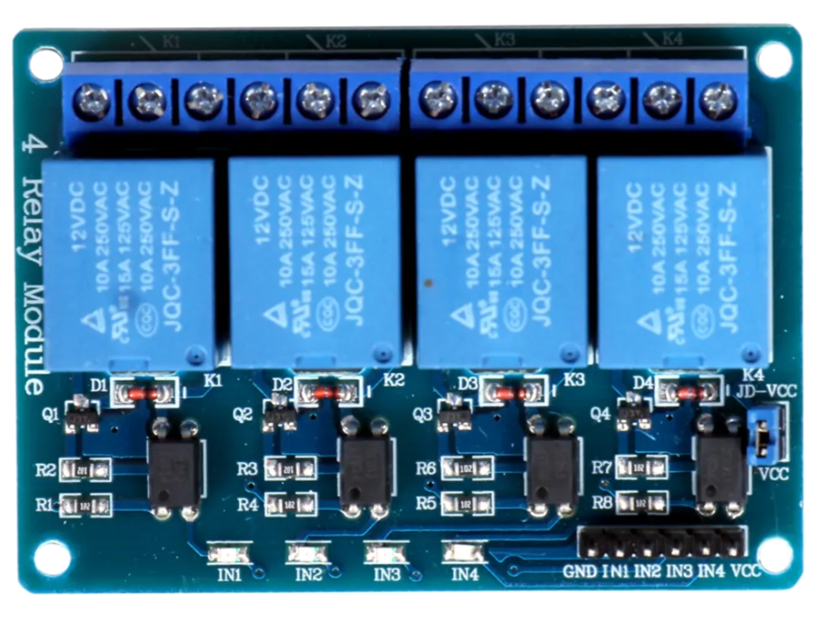
The 4 Channel Relay Module is an electronic component designed to control up to four independent circuits using a single microcontroller or switch. Each relay on the module acts as an electrically operated switch, allowing low-power control signals to manage high-power loads. This module is commonly used in home automation, industrial control systems, and robotics, where it enables the safe and efficient control of high-voltage devices such as lights, fans, and motors.
Key features of the 4 Channel Relay Module include opto-isolation for enhanced safety, compatibility with microcontrollers like Arduino and Raspberry Pi, and the ability to handle both AC and DC loads. Its compact design and ease of use make it a popular choice for hobbyists and professionals alike.
Explore Projects Built with 4 Channel Relay Module
 Open Project in Cirkit Designer
 Open Project in Cirkit Designer
 Open Project in Cirkit Designer
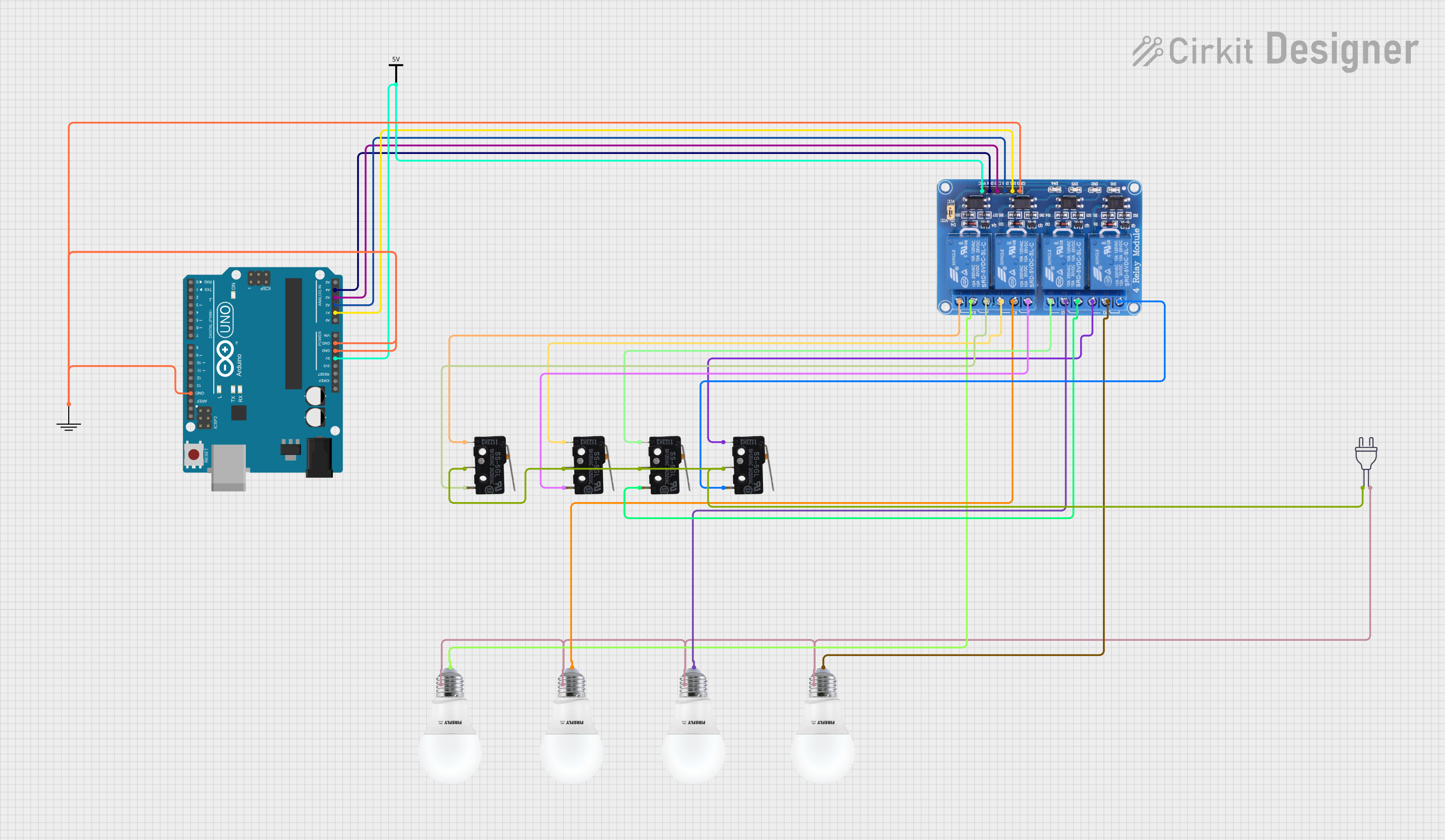 Open Project in Cirkit Designer
Explore Projects Built with 4 Channel Relay Module
Open Project in Cirkit DesignerOpen Project in Cirkit DesignerOpen Project in Cirkit DesignerOpen Project in Cirkit DesignerTechnical Specifications
Key Specifications
- Operating Voltage: 5V DC
- Trigger Voltage: 3.3V to 5V (compatible with most microcontrollers)
- Relay Type: SPDT (Single Pole Double Throw)
- Maximum Load (per channel):
- AC: 250V at 10A
- DC: 30V at 10A
- Opto-Isolation: Yes
- Indicator LEDs: One per channel (indicates relay state)
- Dimensions: ~75mm x 55mm x 20mm
Pin Configuration and Descriptions
Input Pins
| Pin Name | Description |
|---|---|
| VCC | Connect to the 5V power supply of the microcontroller or external source. |
| GND | Ground connection. |
| IN1 | Control signal for Relay 1 (active LOW). |
| IN2 | Control signal for Relay 2 (active LOW). |
| IN3 | Control signal for Relay 3 (active LOW). |
| IN4 | Control signal for Relay 4 (active LOW). |
Output Terminals (Relay Channels)
| Terminal Name | Description |
|---|---|
| COM | Common terminal for the relay. |
| NO | Normally Open terminal. Connect the load here if you want it OFF by default. |
| NC | Normally Closed terminal. Connect the load here if you want it ON by default. |
Usage Instructions
How to Use the 4 Channel Relay Module in a Circuit
Power the Module:
- Connect the VCC pin to a 5V power source and the GND pin to ground.
- Ensure the power supply can provide sufficient current for all active relays (approximately 70mA per relay).
Connect the Control Signals:
- Connect the IN1, IN2, IN3, and IN4 pins to the digital output pins of your microcontroller.
- When the control pin is set to LOW, the corresponding relay will activate.
Connect the Load:
- For each relay, connect the load to the COM and either the NO or NC terminal, depending on whether you want the load to be normally OFF or ON.
Test the Circuit:
- Upload the control code to your microcontroller and verify that the relays activate as expected.
Important Considerations and Best Practices
- Opto-Isolation: Ensure the module's opto-isolation is intact to protect your microcontroller from high-voltage spikes.
- Power Supply: Use a stable 5V power supply to avoid erratic relay behavior.
- Load Ratings: Do not exceed the maximum load ratings of the relays to prevent damage.
- Active LOW Logic: Remember that the relays are triggered by a LOW signal on the input pins.
Example Code for Arduino UNO
/*
  Example code to control a 4 Channel Relay Module with an Arduino UNO.
  This code sequentially activates each relay for 2 seconds.
*/

#define RELAY1 2  // Connect IN1 to digital pin 2
#define RELAY2 3  // Connect IN2 to digital pin 3
#define RELAY3 4  // Connect IN3 to digital pin 4
#define RELAY4 5  // Connect IN4 to digital pin 5

void setup() {
  // Set relay pins as outputs
  pinMode(RELAY1, OUTPUT);
  pinMode(RELAY2, OUTPUT);
  pinMode(RELAY3, OUTPUT);
  pinMode(RELAY4, OUTPUT);

  // Initialize all relays to OFF (HIGH state)
  digitalWrite(RELAY1, HIGH);
  digitalWrite(RELAY2, HIGH);
  digitalWrite(RELAY3, HIGH);
  digitalWrite(RELAY4, HIGH);
}

void loop() {
  // Activate Relay 1
  digitalWrite(RELAY1, LOW);  // Relay ON
  delay(2000);                // Wait 2 seconds
  digitalWrite(RELAY1, HIGH); // Relay OFF

  // Activate Relay 2
  digitalWrite(RELAY2, LOW);  // Relay ON
  delay(2000);                // Wait 2 seconds
  digitalWrite(RELAY2, HIGH); // Relay OFF

  // Activate Relay 3
  digitalWrite(RELAY3, LOW);  // Relay ON
  delay(2000);                // Wait 2 seconds
  digitalWrite(RELAY3, HIGH); // Relay OFF

  // Activate Relay 4
  digitalWrite(RELAY4, LOW);  // Relay ON
  delay(2000);                // Wait 2 seconds
  digitalWrite(RELAY4, HIGH); // Relay OFF
}
Troubleshooting and FAQs
Common Issues
Relays Not Activating:
- Cause: Insufficient power supply or incorrect wiring.
- Solution: Verify the 5V power supply and ensure all connections are secure.
Erratic Relay Behavior:
- Cause: Electrical noise or unstable power supply.
- Solution: Use decoupling capacitors near the module and ensure a stable power source.
Microcontroller Resetting:
- Cause: High inrush current when relays switch.
- Solution: Use a separate power supply for the relay module and microcontroller.
Load Not Switching:
- Cause: Incorrect wiring of the load to the relay terminals.
- Solution: Double-check the connections to the COM, NO, and NC terminals.
FAQs
Q: Can I use the module with a 3.3V microcontroller?
A: Yes, the module is compatible with 3.3V control signals, but ensure the VCC pin is still powered with 5V.Q: Is it safe to control AC loads with this module?
A: Yes, but ensure proper insulation and follow safety guidelines when working with high voltages.Q: Can I control all four relays simultaneously?
A: Yes, as long as your power supply can handle the combined current draw of all active relays.
This concludes the documentation for the 4 Channel Relay Module.