Cirkit Designer Logo
Cirkit Designer
Your all-in-one circuit design IDE
Home / 
Component Documentation

How to Use COSMIC-109: Examples, Pinouts, and Specs
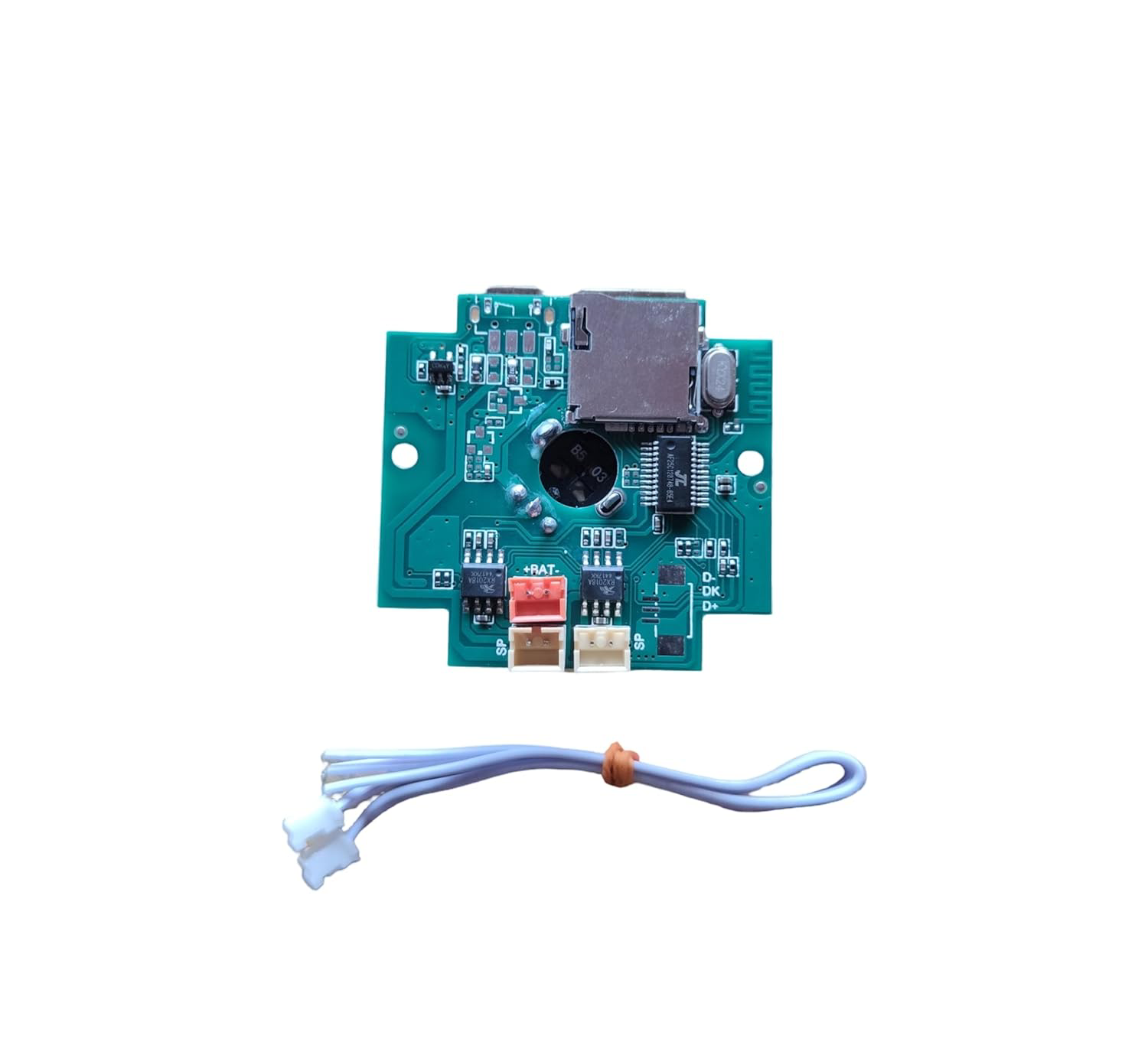

Image of COSMIC-109
Cirkit Designer LogoDesign with COSMIC-109 in Cirkit Designer

Introduction

The COSMIC-109 is a specialized integrated circuit (IC) designed for high-performance applications in advanced communication systems and signal processing. With its low power consumption and high-speed operation, the COSMIC-109 is ideal for modern electronic devices requiring efficient and reliable performance. Its robust design ensures compatibility with a wide range of systems, making it a versatile choice for engineers and developers.

Explore Projects Built with COSMIC-109
Use Cirkit Designer to design, explore, and prototype these projects online. Some projects support real-time simulation. Click "Open Project" to start designing instantly!
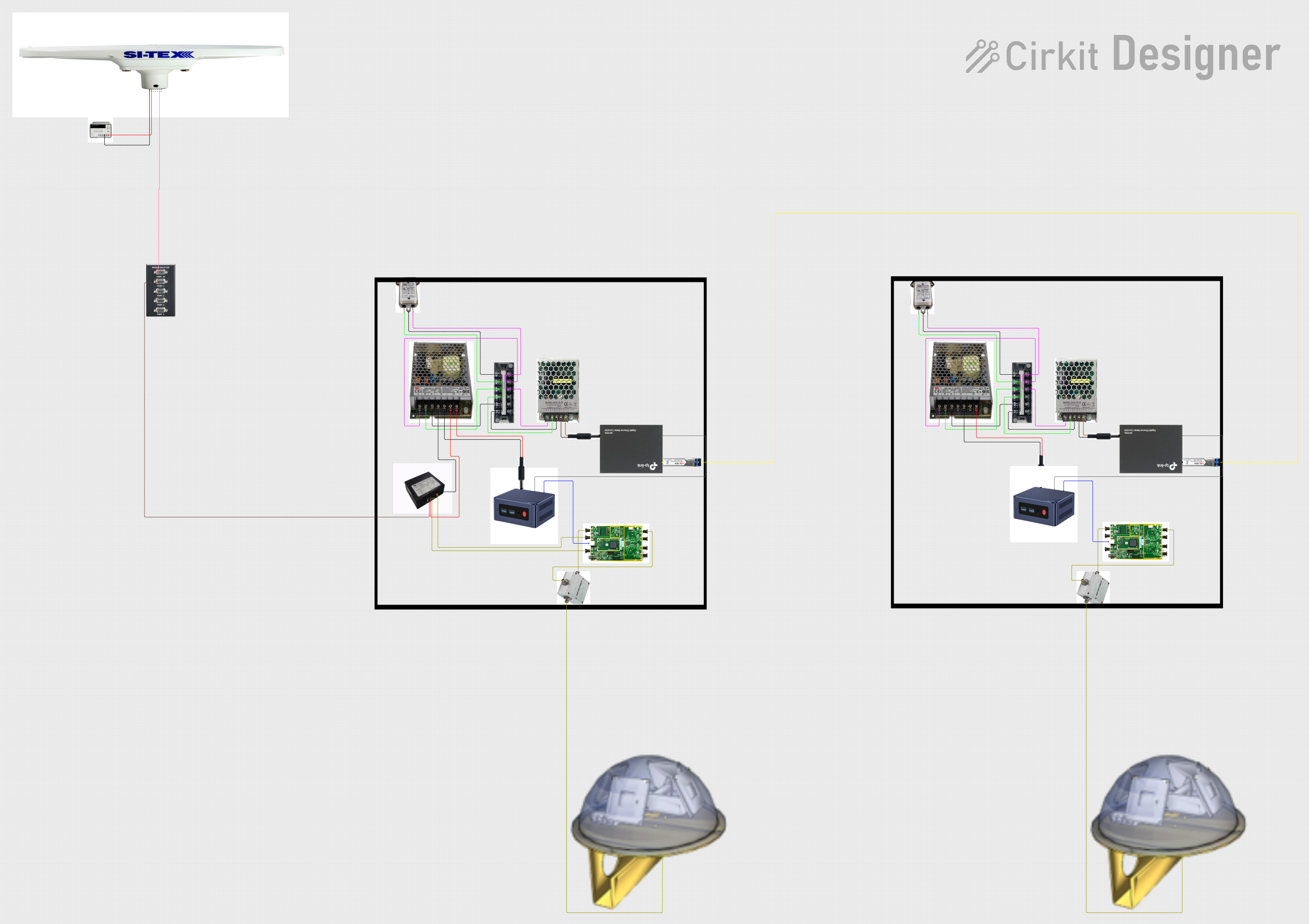
Satellite-Based Timing and Navigation System with SDR and Atomic Clock Synchronization
Image of GPS 시스템 측정 구성도_Confirm: A project utilizing COSMIC-109 in a practical application
This circuit appears to be a complex system involving power supply management, GPS and timing synchronization, and data communication. It includes a SI-TEX G1 Satellite Compass for GPS data, an XHTF1021 Atomic Rubidium Clock for precise timing, and Ettus USRP B200 units for software-defined radio communication. Power is supplied through various SMPS units and distributed via terminal blocks and DC jacks. Data communication is facilitated by Beelink MINI S12 N95 computers, RS232 splitters, and a 1000BASE-T Media Converter for network connectivity. RF Directional Couplers are used to interface antennas with the USRP units, and the entire system is likely contained within cases for protection and organization.
Cirkit Designer LogoOpen Project in Cirkit Designer
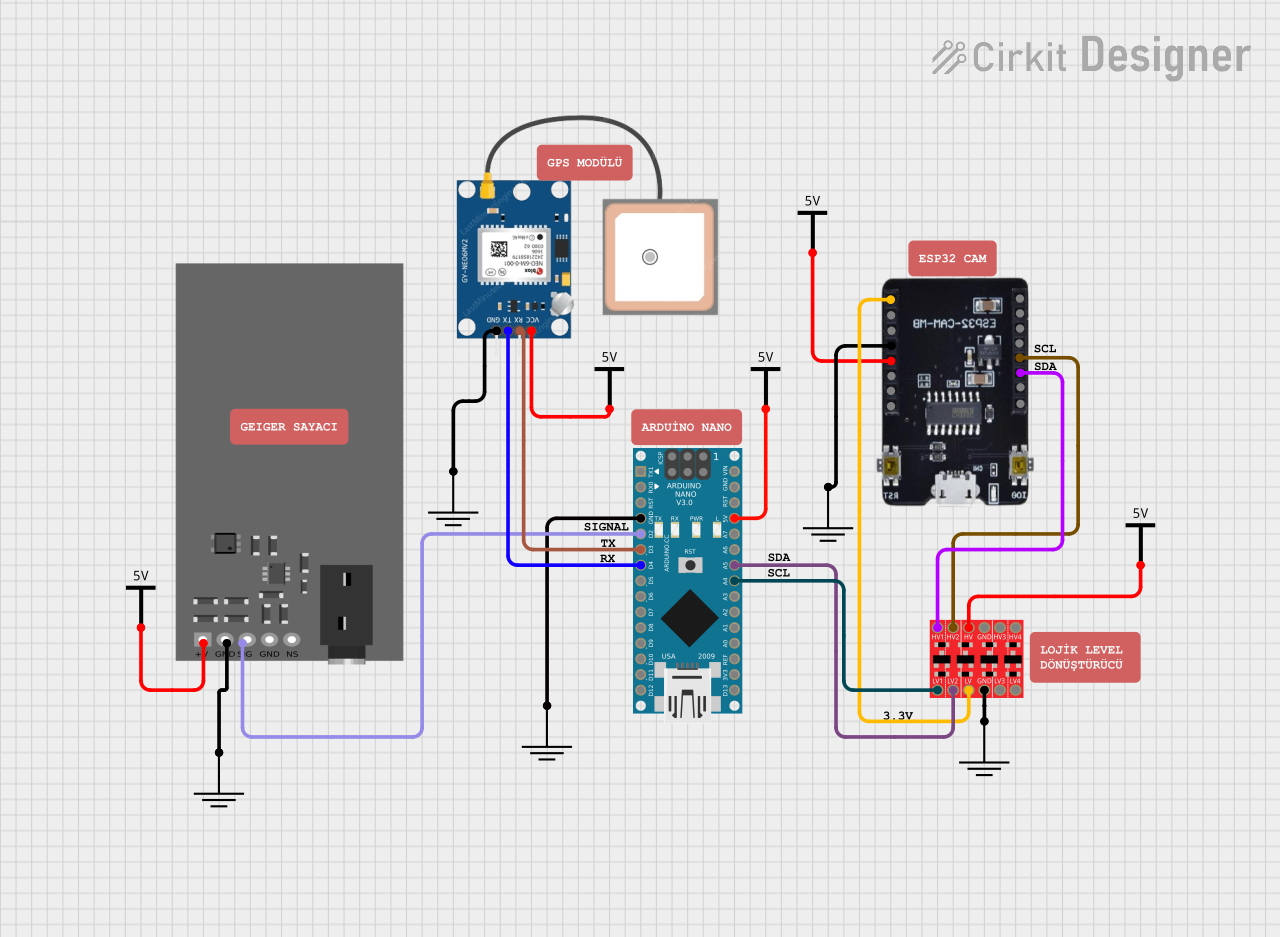
ESP32-CAM and Arduino Nano Radiation Detection System with GPS and Wi-Fi Connectivity
Image of esp32camGps: A project utilizing COSMIC-109 in a practical application
This circuit is a radiation detection and monitoring system that uses an ESP32-CAM for capturing images and streaming video, an Arduino Nano for processing data from a GPS module and a Geiger counter, and a bi-directional logic level converter for interfacing between different voltage levels. The ESP32-CAM also serves as a web server to display the radiation levels and GPS coordinates in real-time.
Cirkit Designer LogoOpen Project in Cirkit Designer
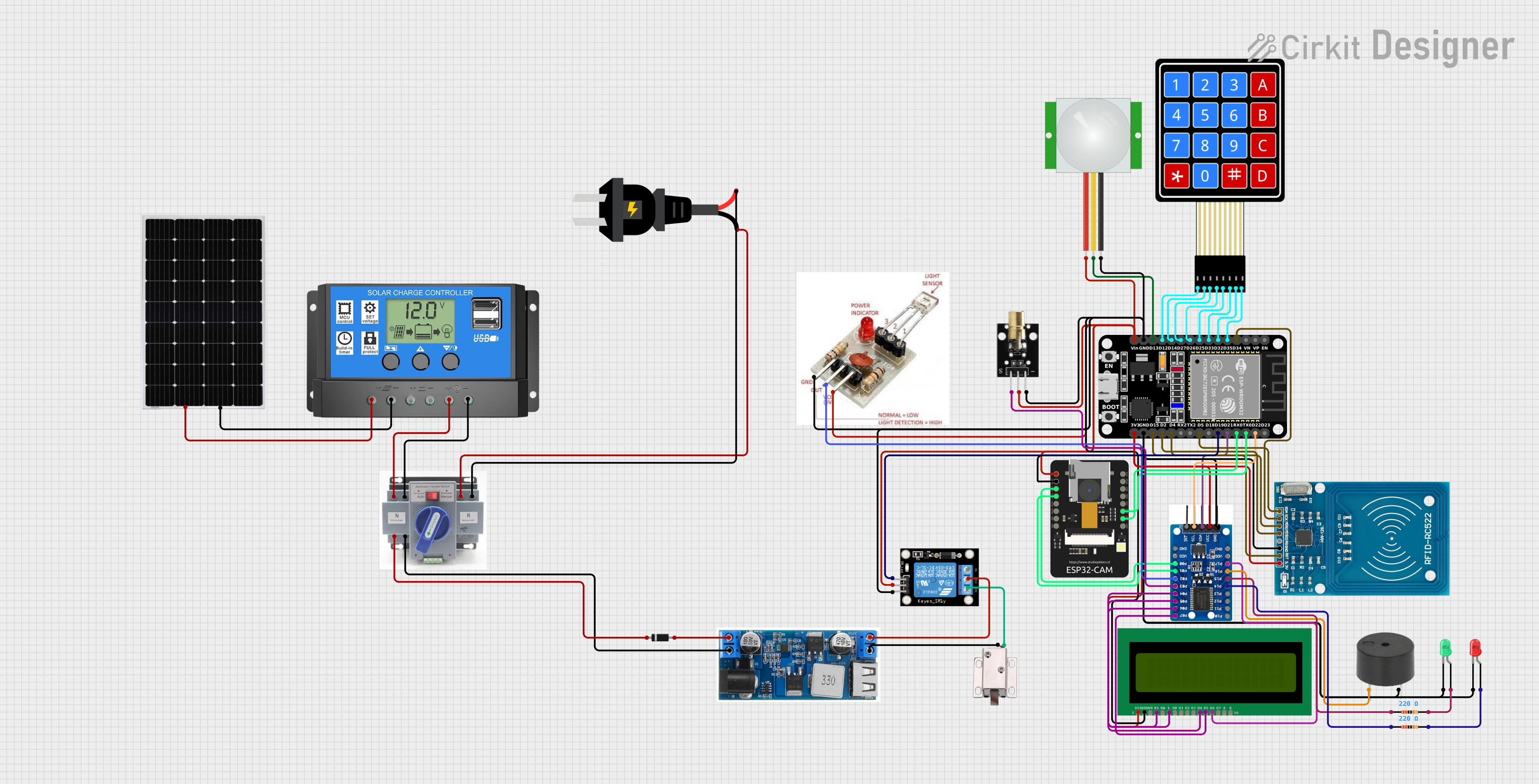
Solar-Powered ESP32 Security System with RFID and Laser Detection
Image of CPE doorlock: A project utilizing COSMIC-109 in a practical application
This circuit appears to be a complex system with multiple sensors and actuators controlled by an ESP32 microcontroller. It includes a laser emitter and receiver for detection purposes, a PIR sensor for motion detection, an RFID reader for identification tasks, and a keypad for user input. The system also features a relay-controlled solenoid lock, visual indicators (LEDs), a buzzer for audio feedback, and an LCD for display, all interfaced through an IO expander. Power management is handled by a solar panel with a charge controller, an AC source with an automatic transfer switch (ATS), and a voltage regulator (buck converter).
Cirkit Designer LogoOpen Project in Cirkit Designer
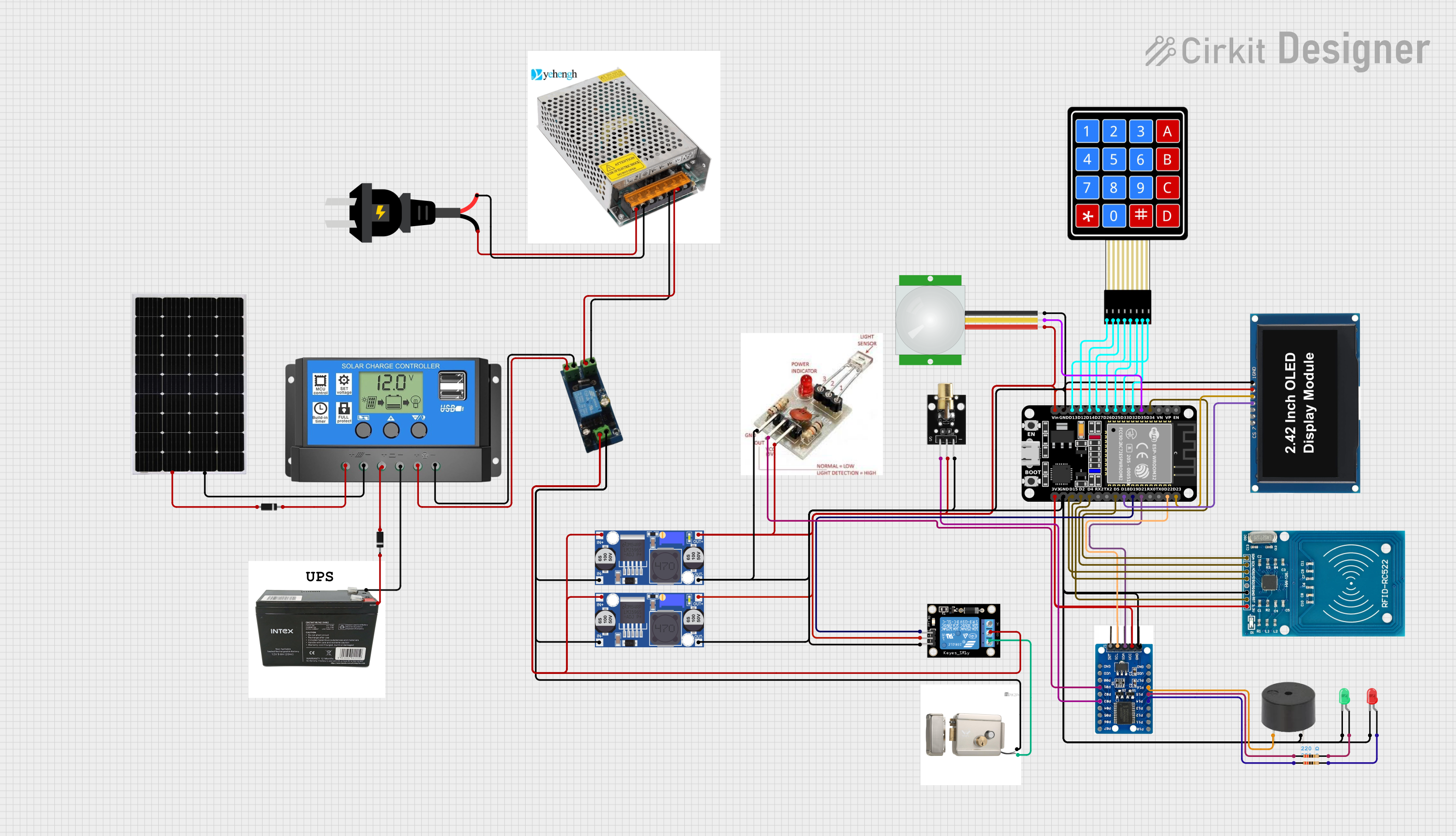
ESP32-Based Security System with RFID and Laser Intrusion Detection
Image of CPE doorlock system upgrade: A project utilizing COSMIC-109 in a practical application
This circuit is a security and access control system featuring motion detection, laser beam-break sensing, and RFID scanning, interfaced with a keypad and visual/audible indicators, powered by a solar-charged battery, and capable of controlling an electric lock via a relay.
Cirkit Designer LogoOpen Project in Cirkit Designer

Explore Projects Built with COSMIC-109

Use Cirkit Designer to design, explore, and prototype these projects online. Some projects support real-time simulation. Click "Open Project" to start designing instantly!
Image of GPS 시스템 측정 구성도_Confirm: A project utilizing COSMIC-109 in a practical application
Satellite-Based Timing and Navigation System with SDR and Atomic Clock Synchronization
This circuit appears to be a complex system involving power supply management, GPS and timing synchronization, and data communication. It includes a SI-TEX G1 Satellite Compass for GPS data, an XHTF1021 Atomic Rubidium Clock for precise timing, and Ettus USRP B200 units for software-defined radio communication. Power is supplied through various SMPS units and distributed via terminal blocks and DC jacks. Data communication is facilitated by Beelink MINI S12 N95 computers, RS232 splitters, and a 1000BASE-T Media Converter for network connectivity. RF Directional Couplers are used to interface antennas with the USRP units, and the entire system is likely contained within cases for protection and organization.
Cirkit Designer LogoOpen Project in Cirkit Designer
Image of esp32camGps: A project utilizing COSMIC-109 in a practical application
ESP32-CAM and Arduino Nano Radiation Detection System with GPS and Wi-Fi Connectivity
This circuit is a radiation detection and monitoring system that uses an ESP32-CAM for capturing images and streaming video, an Arduino Nano for processing data from a GPS module and a Geiger counter, and a bi-directional logic level converter for interfacing between different voltage levels. The ESP32-CAM also serves as a web server to display the radiation levels and GPS coordinates in real-time.
Cirkit Designer LogoOpen Project in Cirkit Designer
Image of CPE doorlock: A project utilizing COSMIC-109 in a practical application
Solar-Powered ESP32 Security System with RFID and Laser Detection
This circuit appears to be a complex system with multiple sensors and actuators controlled by an ESP32 microcontroller. It includes a laser emitter and receiver for detection purposes, a PIR sensor for motion detection, an RFID reader for identification tasks, and a keypad for user input. The system also features a relay-controlled solenoid lock, visual indicators (LEDs), a buzzer for audio feedback, and an LCD for display, all interfaced through an IO expander. Power management is handled by a solar panel with a charge controller, an AC source with an automatic transfer switch (ATS), and a voltage regulator (buck converter).
Cirkit Designer LogoOpen Project in Cirkit Designer
Image of CPE doorlock system upgrade: A project utilizing COSMIC-109 in a practical application
ESP32-Based Security System with RFID and Laser Intrusion Detection
This circuit is a security and access control system featuring motion detection, laser beam-break sensing, and RFID scanning, interfaced with a keypad and visual/audible indicators, powered by a solar-charged battery, and capable of controlling an electric lock via a relay.
Cirkit Designer LogoOpen Project in Cirkit Designer

Common Applications and Use Cases

  • High-speed data communication systems
  • Signal processing in telecommunications
  • Embedded systems requiring low power and high efficiency
  • Advanced IoT devices and smart electronics
  • Digital signal modulation and demodulation

Technical Specifications

Key Technical Details

Parameter Value
Supply Voltage (Vcc) 3.3V to 5V
Operating Current 10 mA (typical)
Maximum Clock Speed 50 MHz
Power Consumption < 50 mW
Operating Temperature -40°C to +85°C
Package Type 16-pin SOIC
Communication Protocols SPI, I2C

Pin Configuration and Descriptions

Pin Number Pin Name Description
1 VCC Power supply input (3.3V to 5V).
2 GND Ground connection.
3 CLK Clock input for synchronization.
4 DATA_IN Data input pin for signal processing.
5 DATA_OUT Data output pin for processed signals.
6 CS Chip Select for SPI communication.
7 SDA Serial Data Line for I2C communication.
8 SCL Serial Clock Line for I2C communication.
9 RESET Reset pin to initialize the IC.
10 INT Interrupt output for signaling events.
11-16 NC Not connected (reserved for future use).

Usage Instructions

How to Use the COSMIC-109 in a Circuit

  1. Power Supply: Connect the VCC pin to a stable 3.3V or 5V power source and the GND pin to the ground of your circuit.
  2. Clock Input: Provide a clock signal (up to 50 MHz) to the CLK pin for synchronization.
  3. Data Communication:
    • For SPI: Use the CS, DATA_IN, and DATA_OUT pins for communication.
    • For I2C: Connect the SDA and SCL pins to the respective lines of your I2C bus.
  4. Reset: Use the RESET pin to initialize the IC during startup or after a fault.
  5. Interrupt Handling: Monitor the INT pin for event signaling, if required.

Important Considerations and Best Practices

  • Ensure the supply voltage does not exceed the specified range (3.3V to 5V) to avoid damage.
  • Use decoupling capacitors (e.g., 0.1 µF) near the VCC pin to stabilize the power supply.
  • Keep the clock and data lines as short as possible to minimize noise and signal degradation.
  • If unused, leave the NC pins unconnected to avoid interference.
  • For I2C communication, ensure pull-up resistors (typically 4.7 kΩ) are connected to the SDA and SCL lines.

Example: Connecting COSMIC-109 to an Arduino UNO

Below is an example of interfacing the COSMIC-109 with an Arduino UNO using SPI communication:

#include <SPI.h>

// Define COSMIC-109 pin connections
const int CS_PIN = 10;  // Chip Select pin connected to Arduino pin 10

void setup() {
  // Initialize SPI communication
  SPI.begin();
  
  // Set the Chip Select pin as output
  pinMode(CS_PIN, OUTPUT);
  
  // Set the Chip Select pin to HIGH (inactive state)
  digitalWrite(CS_PIN, HIGH);
  
  Serial.begin(9600);  // Initialize serial communication for debugging
  Serial.println("COSMIC-109 Initialization Complete");
}

void loop() {
  // Example: Sending data to COSMIC-109
  digitalWrite(CS_PIN, LOW);  // Activate the COSMIC-109
  SPI.transfer(0x55);         // Send a sample byte (0x55)
  digitalWrite(CS_PIN, HIGH); // Deactivate the COSMIC-109
  
  delay(1000);  // Wait for 1 second before sending the next byte
}

Troubleshooting and FAQs

Common Issues and Solutions

  1. No Output Signal:

    • Verify the power supply voltage and ensure it is within the specified range.
    • Check the clock signal on the CLK pin for proper synchronization.
    • Ensure the Chip Select (CS) pin is correctly toggled during communication.
  2. Data Corruption:

    • Inspect the data and clock lines for noise or interference.
    • Use shorter wires and proper shielding to reduce signal degradation.
    • Verify the SPI or I2C configuration settings (e.g., clock speed, mode).
  3. Device Not Responding:

    • Confirm the RESET pin is properly initialized during startup.
    • Check for loose or incorrect connections in the circuit.
    • Ensure the INT pin is monitored if the IC requires event acknowledgment.

FAQs

Q1: Can the COSMIC-109 operate at 3.3V?
A1: Yes, the COSMIC-109 is designed to operate within a supply voltage range of 3.3V to 5V.

Q2: What is the maximum clock speed supported by the COSMIC-109?
A2: The COSMIC-109 supports a maximum clock speed of 50 MHz.

Q3: Are the NC pins required to be connected?
A3: No, the NC (Not Connected) pins should be left unconnected as they are reserved for future use.

Q4: Does the COSMIC-109 support both SPI and I2C simultaneously?
A4: No, the COSMIC-109 can operate in either SPI or I2C mode, but not both at the same time. Select the appropriate mode based on your application.

Q5: What is the typical power consumption of the COSMIC-109?
A5: The typical power consumption of the COSMIC-109 is less than 50 mW.