
How to Use LoRA E22 900T30D: Examples, Pinouts, and Specs
 Design with LoRA E22 900T30D in Cirkit Designer
Introduction
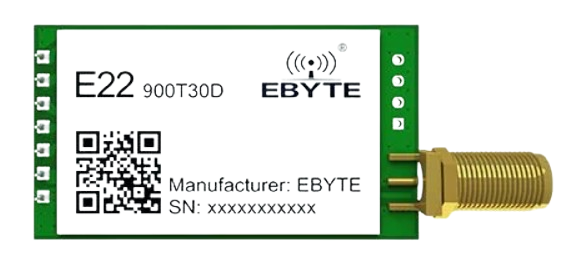
The LoRa E22 900T30D is a high-performance, long-range wireless communication module manufactured by Ebyte. It operates in the 900 MHz frequency band and is designed for low-power Internet of Things (IoT) applications. With a communication range of up to 30 kilometers (in ideal conditions) and support for various data rates, this module is ideal for applications requiring reliable, long-distance data transmission.
Explore Projects Built with LoRA E22 900T30D
 Open Project in Cirkit Designer
 Open Project in Cirkit Designer
 Open Project in Cirkit Designer
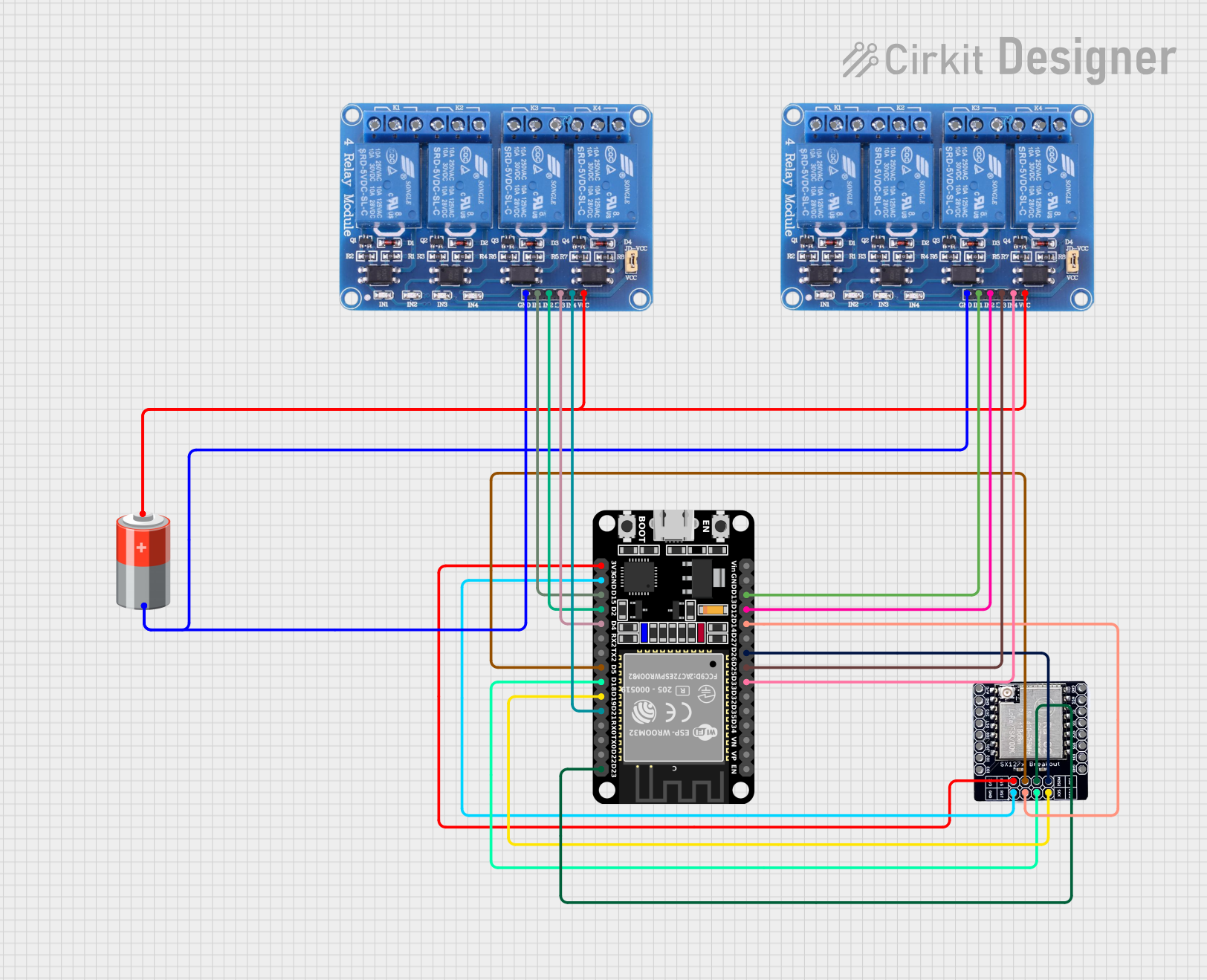 Open Project in Cirkit Designer
Explore Projects Built with LoRA E22 900T30D
Open Project in Cirkit DesignerOpen Project in Cirkit DesignerOpen Project in Cirkit DesignerOpen Project in Cirkit DesignerCommon Applications and Use Cases
- Smart agriculture (e.g., soil moisture monitoring, weather stations)
- Industrial automation and control systems
- Smart cities (e.g., parking sensors, streetlight control)
- Environmental monitoring (e.g., air quality sensors)
- Remote telemetry and data logging
- Wireless sensor networks
Technical Specifications
The following table outlines the key technical details of the LoRa E22 900T30D module:
| Parameter | Specification |
|---|---|
| Frequency Band | 900 MHz |
| Communication Range | Up to 30 km (line of sight) |
| Transmit Power | 30 dBm (1 W) |
| Sensitivity | -139 dBm |
| Data Rate | 0.3 kbps to 19.2 kbps |
| Operating Voltage | 3.3 V to 5.5 V |
| Current Consumption | 100 mA (transmit), 16 mA (receive) |
| Operating Temperature | -40°C to +85°C |
| Modulation Technique | LoRa (Long Range) |
| Interface | UART (TTL) |
| Dimensions | 24 mm × 43 mm × 3 mm |
Pin Configuration and Descriptions
The LoRa E22 900T30D module has 8 pins, as described in the table below:
| Pin Number | Pin Name | Description |
|---|---|---|
| 1 | M0 | Mode selection pin (connect to HIGH/LOW for different modes) |
| 2 | M1 | Mode selection pin (connect to HIGH/LOW for different modes) |
| 3 | RXD | UART receive pin (connect to TX of the microcontroller) |
| 4 | TXD | UART transmit pin (connect to RX of the microcontroller) |
| 5 | AUX | Auxiliary pin (indicates module status, e.g., busy or idle) |
| 6 | VCC | Power supply pin (3.3 V to 5.5 V) |
| 7 | GND | Ground pin |
| 8 | ANT | Antenna interface (connect to an external antenna for optimal performance) |
Usage Instructions
How to Use the Component in a Circuit
- Power Supply: Connect the VCC pin to a regulated power source (3.3 V to 5.5 V) and the GND pin to ground.
- UART Communication: Connect the RXD and TXD pins to the corresponding TX and RX pins of your microcontroller (e.g., Arduino UNO).
- Mode Selection: Use the M0 and M1 pins to configure the module's operating mode:
- Mode 0 (Normal): M0 = LOW, M1 = LOW
- Mode 1 (Wake-up): M0 = HIGH, M1 = LOW
- Mode 2 (Power-saving): M0 = LOW, M1 = HIGH
- Mode 3 (Configuration): M0 = HIGH, M1 = HIGH
- Antenna Connection: Attach an external antenna to the ANT pin for optimal signal strength and range.
- Status Monitoring: Use the AUX pin to monitor the module's status (e.g., busy or idle).
Important Considerations and Best Practices
- Use a high-quality, properly tuned antenna to achieve the maximum communication range.
- Ensure that the power supply is stable and within the specified voltage range to avoid damage to the module.
- Avoid placing the module near sources of electromagnetic interference (EMI) to maintain signal integrity.
- Configure the module's parameters (e.g., frequency, data rate) using AT commands in Configuration Mode (Mode 3).
Example: Connecting to an Arduino UNO
Below is an example of how to connect the LoRa E22 900T30D module to an Arduino UNO and send data:
Wiring Diagram
| LoRa E22 Pin | Arduino UNO Pin |
|---|---|
| VCC | 5V |
| GND | GND |
| RXD | D3 (via voltage divider if using 5V logic) |
| TXD | D2 |
| M0 | GND |
| M1 | GND |
| AUX | Not connected |
| ANT | External antenna |
Arduino Code
#include <SoftwareSerial.h>

// Define software serial pins for communication with LoRa module
SoftwareSerial LoRaSerial(2, 3); // RX = 2, TX = 3

void setup() {
  // Initialize serial communication
  Serial.begin(9600); // For debugging via Serial Monitor
  LoRaSerial.begin(9600); // Communication with LoRa module

  Serial.println("LoRa E22 900T30D Test");
  delay(1000);
}

void loop() {
  // Send data to LoRa module
  LoRaSerial.println("Hello, LoRa!");
  Serial.println("Data sent: Hello, LoRa!");

  // Wait for 1 second before sending the next message
  delay(1000);
}
Troubleshooting and FAQs
Common Issues and Solutions
No Communication Between Devices
- Ensure that the RXD and TXD pins are correctly connected to the microcontroller.
- Verify that the baud rate of the module matches the microcontroller's UART settings.
Poor Signal Strength or Range
- Check the antenna connection and ensure it is properly tuned for the 900 MHz frequency band.
- Avoid physical obstructions and sources of interference between the transmitter and receiver.
Module Not Responding to AT Commands
- Ensure the module is in Configuration Mode (M0 = HIGH, M1 = HIGH).
- Double-check the wiring and power supply connections.
High Power Consumption
- Use Power-saving Mode (M0 = LOW, M1 = HIGH) to reduce power consumption during idle periods.
FAQs
Q: Can the LoRa E22 900T30D module communicate with other LoRa modules?
A: Yes, as long as the frequency, data rate, and other communication parameters are configured to match.
Q: What is the maximum data rate supported by the module?
A: The module supports data rates up to 19.2 kbps.
Q: Can I use the module with a 5V microcontroller?
A: Yes, the module supports a 3.3 V to 5.5 V power supply. However, use a voltage divider or level shifter for the RXD pin if the microcontroller operates at 5V logic levels.
Q: How can I increase the communication range?
A: Use a high-gain antenna, ensure a clear line of sight, and reduce the data rate to improve range.