
How to Use MOC3043: Examples, Pinouts, and Specs
 Design with MOC3043 in Cirkit Designer
Introduction
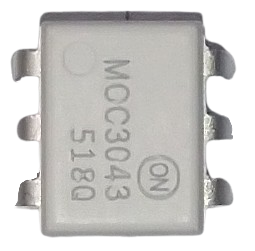
The MOC3043, manufactured by Onsemi (Part ID: 518Q), is an optoisolator designed to provide electrical isolation between its input and output. It features a phototransistor output and is optimized for high-speed switching and noise immunity. This component is commonly used in applications requiring safe interfacing between high-voltage and low-voltage circuits, such as motor control, industrial automation, and AC load switching.
Explore Projects Built with MOC3043
 Open Project in Cirkit Designer
 Open Project in Cirkit Designer
 Open Project in Cirkit Designer
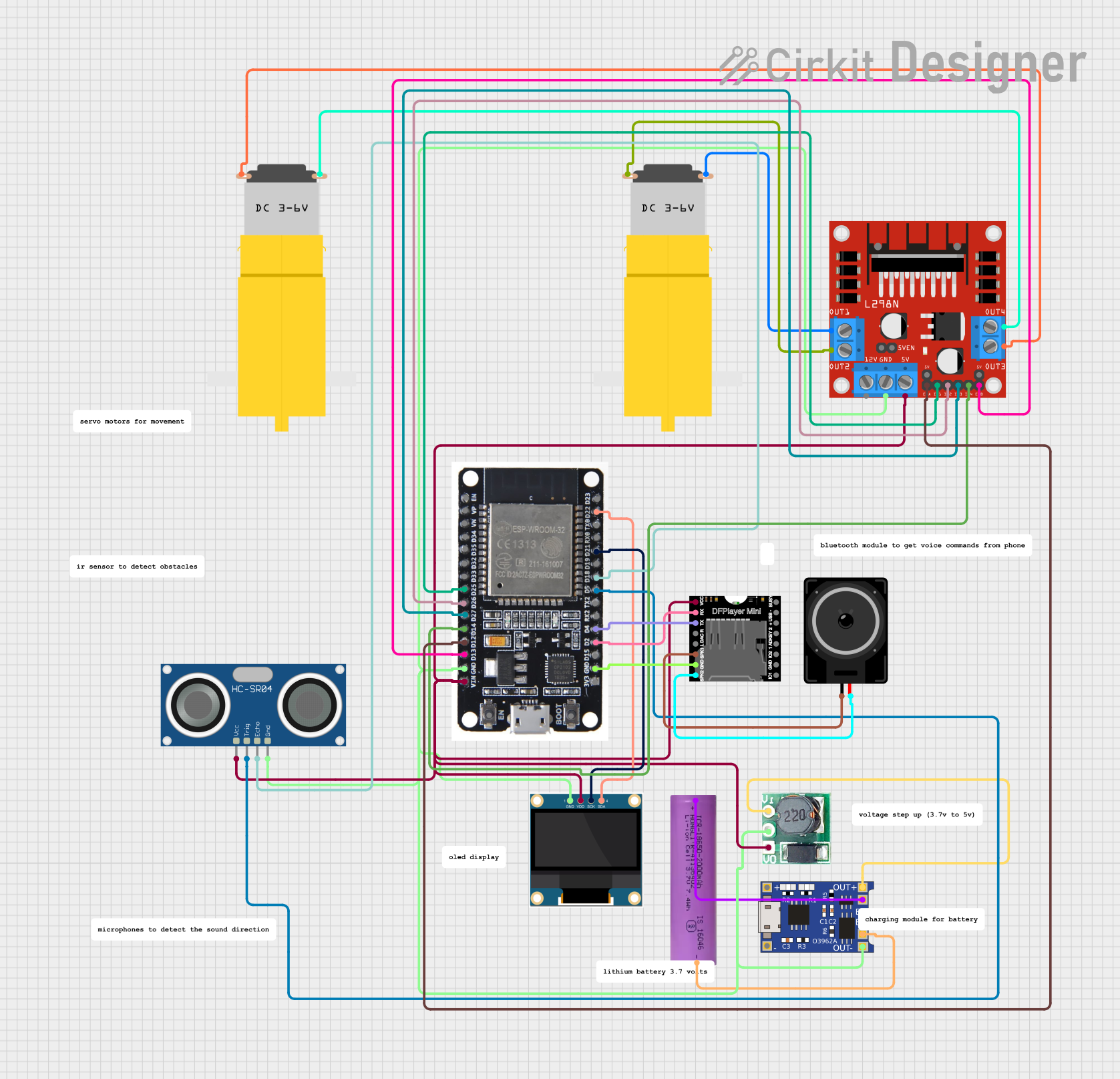 Open Project in Cirkit Designer
Explore Projects Built with MOC3043
Open Project in Cirkit DesignerOpen Project in Cirkit DesignerOpen Project in Cirkit DesignerOpen Project in Cirkit DesignerCommon Applications:
- AC load control (e.g., driving TRIACs for dimmers or motor speed control)
- Electrical isolation in industrial systems
- Noise suppression in sensitive circuits
- Microcontroller-to-AC interface
Technical Specifications
Key Technical Details:
| Parameter | Value |
|---|---|
| Input Forward Voltage (VF) | 1.15V (typical), 1.5V (max) |
| Input Forward Current (IF) | 10mA (typical), 60mA (max) |
| Output Voltage (VO) | 400V (max) |
| Isolation Voltage | 7500Vrms |
| Trigger LED Current (IFT) | 5mA (max) |
| Operating Temperature Range | -40°C to +100°C |
| Package Type | 6-pin DIP |
Pin Configuration and Descriptions:
The MOC3043 is housed in a 6-pin DIP package. Below is the pinout and description:
| Pin Number | Name | Description |
|---|---|---|
| 1 | Anode | Positive terminal of the input LED. |
| 2 | Cathode | Negative terminal of the input LED. |
| 3 | NC (No Connect) | Not connected internally. Leave unconnected in the circuit. |
| 4 | Main Terminal 1 (MT1) | First terminal of the internal TRIAC driver. |
| 5 | Main Terminal 2 (MT2) | Second terminal of the internal TRIAC driver. |
| 6 | Gate | Gate terminal of the internal TRIAC driver. |
Usage Instructions
How to Use the MOC3043 in a Circuit:
Input Side (LED):
- Connect a current-limiting resistor in series with the LED (pins 1 and 2) to limit the forward current to a safe value (typically 10mA).
- The resistor value can be calculated using Ohm's Law:
R = (VCC - VF) / IF
For example, if VCC = 5V, VF = 1.15V, and IF = 10mA:R = (5V - 1.15V) / 0.01A = 385Ω(use a standard 390Ω resistor).
Output Side (TRIAC Driver):
- Connect the output terminals (pins 4 and 6) to the gate of an external TRIAC for AC load control.
- Ensure proper snubber circuitry is used across the TRIAC to suppress voltage spikes and prevent false triggering.
Isolation:
- The input and output sides are electrically isolated, allowing safe interfacing between high-voltage and low-voltage circuits.
Important Considerations:
- Trigger Current: Ensure the input LED current exceeds the trigger LED current (IFT) of 5mA to activate the output.
- Snubber Circuit: Use a snubber network (resistor and capacitor in series) across the TRIAC to improve noise immunity.
- Thermal Management: Operate the MOC3043 within its specified temperature range (-40°C to +100°C) to avoid damage.
Example: Interfacing MOC3043 with Arduino UNO
Below is an example of using the MOC3043 to control an AC load with an Arduino UNO:
/*
  Example: Controlling an AC load using MOC3043 and Arduino UNO
  - The MOC3043 optoisolator is used to drive a TRIAC for AC load control.
  - Ensure proper snubber circuitry is used across the TRIAC for noise suppression.
*/

const int ledPin = 9; // Arduino pin connected to the MOC3043 input (via resistor)

void setup() {
  pinMode(ledPin, OUTPUT); // Set the pin as output
}

void loop() {
  digitalWrite(ledPin, HIGH); // Turn on the AC load
  delay(1000);               // Keep the load on for 1 second
  digitalWrite(ledPin, LOW);  // Turn off the AC load
  delay(1000);               // Keep the load off for 1 second
}
Note:
- Use a 390Ω resistor between the Arduino pin and the MOC3043 input to limit current.
- Ensure the TRIAC and AC load are properly rated for the application.
Troubleshooting and FAQs
Common Issues:
Output Not Triggering:
- Cause: Insufficient input current to the LED.
- Solution: Verify the current-limiting resistor value and ensure the input current exceeds the trigger LED current (IFT).
False Triggering of TRIAC:
- Cause: Noise or voltage spikes in the AC line.
- Solution: Add a snubber circuit across the TRIAC to suppress noise.
Overheating:
- Cause: Operating outside the specified temperature range or excessive current.
- Solution: Ensure proper thermal management and operate within the specified limits.
FAQs:
Q: Can the MOC3043 drive a TRIAC directly?
A: Yes, the MOC3043 is designed to drive a TRIAC directly, provided the TRIAC's gate current requirements are met.Q: What is the maximum isolation voltage?
A: The MOC3043 provides an isolation voltage of up to 7500Vrms.Q: Can I use the MOC3043 for DC load control?
A: No, the MOC3043 is designed for AC load control and is not suitable for DC applications.
By following the guidelines and best practices outlined in this documentation, you can effectively use the MOC3043 in your projects for safe and reliable AC load control.