
How to Use GY_511: Examples, Pinouts, and Specs
 Design with GY_511 in Cirkit Designer
Introduction
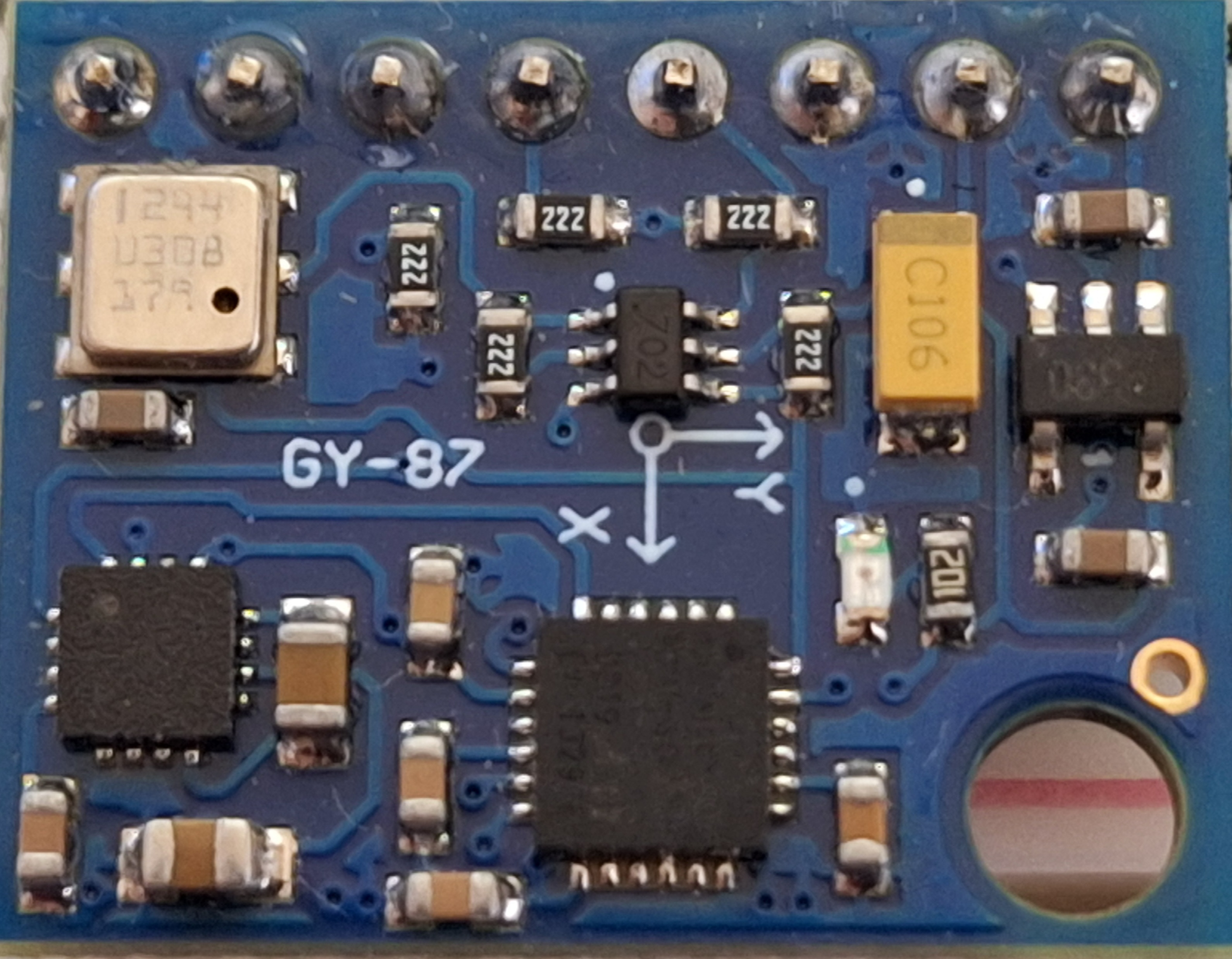
The GY-511 is a digital compass module based on the HMC5883L sensor, designed to provide precise heading and orientation information. It measures the Earth's magnetic field in three axes (X, Y, and Z) and outputs the data digitally via the I2C communication protocol. This module is widely used in robotics, navigation systems, drones, and other applications requiring accurate directional data.
Explore Projects Built with GY_511
 Open Project in Cirkit Designer
 Open Project in Cirkit Designer
 Open Project in Cirkit Designer
 Open Project in Cirkit Designer
Explore Projects Built with GY_511
Open Project in Cirkit DesignerOpen Project in Cirkit DesignerOpen Project in Cirkit DesignerOpen Project in Cirkit DesignerCommon Applications
- Robotics for navigation and pathfinding
- Drones and UAVs for orientation control
- Handheld compasses and navigation devices
- Augmented reality systems
- Vehicle tracking and positioning systems
Technical Specifications
Below are the key technical details of the GY-511 module:
| Parameter | Value |
|---|---|
| Sensor Model | HMC5883L |
| Manufacturer Part ID | MP085 |
| Communication Protocol | I2C |
| Operating Voltage | 3.3V to 5V |
| Operating Current | 100 µA (typical) |
| Measurement Range | ±1.3 to ±8 Gauss |
| Resolution | 0.73 mG/LSB (at ±1.3 Gauss range) |
| Dimensions | 14mm x 13mm x 3.5mm |
| Operating Temperature | -40°C to +85°C |
Pin Configuration
The GY-511 module has 4 pins for interfacing. The table below describes each pin:
| Pin | Name | Description |
|---|---|---|
| 1 | VCC | Power supply input (3.3V to 5V). Connect to the power source. |
| 2 | GND | Ground. Connect to the ground of the circuit. |
| 3 | SDA | I2C data line. Connect to the SDA pin of the microcontroller. |
| 4 | SCL | I2C clock line. Connect to the SCL pin of the microcontroller. |
Usage Instructions
How to Use the GY-511 in a Circuit
- Power the Module: Connect the VCC pin to a 3.3V or 5V power source and the GND pin to the ground.
- I2C Communication: Connect the SDA and SCL pins to the corresponding I2C pins on your microcontroller (e.g., Arduino UNO).
- Pull-Up Resistors: Ensure that the I2C lines (SDA and SCL) have pull-up resistors (typically 4.7kΩ). Some GY-511 modules include these resistors onboard.
- Addressing: The default I2C address of the HMC5883L sensor is
0x1E. Ensure no other devices on the I2C bus conflict with this address. - Software Setup: Use a library or write custom code to initialize the sensor and read data.
Example Arduino Code
Below is an example of how to interface the GY-511 with an Arduino UNO using the Wire library:
#include <Wire.h>

// HMC5883L I2C address
#define HMC5883L_ADDRESS 0x1E

void setup() {
  Wire.begin(); // Initialize I2C communication
  Serial.begin(9600); // Start serial communication for debugging

  // Initialize the HMC5883L sensor
  Wire.beginTransmission(HMC5883L_ADDRESS);
  Wire.write(0x00); // Select configuration register A
  Wire.write(0x70); // Set 8-average, 15 Hz default, normal measurement
  Wire.endTransmission();

  Wire.beginTransmission(HMC5883L_ADDRESS);
  Wire.write(0x01); // Select configuration register B
  Wire.write(0xA0); // Set gain = 5
  Wire.endTransmission();

  Wire.beginTransmission(HMC5883L_ADDRESS);
  Wire.write(0x02); // Select mode register
  Wire.write(0x00); // Continuous measurement mode
  Wire.endTransmission();
}

void loop() {
  int16_t x, y, z;

  // Request 6 bytes of data from the sensor
  Wire.beginTransmission(HMC5883L_ADDRESS);
  Wire.write(0x03); // Start reading from data output X MSB register
  Wire.endTransmission();
  Wire.requestFrom(HMC5883L_ADDRESS, 6);

  if (Wire.available() == 6) {
    x = (Wire.read() << 8) | Wire.read(); // Combine MSB and LSB for X-axis
    z = (Wire.read() << 8) | Wire.read(); // Combine MSB and LSB for Z-axis
    y = (Wire.read() << 8) | Wire.read(); // Combine MSB and LSB for Y-axis
  }

  // Print the raw magnetometer data
  Serial.print("X: ");
  Serial.print(x);
  Serial.print(" Y: ");
  Serial.print(y);
  Serial.print(" Z: ");
  Serial.println(z);

  delay(500); // Wait for 500ms before the next reading
}
Important Considerations
- Magnetic Interference: Avoid placing the GY-511 near ferromagnetic materials or strong magnetic fields, as they can distort readings.
- Calibration: Perform a calibration routine to account for hard and soft iron distortions in your environment.
- Orientation: Mount the module flat and ensure consistent orientation for accurate readings.
Troubleshooting and FAQs
Common Issues and Solutions
No Data Output
- Cause: Incorrect wiring or I2C address mismatch.
- Solution: Double-check the connections and ensure the I2C address is set to
0x1E.
Inaccurate Readings
- Cause: Magnetic interference or lack of calibration.
- Solution: Move the module away from magnetic sources and perform a calibration routine.
I2C Communication Errors
- Cause: Missing pull-up resistors or incorrect I2C clock speed.
- Solution: Add 4.7kΩ pull-up resistors to SDA and SCL lines if not already present. Ensure the I2C clock speed is set to 100kHz.
FAQs
Q: Can the GY-511 operate at 5V?
A: Yes, the GY-511 module supports both 3.3V and 5V power supplies.
Q: How do I calibrate the GY-511?
A: Rotate the module in all directions while collecting data. Use the readings to calculate offsets and scaling factors to correct for distortions.
Q: What is the maximum range of the GY-511?
A: The HMC5883L sensor on the GY-511 can measure magnetic fields up to ±8 Gauss.
Q: Can I use the GY-511 with microcontrollers other than Arduino?
A: Yes, the GY-511 can be used with any microcontroller that supports I2C communication, such as Raspberry Pi, ESP32, or STM32.