
How to Use CJMCU-055: Examples, Pinouts, and Specs
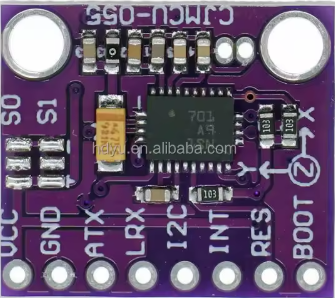
 Design with CJMCU-055 in Cirkit Designer
Introduction
The CJMCU-055 is a high-precision digital pressure sensor designed to measure atmospheric pressure and temperature. Manufactured by Shenzhen HangGuo Technology Co., Ltd., this sensor is compact, reliable, and communicates via the I2C interface, making it ideal for integration into a wide range of projects. Its ability to provide accurate environmental data makes it a popular choice for applications such as:
- Weather stations
- Altitude measurement in drones
- Environmental monitoring systems
- IoT devices requiring atmospheric data
- Barometric pressure-based navigation systems
Explore Projects Built with CJMCU-055
 Open Project in Cirkit Designer
 Open Project in Cirkit Designer
 Open Project in Cirkit Designer
 Open Project in Cirkit Designer
Explore Projects Built with CJMCU-055
Open Project in Cirkit DesignerOpen Project in Cirkit DesignerOpen Project in Cirkit DesignerOpen Project in Cirkit DesignerTechnical Specifications
Below are the key technical details of the CJMCU-055:
| Parameter | Value |
|---|---|
| Manufacturer Part ID | MCU-055 |
| Operating Voltage | 1.8V to 3.6V |
| Communication Interface | I2C |
| Pressure Measurement Range | 300 hPa to 1100 hPa |
| Temperature Range | -40°C to +85°C |
| Pressure Accuracy | ±1 hPa |
| Temperature Accuracy | ±0.5°C |
| Power Consumption | < 1 µA in sleep mode |
| Dimensions | 10mm x 10mm x 2mm |
Pin Configuration and Descriptions
The CJMCU-055 has a total of 6 pins. The table below describes each pin:
| Pin | Name | Description |
|---|---|---|
| 1 | VCC | Power supply pin (1.8V to 3.6V) |
| 2 | GND | Ground connection |
| 3 | SDA | I2C data line |
| 4 | SCL | I2C clock line |
| 5 | INT | Interrupt pin (optional, for advanced configurations) |
| 6 | NC | Not connected (leave unconnected) |
Usage Instructions
How to Use the CJMCU-055 in a Circuit
- Power Supply: Connect the VCC pin to a 3.3V power source (or 1.8V if your system supports it) and the GND pin to ground.
- I2C Communication: Connect the SDA and SCL pins to the corresponding I2C pins on your microcontroller. Use pull-up resistors (typically 4.7kΩ) on both SDA and SCL lines if not already present on your board.
- Interrupt Pin: The INT pin is optional and can be used for advanced configurations, such as triggering an event when a specific pressure threshold is reached.
- Leave NC Pin Unconnected: The NC pin should not be connected to any circuit.
Important Considerations and Best Practices
- Ensure the operating voltage of the sensor matches your system's voltage level.
- Use appropriate pull-up resistors on the I2C lines to ensure reliable communication.
- Avoid exposing the sensor to extreme environmental conditions beyond its specified range.
- Place the sensor in a location where it can accurately measure atmospheric pressure without obstructions.
Example Code for Arduino UNO
Below is an example of how to interface the CJMCU-055 with an Arduino UNO using the I2C interface:
#include <Wire.h>

// I2C address of the CJMCU-055 sensor
#define CJMCU055_ADDR 0x76

void setup() {
  Wire.begin(); // Initialize I2C communication
  Serial.begin(9600); // Start serial communication for debugging

  // Check if the sensor is connected
  Wire.beginTransmission(CJMCU055_ADDR);
  if (Wire.endTransmission() == 0) {
    Serial.println("CJMCU-055 connected successfully!");
  } else {
    Serial.println("Failed to connect to CJMCU-055.");
    while (1); // Halt execution if sensor is not detected
  }
}

void loop() {
  // Request pressure and temperature data from the sensor
  Wire.beginTransmission(CJMCU055_ADDR);
  Wire.write(0xF7); // Register to read pressure and temperature data
  Wire.endTransmission();
  Wire.requestFrom(CJMCU055_ADDR, 6); // Request 6 bytes of data

  if (Wire.available() == 6) {
    // Read pressure and temperature data
    uint8_t data[6];
    for (int i = 0; i < 6; i++) {
      data[i] = Wire.read();
    }

    // Convert the data to pressure and temperature values
    long pressure = ((long)data[0] << 16) | ((long)data[1] << 8) | data[2];
    pressure >>= 4; // Adjust for 20-bit resolution
    float pressure_hPa = pressure / 256.0;

    long temperature = ((long)data[3] << 16) | ((long)data[4] << 8) | data[5];
    temperature >>= 4; // Adjust for 20-bit resolution
    float temperature_C = temperature / 100.0;

    // Print the results
    Serial.print("Pressure: ");
    Serial.print(pressure_hPa);
    Serial.println(" hPa");

    Serial.print("Temperature: ");
    Serial.print(temperature_C);
    Serial.println(" °C");
  }

  delay(1000); // Wait 1 second before the next reading
}
Troubleshooting and FAQs
Common Issues
Sensor Not Detected on I2C Bus:
- Cause: Incorrect wiring or missing pull-up resistors on SDA/SCL lines.
- Solution: Double-check the wiring and ensure pull-up resistors are present.
Inaccurate Readings:
- Cause: Sensor exposed to extreme environmental conditions or interference.
- Solution: Ensure the sensor is within its operating range and placed in a stable environment.
No Data Output:
- Cause: Incorrect I2C address or communication failure.
- Solution: Verify the I2C address (default is 0x76) and check connections.
FAQs
Q: Can the CJMCU-055 operate at 5V?
A: No, the sensor operates at a voltage range of 1.8V to 3.6V. Use a level shifter if interfacing with a 5V system.
Q: Do I need to calibrate the sensor?
A: The CJMCU-055 is factory-calibrated, so no additional calibration is required for most applications.
Q: Can I use the sensor for underwater pressure measurement?
A: No, the CJMCU-055 is designed for atmospheric pressure measurement and is not waterproof.
By following this documentation, you can effectively integrate the CJMCU-055 into your projects for accurate pressure and temperature measurements.