
How to Use XIAO ESP32-C6: Examples, Pinouts, and Specs
 Design with XIAO ESP32-C6 in Cirkit Designer
Introduction
The XIAO ESP32-C6 is a compact and powerful microcontroller board built around the ESP32-C6 chip. It supports both Wi-Fi 6 and Bluetooth 5.0 Low Energy (BLE), making it an excellent choice for Internet of Things (IoT) applications and projects requiring robust wireless communication. Its small form factor and versatile features make it suitable for wearable devices, smart home systems, and other embedded applications.
Explore Projects Built with XIAO ESP32-C6
 Open Project in Cirkit Designer
 Open Project in Cirkit Designer
 Open Project in Cirkit Designer
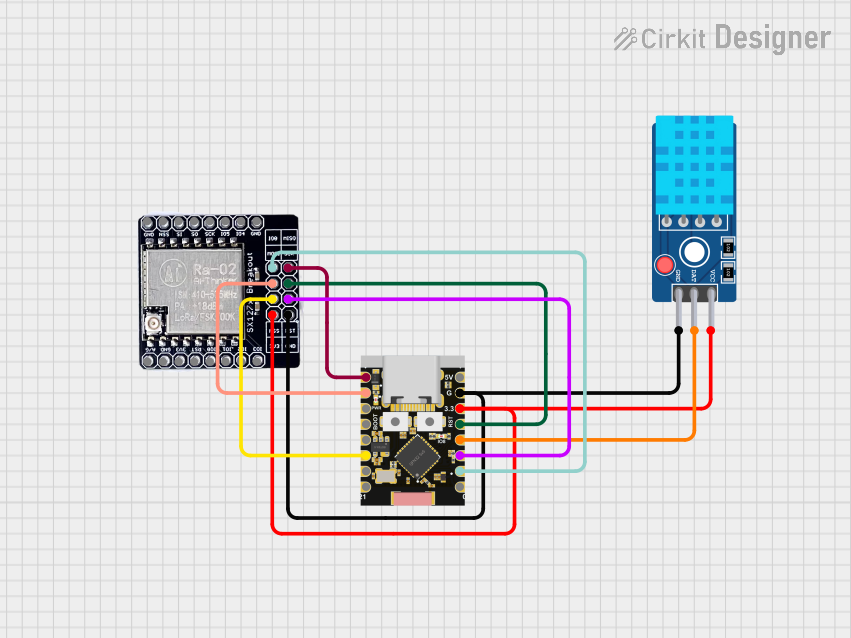 Open Project in Cirkit Designer
Explore Projects Built with XIAO ESP32-C6
Open Project in Cirkit DesignerOpen Project in Cirkit DesignerOpen Project in Cirkit DesignerOpen Project in Cirkit DesignerCommon Applications
- IoT devices and smart home automation
- Wearable electronics
- Wireless sensor networks
- Prototyping for Wi-Fi and Bluetooth-enabled projects
- Low-power applications requiring efficient connectivity
Technical Specifications
The XIAO ESP32-C6 offers a range of features and specifications that make it a versatile microcontroller for various applications.
Key Technical Details
| Specification | Value |
|---|---|
| Microcontroller | ESP32-C6 |
| Wireless Connectivity | Wi-Fi 6, Bluetooth 5.0 LE |
| Operating Voltage | 3.3V |
| Input Voltage Range | 5V (via USB-C) |
| Flash Memory | 4MB |
| SRAM | 512KB |
| GPIO Pins | 11 (including multifunctional pins) |
| Communication Interfaces | UART, I2C, SPI, ADC, PWM |
| Dimensions | 21mm x 17.5mm |
| Power Consumption | Ultra-low power modes supported |
Pin Configuration and Descriptions
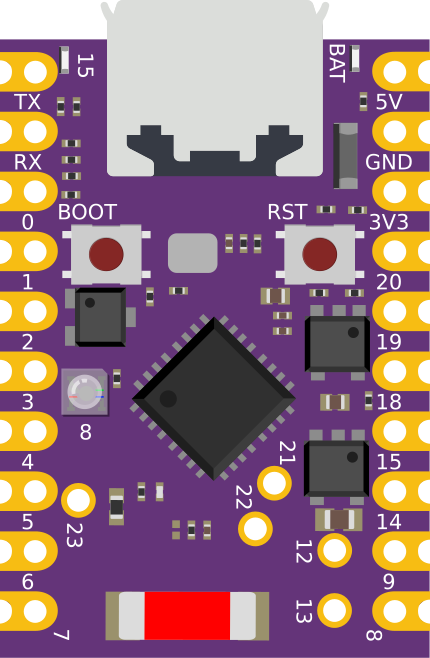
The XIAO ESP32-C6 features a total of 11 GPIO pins, which can be configured for various functions. Below is the pinout description:
| Pin Number | Pin Name | Functionality |
|---|---|---|
| 1 | 3V3 | 3.3V Power Output |
| 2 | GND | Ground |
| 3 | GPIO0 | General Purpose I/O, ADC, PWM |
| 4 | GPIO1 | General Purpose I/O, ADC, PWM |
| 5 | GPIO2 | General Purpose I/O, ADC, PWM |
| 6 | GPIO3 | General Purpose I/O, UART TX, PWM |
| 7 | GPIO4 | General Purpose I/O, UART RX, PWM |
| 8 | GPIO5 | General Purpose I/O, I2C SDA, PWM |
| 9 | GPIO6 | General Purpose I/O, I2C SCL, PWM |
| 10 | GPIO7 | General Purpose I/O, SPI MOSI, PWM |
| 11 | GPIO8 | General Purpose I/O, SPI MISO, PWM |
Usage Instructions
The XIAO ESP32-C6 is easy to integrate into your projects. Below are the steps to get started and important considerations for using the board.
How to Use the XIAO ESP32-C6 in a Circuit
Powering the Board:
- Use a USB-C cable to supply 5V to the board. The onboard voltage regulator will convert it to 3.3V.
- Alternatively, you can power the board directly via the 3V3 pin with a regulated 3.3V supply.
Connecting Peripherals:
- Use the GPIO pins to connect sensors, actuators, or other peripherals. Refer to the pin configuration table for specific pin functions.
- For communication, use UART, I2C, or SPI interfaces as required by your peripherals.
Programming the Board:
- Install the Arduino IDE and add the ESP32 board package.
- Select "XIAO ESP32-C6" as the target board in the Arduino IDE.
- Connect the board to your computer via USB-C and upload your code.
Example Code for Arduino IDE
The following example demonstrates how to connect the XIAO ESP32-C6 to a Wi-Fi network and send data to a server:
#include <WiFi.h>

// Replace with your network credentials
const char* ssid = "Your_SSID";
const char* password = "Your_PASSWORD";

void setup() {
  Serial.begin(115200); // Initialize serial communication at 115200 baud
  delay(1000);

  // Connect to Wi-Fi
  Serial.println("Connecting to Wi-Fi...");
  WiFi.begin(ssid, password);

  while (WiFi.status() != WL_CONNECTED) {
    delay(500);
    Serial.print(".");
  }

  Serial.println("\nWi-Fi connected!");
  Serial.print("IP Address: ");
  Serial.println(WiFi.localIP()); // Print the device's IP address
}

void loop() {
  // Add your main code here
}
Important Considerations and Best Practices
- Voltage Levels: Ensure all connected peripherals operate at 3.3V logic levels to avoid damaging the board.
- Power Supply: Use a stable power source to prevent unexpected resets or malfunctions.
- Antenna Placement: Avoid placing the board near metal objects or inside enclosures that may interfere with the wireless signal.
- Firmware Updates: Regularly update the ESP32-C6 firmware to ensure compatibility and access to the latest features.
Troubleshooting and FAQs
Common Issues and Solutions
Board Not Detected by Computer:
- Ensure the USB-C cable is data-capable (not just for charging).
- Check if the correct drivers for the ESP32-C6 are installed on your computer.
Wi-Fi Connection Fails:
- Double-check the SSID and password in your code.
- Ensure the Wi-Fi network is within range and operational.
Code Upload Fails:
- Verify that the correct board and COM port are selected in the Arduino IDE.
- Press the reset button on the board before uploading the code.
Peripherals Not Responding:
- Confirm that the peripherals are connected to the correct GPIO pins.
- Check for loose connections or incorrect wiring.
FAQs
Q: Can I power the XIAO ESP32-C6 with a battery?
A: Yes, you can use a 3.7V LiPo battery connected to the 3V3 pin, but ensure the voltage is regulated to 3.3V.
Q: Does the board support deep sleep mode?
A: Yes, the ESP32-C6 supports ultra-low power deep sleep mode for energy-efficient applications.
Q: Can I use the XIAO ESP32-C6 with MicroPython?
A: Yes, the ESP32-C6 is compatible with MicroPython. You can flash the MicroPython firmware and use it for programming.
Q: What is the maximum range of Wi-Fi and Bluetooth?
A: The range depends on environmental factors, but typically Wi-Fi can reach up to 50m indoors and 200m outdoors, while Bluetooth LE has a range of up to 100m in ideal conditions.
This concludes the documentation for the XIAO ESP32-C6. For further assistance, refer to the official datasheet or community forums.