
How to Use LCD I2C 16x2: Examples, Pinouts, and Specs
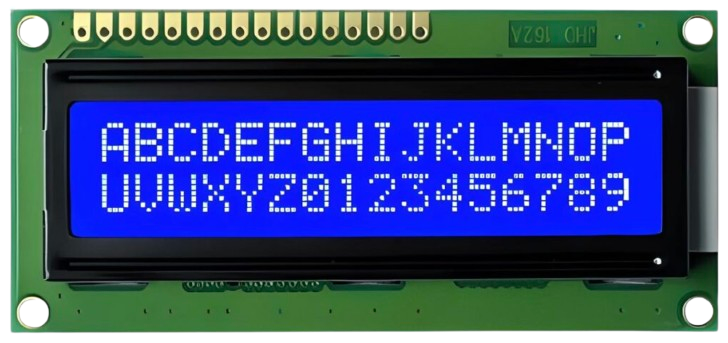
 Design with LCD I2C 16x2 in Cirkit Designer
Introduction
The LCD I2C 16x2 is a 16-character by 2-line Liquid Crystal Display (LCD) module that uses I2C (Inter-Integrated Circuit) communication for simplified interfacing with microcontrollers. This module is ideal for applications requiring a compact and efficient way to display text or simple graphics. The I2C interface reduces the number of pins required for connection, making it perfect for projects with limited GPIO availability.
Explore Projects Built with LCD I2C 16x2
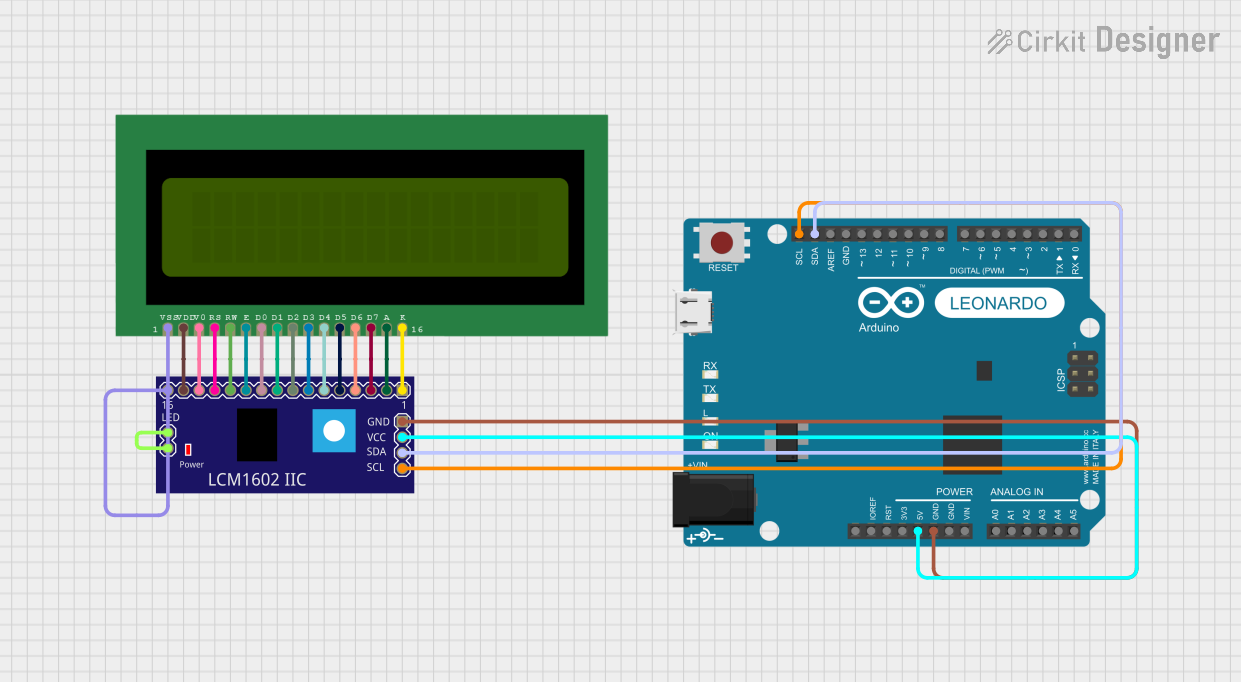 Open Project in Cirkit Designer
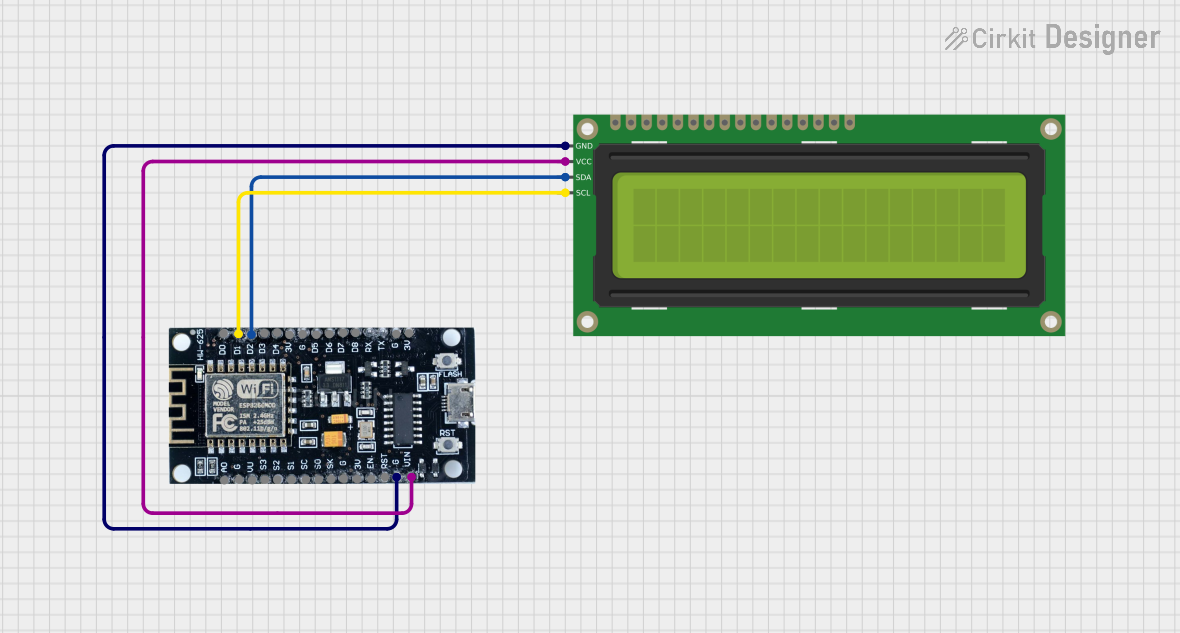 Open Project in Cirkit Designer
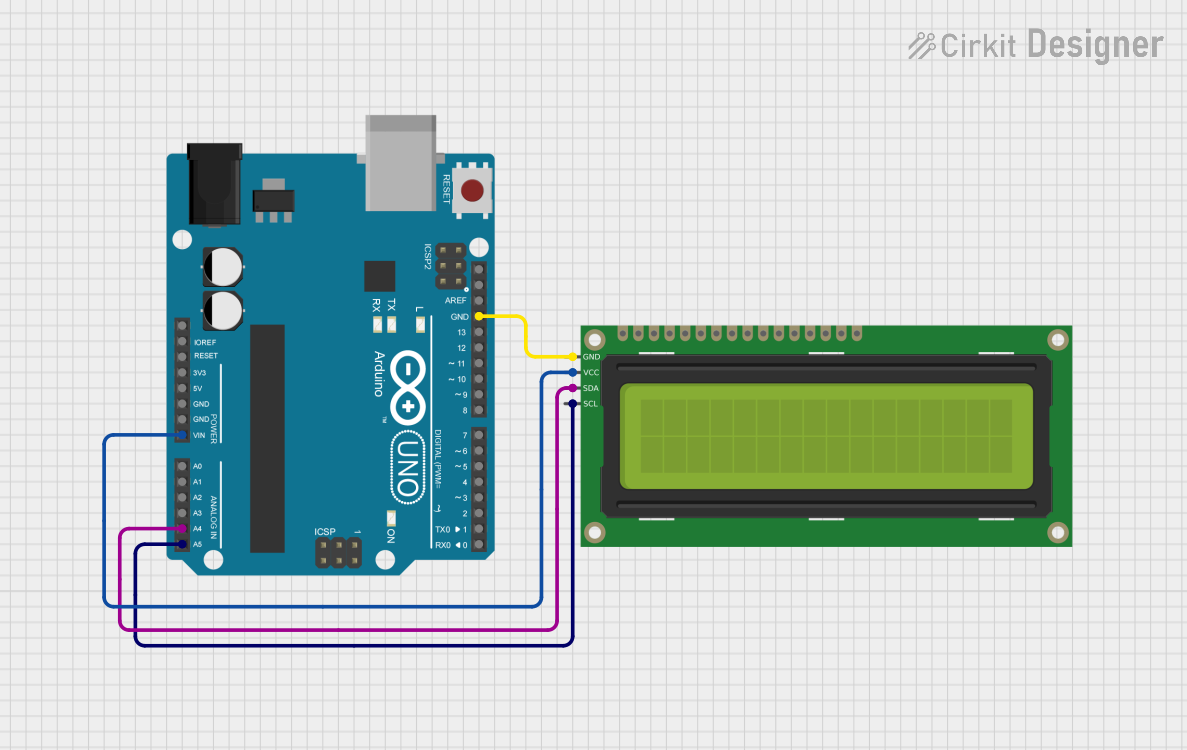 Open Project in Cirkit Designer
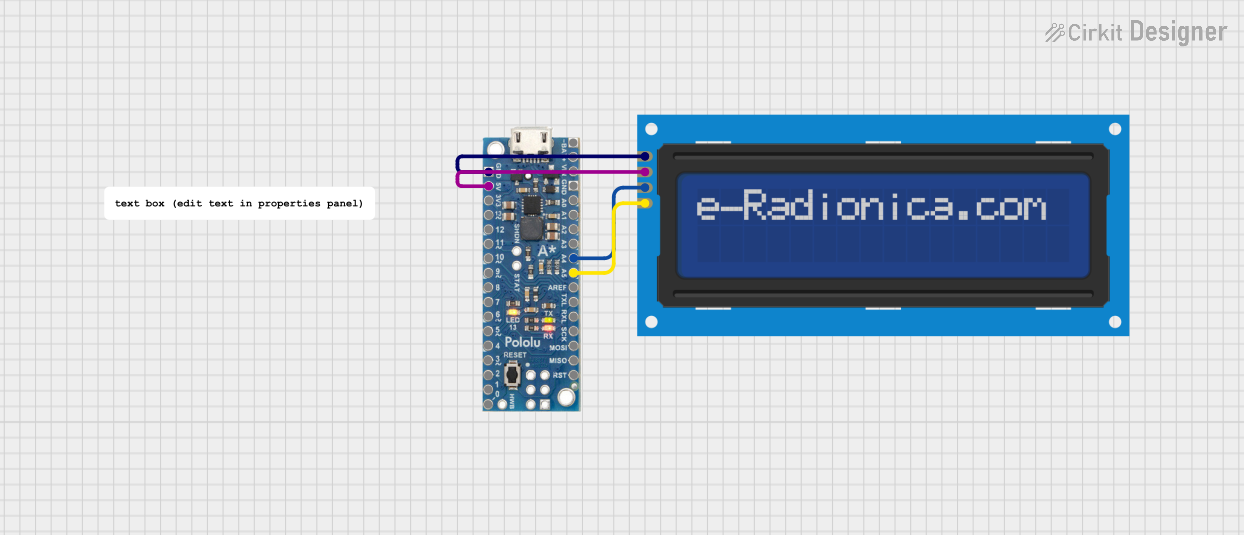 Open Project in Cirkit Designer
Explore Projects Built with LCD I2C 16x2
Open Project in Cirkit DesignerOpen Project in Cirkit DesignerOpen Project in Cirkit DesignerOpen Project in Cirkit DesignerCommon Applications and Use Cases
- Microcontroller-based projects (e.g., Arduino, Raspberry Pi)
- Home automation systems
- Digital clocks and timers
- Sensor data displays
- Educational and prototyping projects
Technical Specifications
Key Technical Details
- Display Type: 16x2 character LCD
- Interface: I2C (2-wire communication)
- Operating Voltage: 5V DC
- Backlight: LED (usually white or blue)
- Contrast Adjustment: Via onboard potentiometer
- I2C Address: Typically 0x27 or 0x3F (configurable)
- Dimensions: 80mm x 36mm x 12mm (approx.)
- Character Size: 5x8 dot matrix per character
Pin Configuration and Descriptions
The LCD I2C 16x2 module has a 4-pin header for I2C communication. Below is the pinout:
| Pin | Name | Description |
|---|---|---|
| 1 | GND | Ground (0V) |
| 2 | VCC | Power supply (5V DC) |
| 3 | SDA | Serial Data Line for I2C communication |
| 4 | SCL | Serial Clock Line for I2C communication |
Usage Instructions
How to Use the Component in a Circuit
Wiring the LCD I2C 16x2:
- Connect the GND pin to the ground of your microcontroller.
- Connect the VCC pin to the 5V power supply of your microcontroller.
- Connect the SDA pin to the I2C data pin of your microcontroller (e.g., A4 on Arduino UNO).
- Connect the SCL pin to the I2C clock pin of your microcontroller (e.g., A5 on Arduino UNO).
Install Required Libraries:
- For Arduino, install the
LiquidCrystal_I2Clibrary via the Library Manager in the Arduino IDE.
- For Arduino, install the
Write and Upload Code:
- Use the example code below to display text on the LCD.
Example Code for Arduino UNO
#include <Wire.h>
#include <LiquidCrystal_I2C.h>

// Initialize the LCD with I2C address 0x27 and 16x2 dimensions
LiquidCrystal_I2C lcd(0x27, 16, 2);

void setup() {
  lcd.begin(); // Initialize the LCD
  lcd.backlight(); // Turn on the backlight
  lcd.setCursor(0, 0); // Set cursor to the first row, first column
  lcd.print("Hello, World!"); // Display text on the first row
  lcd.setCursor(0, 1); // Set cursor to the second row, first column
  lcd.print("LCD I2C 16x2"); // Display text on the second row
}

void loop() {
  // No actions in the loop for this example
}
Important Considerations and Best Practices
- I2C Address: Verify the I2C address of your module (commonly 0x27 or 0x3F). Use an I2C scanner sketch if unsure.
- Power Supply: Ensure a stable 5V power supply to avoid flickering or malfunction.
- Contrast Adjustment: Use the onboard potentiometer to adjust the display contrast.
- Pull-Up Resistors: Some modules include built-in pull-up resistors for the I2C lines. If not, add external pull-up resistors (4.7kΩ to 10kΩ) to SDA and SCL.
Troubleshooting and FAQs
Common Issues and Solutions
No Display or Backlight:
- Check the power connections (GND and VCC).
- Ensure the backlight is enabled in the code (
lcd.backlight()).
Incorrect or No Text Displayed:
- Verify the I2C address of the module and update it in the code.
- Check the SDA and SCL connections for proper wiring.
Flickering or Unstable Display:
- Ensure a stable 5V power supply.
- Add pull-up resistors to the SDA and SCL lines if necessary.
Contrast Issues:
- Adjust the contrast using the onboard potentiometer.
FAQs
Q1: How do I find the I2C address of my LCD module?
A1: Use an I2C scanner sketch to detect the address. Upload the sketch to your microcontroller, and it will print the detected address in the Serial Monitor.
Q2: Can I use this module with a 3.3V microcontroller?
A2: While the module is designed for 5V operation, some modules may work with 3.3V logic. Use a level shifter if needed for reliable communication.
Q3: Can I connect multiple I2C devices to the same microcontroller?
A3: Yes, as long as each device has a unique I2C address. Use an I2C multiplexer if address conflicts occur.
Q4: What is the maximum cable length for I2C communication?
A4: I2C is designed for short distances (typically less than 1 meter). For longer distances, reduce the clock speed or use I2C extenders.
By following this documentation, you can effectively integrate and troubleshoot the LCD I2C 16x2 module in your projects.