
How to Use DS3231 RTC: Examples, Pinouts, and Specs
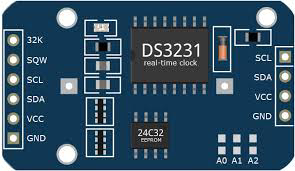
 Design with DS3231 RTC in Cirkit Designer
Introduction
The DS3231 RTC (Real-Time Clock) module, manufactured by SmartElex (Part ID: R196208), is a highly accurate timekeeping device designed for applications requiring precise time and date tracking. It features a temperature-compensated crystal oscillator (TCXO) to maintain accuracy under varying environmental conditions. The module communicates via the I2C interface, making it easy to integrate with microcontrollers such as Arduino, Raspberry Pi, and other embedded systems.
Explore Projects Built with DS3231 RTC
 Open Project in Cirkit Designer
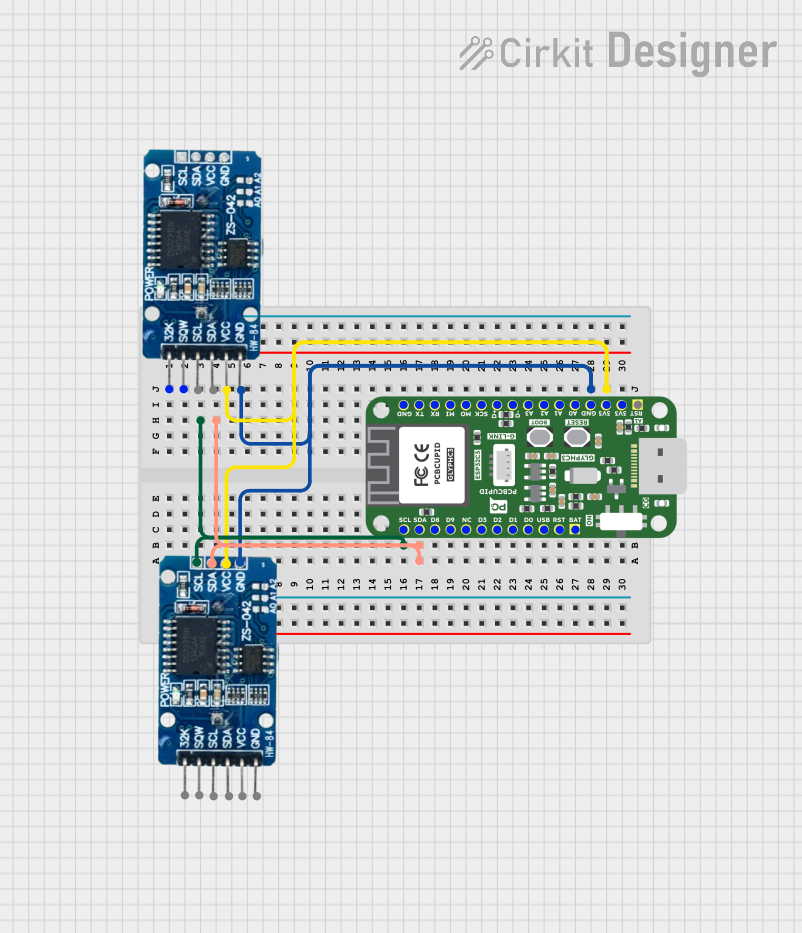 Open Project in Cirkit Designer
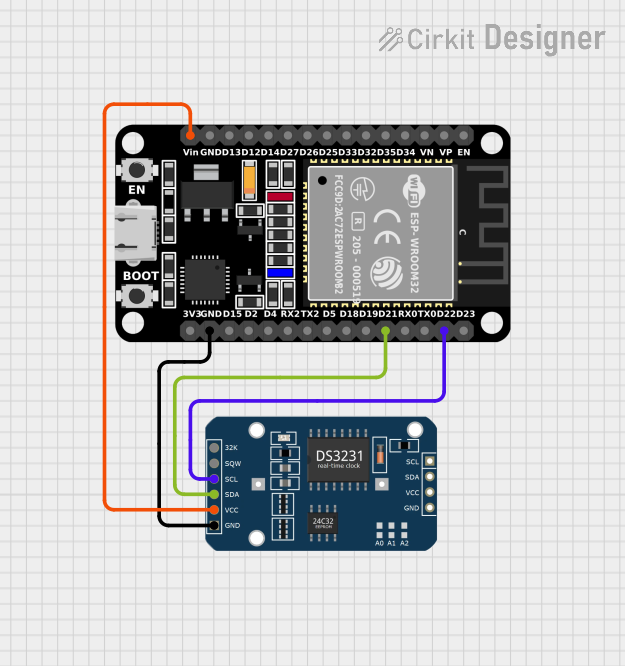 Open Project in Cirkit Designer
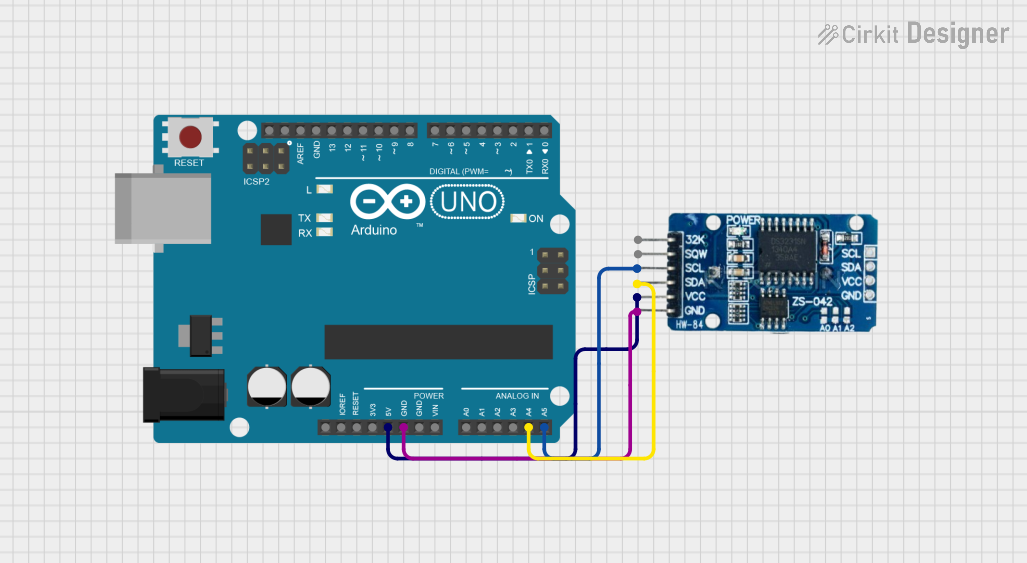 Open Project in Cirkit Designer
Explore Projects Built with DS3231 RTC
Open Project in Cirkit DesignerOpen Project in Cirkit DesignerOpen Project in Cirkit DesignerOpen Project in Cirkit DesignerCommon Applications
- Time-stamping data in data logging systems
- Alarm clocks and timers
- Scheduling and automation systems
- Real-time event tracking in IoT devices
- Calendar-based applications
Technical Specifications
The DS3231 RTC module offers robust performance and reliability. Below are its key technical details:
Key Features
- Operating Voltage: 2.3V to 5.5V
- Current Consumption: 1.5 µA (battery backup mode)
- Timekeeping Accuracy: ±2 ppm (±0.17 seconds/day) from 0°C to +40°C
- Interface: I2C (7-bit address: 0x68)
- Backup Battery Support: CR2032 coin cell
- Temperature Range: -40°C to +85°C
- Built-in Oscillator: Temperature-compensated crystal oscillator (TCXO)
- Alarm Functions: Two programmable alarms
- Additional Features: 32kHz output pin, square wave output
Pin Configuration
The DS3231 RTC module typically has a 5-pin interface. Below is the pinout description:
| Pin | Name | Description |
|---|---|---|
| 1 | GND | Ground connection |
| 2 | VCC | Power supply input (2.3V to 5.5V) |
| 3 | SDA | Serial Data Line for I2C communication |
| 4 | SCL | Serial Clock Line for I2C communication |
| 5 | SQW/32k | Configurable output for square wave or 32kHz clock signal |
Usage Instructions
The DS3231 RTC module is straightforward to use in a circuit. Below are the steps and best practices for integrating it into your project.
Connecting the DS3231 to an Arduino UNO
- Wiring: Connect the DS3231 module to the Arduino UNO as follows:
- GND → GND
- VCC → 5V
- SDA → A4 (on Arduino UNO)
- SCL → A5 (on Arduino UNO)
- Install Required Libraries: Use the Arduino IDE to install the
RTCliblibrary, which simplifies communication with the DS3231.- Go to Sketch > Include Library > Manage Libraries.
- Search for
RTCliband click Install.
Example Code
The following Arduino sketch demonstrates how to read the current time and date from the DS3231 module:
#include <Wire.h>
#include <RTClib.h>

// Create an RTC_DS3231 object to interact with the DS3231 module
RTC_DS3231 rtc;

void setup() {
  Serial.begin(9600); // Initialize serial communication at 9600 baud
  Wire.begin();       // Initialize I2C communication

  if (!rtc.begin()) {
    // Check if the RTC module is connected and working
    Serial.println("Couldn't find RTC. Check wiring!");
    while (1); // Halt the program if the RTC is not detected
  }

  if (rtc.lostPower()) {
    // If the RTC lost power, set the time to a default value
    Serial.println("RTC lost power, setting the time!");
    rtc.adjust(DateTime(F(__DATE__), F(__TIME__)));
    // Sets the RTC to the date & time of the sketch compilation
  }
}

void loop() {
  DateTime now = rtc.now(); // Get the current date and time

  // Print the current date and time to the Serial Monitor
  Serial.print(now.year(), DEC);
  Serial.print('/');
  Serial.print(now.month(), DEC);
  Serial.print('/');
  Serial.print(now.day(), DEC);
  Serial.print(" ");
  Serial.print(now.hour(), DEC);
  Serial.print(':');
  Serial.print(now.minute(), DEC);
  Serial.print(':');
  Serial.print(now.second(), DEC);
  Serial.println();

  delay(1000); // Wait for 1 second before updating the time
}
Best Practices
- Use a CR2032 coin cell battery to ensure the RTC keeps time during power outages.
- Avoid exposing the module to extreme temperatures to maintain accuracy.
- Use pull-up resistors (typically 4.7kΩ) on the SDA and SCL lines if not already included on the module.
Troubleshooting and FAQs
Common Issues
RTC Not Detected
- Cause: Incorrect wiring or I2C address mismatch.
- Solution: Double-check the connections and ensure the I2C address is set to
0x68.
Incorrect Time or Date
- Cause: RTC lost power or was not initialized properly.
- Solution: Use the
rtc.adjust()function to set the correct time and date.
No Output on Serial Monitor
- Cause: Serial communication not initialized or incorrect baud rate.
- Solution: Ensure
Serial.begin(9600)is called insetup()and the Serial Monitor is set to 9600 baud.
Square Wave Output Not Working
- Cause: Incorrect configuration of the SQW/32k pin.
- Solution: Use the
rtc.writeSqwPinMode()function to configure the output mode.
FAQs
Q: Can the DS3231 module operate without a backup battery?
A: Yes, but it will lose timekeeping functionality when the main power supply is disconnected.
Q: How accurate is the DS3231 RTC?
A: The DS3231 is accurate to ±2 ppm, which translates to a drift of about ±1 minute per year under typical conditions.
Q: Can I use the DS3231 with a 3.3V microcontroller?
A: Yes, the DS3231 operates within a voltage range of 2.3V to 5.5V, making it compatible with both 3.3V and 5V systems.
Q: How do I set alarms on the DS3231?
A: The DS3231 supports two programmable alarms. Use the RTClib library to configure and manage alarms programmatically.
By following this documentation, you can effectively integrate and utilize the DS3231 RTC module in your projects.