
How to Use NUCLEOH753: Examples, Pinouts, and Specs
 Design with NUCLEOH753 in Cirkit Designer
Introduction
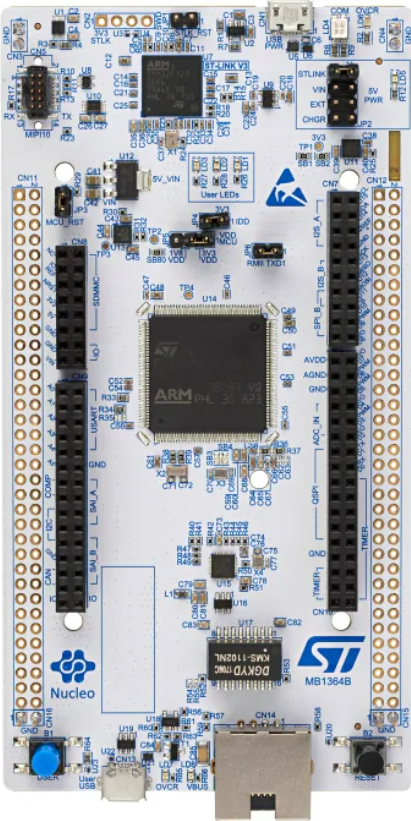
The NUCLEOH753 is a microcontroller development board manufactured by STM. It is based on the STM32H7 series, which features a high-performance ARM Cortex-M7 core running at up to 480 MHz. This board is designed for advanced applications that demand high processing power, extensive connectivity, and robust peripheral support. It is particularly well-suited for use in IoT, industrial control, and multimedia applications.
Explore Projects Built with NUCLEOH753
 Open Project in Cirkit Designer
 Open Project in Cirkit Designer
 Open Project in Cirkit Designer
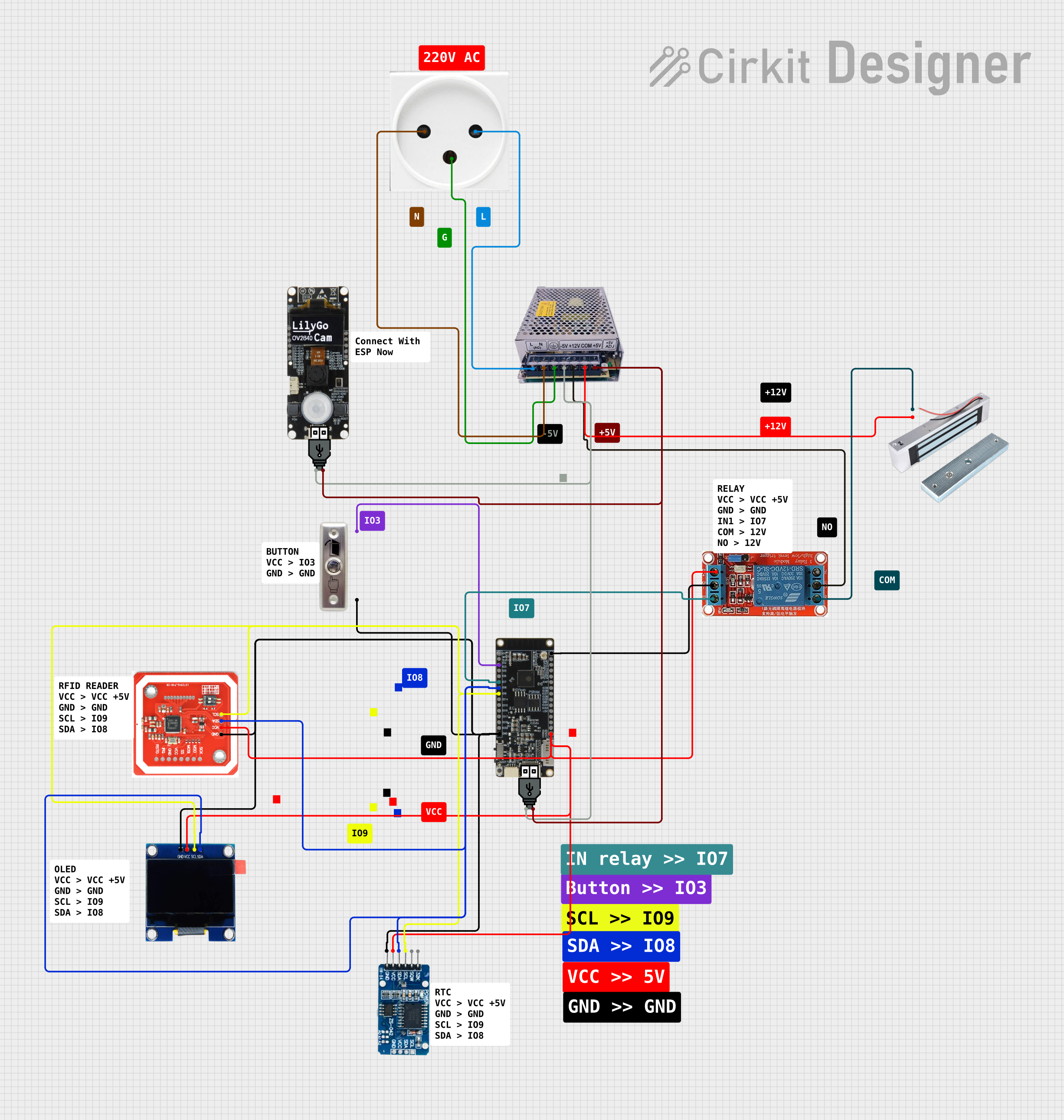 Open Project in Cirkit Designer
Explore Projects Built with NUCLEOH753
Open Project in Cirkit DesignerOpen Project in Cirkit DesignerOpen Project in Cirkit DesignerOpen Project in Cirkit DesignerCommon Applications:
- IoT (Internet of Things): Smart devices, edge computing, and sensor hubs.
- Industrial Control: Motor control, automation systems, and robotics.
- Multimedia Applications: Audio processing, graphical interfaces, and video streaming.
- Embedded Systems Development: Prototyping and testing of high-performance embedded systems.
Technical Specifications
Key Technical Details:
| Specification | Value |
|---|---|
| Microcontroller | STM32H753 (ARM Cortex-M7 @ 480 MHz) |
| Flash Memory | 2 MB |
| RAM | 1 MB |
| Operating Voltage | 3.3V |
| Input Voltage (via USB) | 5V |
| Input Voltage (via VIN pin) | 7V to 12V |
| Digital I/O Pins | 50 |
| Analog Input Pins | 16 |
| Communication Interfaces | UART, SPI, I2C, CAN, Ethernet, USB OTG |
| Clock Speed | 480 MHz |
| Debugging Interface | ST-LINK/V2-1 |
| Dimensions | 68.6 mm x 53.3 mm |
Pin Configuration and Descriptions:
The NUCLEOH753 features a variety of pins for digital, analog, and communication purposes. Below is a summary of the pin configuration:
Power Pins:
| Pin Name | Description |
|---|---|
| VIN | External power input (7V-12V) |
| 3.3V | Regulated 3.3V output |
| 5V | Regulated 5V output |
| GND | Ground |
Communication Pins:
| Pin Name | Description |
|---|---|
| TX/RX | UART communication pins |
| SCL/SDA | I2C communication pins |
| MOSI/MISO | SPI communication pins |
| CAN_TX/RX | CAN bus communication pins |
Analog Pins:
| Pin Name | Description |
|---|---|
| A0-A15 | Analog input pins (12-bit ADC) |
Digital Pins:
| Pin Name | Description |
|---|---|
| D0-D49 | General-purpose digital I/O |
Usage Instructions
How to Use the NUCLEOH753 in a Circuit:
Powering the Board:
- Connect the board to a computer via the USB Type-B connector for power and programming.
- Alternatively, supply power through the VIN pin (7V-12V) or the 5V pin.
Programming the Board:
- Use the STM32CubeIDE or Keil uVision for programming.
- The board includes an ST-LINK/V2-1 debugger for seamless programming and debugging.
Connecting Peripherals:
- Use the digital I/O pins for interfacing with sensors, actuators, and other devices.
- Utilize the communication interfaces (UART, SPI, I2C, CAN) for connecting to external modules.
Running the Program:
- After uploading the program, the board will automatically reset and execute the code.
Important Considerations and Best Practices:
- Ensure the input voltage does not exceed the specified range to avoid damaging the board.
- Use appropriate pull-up or pull-down resistors for I2C and other communication protocols.
- Avoid connecting high-current loads directly to the GPIO pins; use external drivers if needed.
- For real-time applications, leverage the RTOS support provided by the STM32H7 series.
Example Code for Arduino IDE:
The NUCLEOH753 can be programmed using the Arduino IDE with the STM32 core installed. Below is an example of blinking an LED connected to pin D13:
// Example: Blink an LED on pin D13

// Define the LED pin
#define LED_PIN 13

void setup() {
  pinMode(LED_PIN, OUTPUT); // Set pin D13 as an output
}

void loop() {
  digitalWrite(LED_PIN, HIGH); // Turn the LED on
  delay(1000);                 // Wait for 1 second
  digitalWrite(LED_PIN, LOW);  // Turn the LED off
  delay(1000);                 // Wait for 1 second
}
Troubleshooting and FAQs
Common Issues and Solutions:
The board does not power on:
- Ensure the USB cable is properly connected and functional.
- Verify the input voltage on the VIN pin is within the specified range (7V-12V).
Unable to upload code:
- Check that the ST-LINK/V2-1 driver is installed on your computer.
- Ensure the board is in programming mode and not running a conflicting program.
Peripherals not responding:
- Double-check the wiring and connections to the peripheral devices.
- Verify that the correct pins and communication protocols are being used in the code.
Analog readings are inaccurate:
- Ensure the input voltage to the analog pins does not exceed 3.3V.
- Use proper decoupling capacitors to reduce noise in the analog signals.
FAQs:
Q: Can the NUCLEOH753 be powered via USB and VIN simultaneously?
A: No, it is recommended to use only one power source at a time to avoid potential damage.
Q: Does the board support Ethernet connectivity?
A: Yes, the NUCLEOH753 includes an Ethernet interface for network communication.
Q: Can I use the board for audio processing?
A: Yes, the high-performance ARM Cortex-M7 core and DSP instructions make it suitable for audio applications.
Q: Is the board compatible with Arduino shields?
A: Yes, the NUCLEOH753 is compatible with most Arduino Uno R3 shields.
By following this documentation, users can effectively utilize the NUCLEOH753 for a wide range of applications.