
Cirkit Designer
Your all-in-one circuit design IDE
Home /
Component Documentation
How to Use GND: Examples, Pinouts, and Specs

 Design with GND in Cirkit Designer
Introduction
- GND (Ground) is a fundamental concept and component in electrical and electronic circuits. It serves as a reference point in the circuit, from which all voltages are measured. Additionally, it acts as a common return path for electric current, ensuring proper circuit operation.
- GND is used in virtually all electronic devices and systems. Common applications include:
- Providing a stable reference voltage for sensors, microcontrollers, and other components.
- Completing electrical circuits by serving as the return path for current.
- Ensuring safety by connecting to the earth ground in high-power systems to prevent electrical hazards.
Explore Projects Built with GND
12V Multi-Component Control Circuit
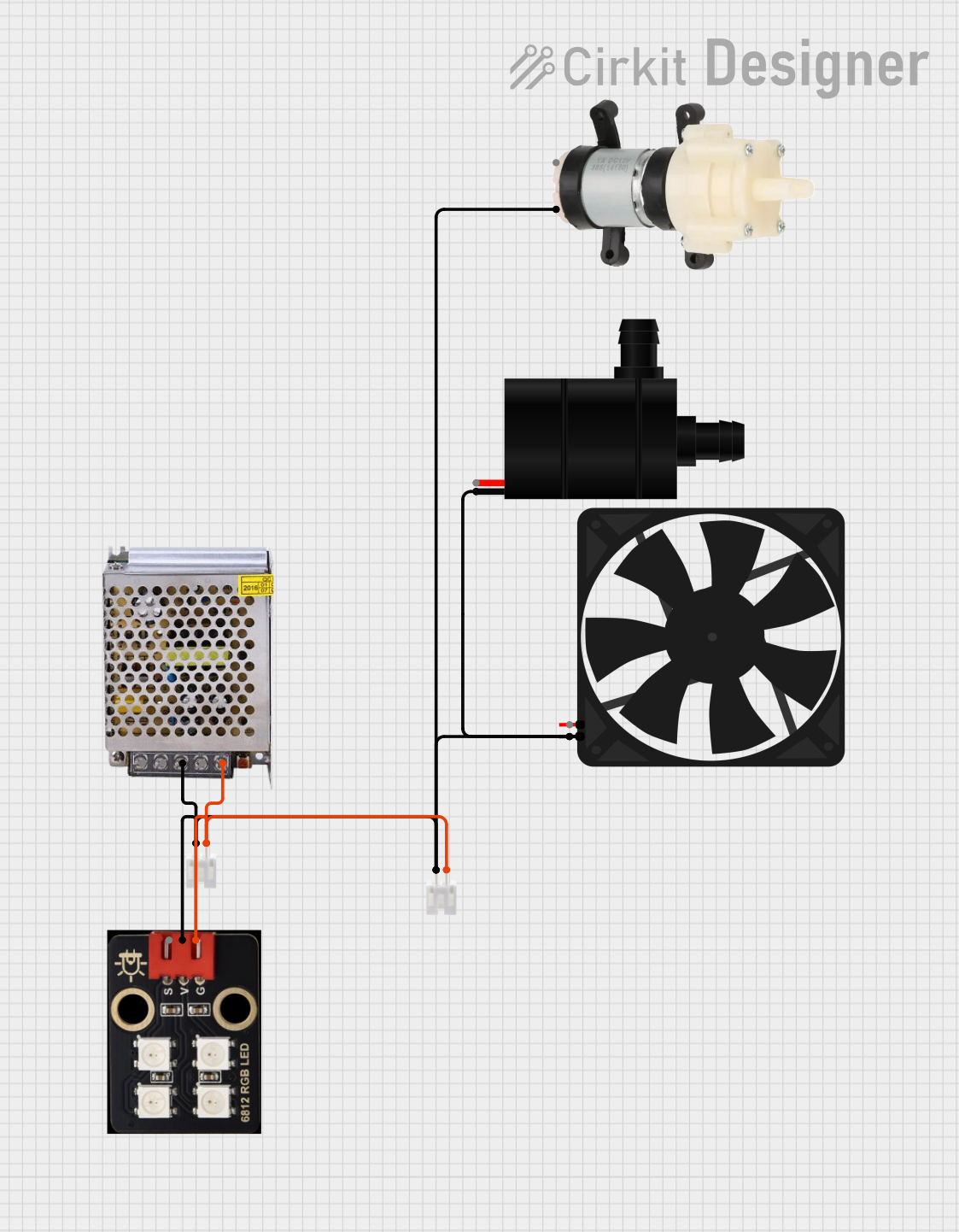
This circuit appears to be a power distribution system that supplies power to various components from a 12V 5A power supply. It connects the negative terminal of the power supply to the ground (GND) pins of a mini diaphragm water pump, an RGB LED, a fan, and a water pump, while the positive DC output is connected to the positive pins of the RGB LED and presumably to other components through JST PH 2.0 connectors. The circuit lacks a controlling element, such as a microcontroller, suggesting that the components operate continuously or are switched externally.
Open Project in Cirkit DesignerPushbutton Interface with General Purpose I/O Plug

This circuit consists of a General Purpose Input/Output (GPIO) plug connected to four pushbuttons. Each pushbutton is wired to a unique input pin on the GPIO plug, allowing the state of each button (pressed or not pressed) to be detected individually. The common terminals of the pushbuttons are interconnected and likely serve as a ground or reference voltage connection.
Open Project in Cirkit DesignerBasic Surge Protection Circuit with Benedict Switch
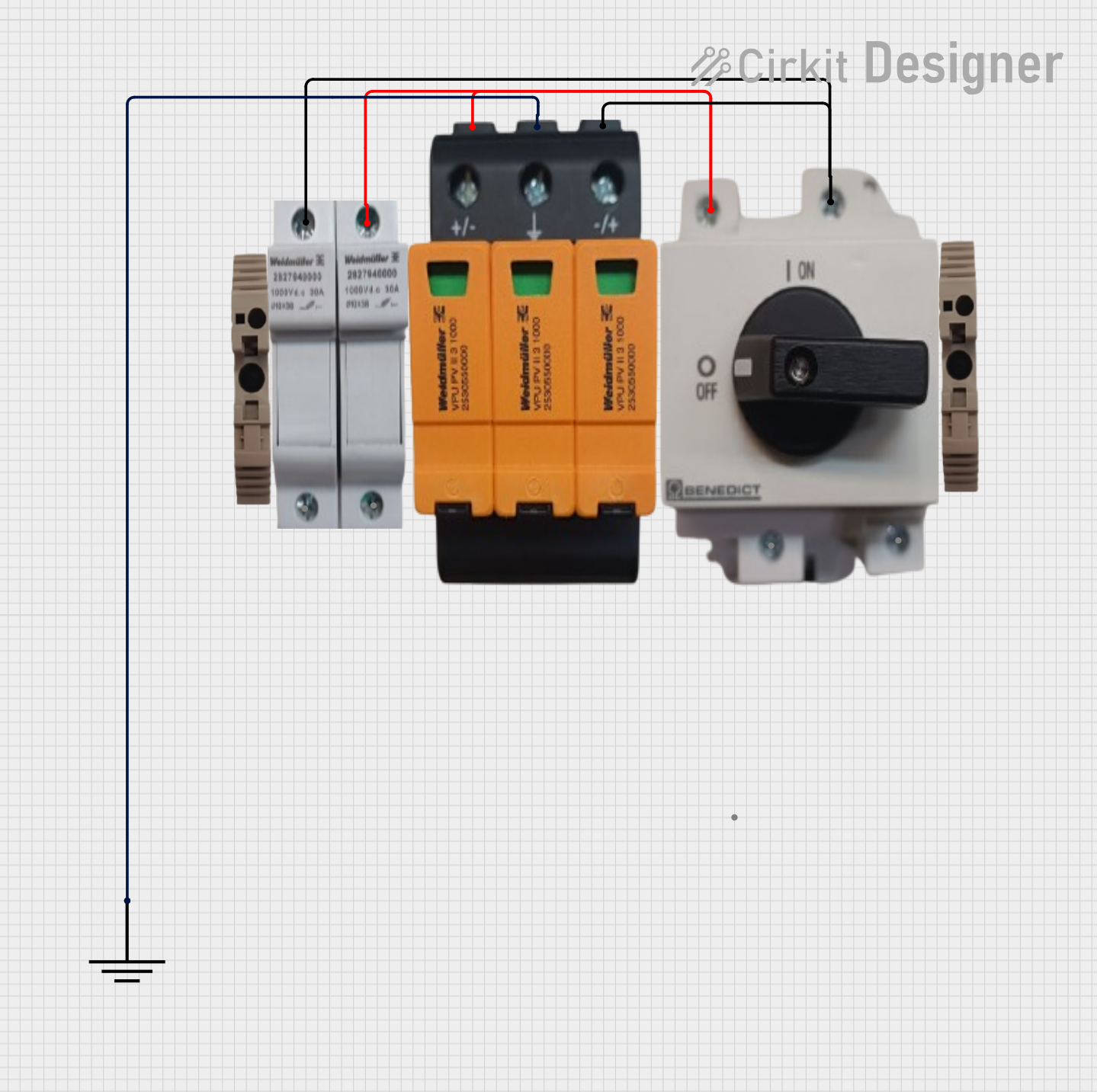
The circuit includes a Benedict Switch connected in series with a Fuse Holder and an SPD (Surge Protection Device). The SPD is also connected to a Ground reference. This configuration suggests that the circuit is designed to control power flow, protect against overcurrent with the fuse, and guard against voltage surges with the SPD, with a safe path to ground for surge dissipation.
Open Project in Cirkit DesignerArduino UNO-Based Sensor Array with Resistor Network
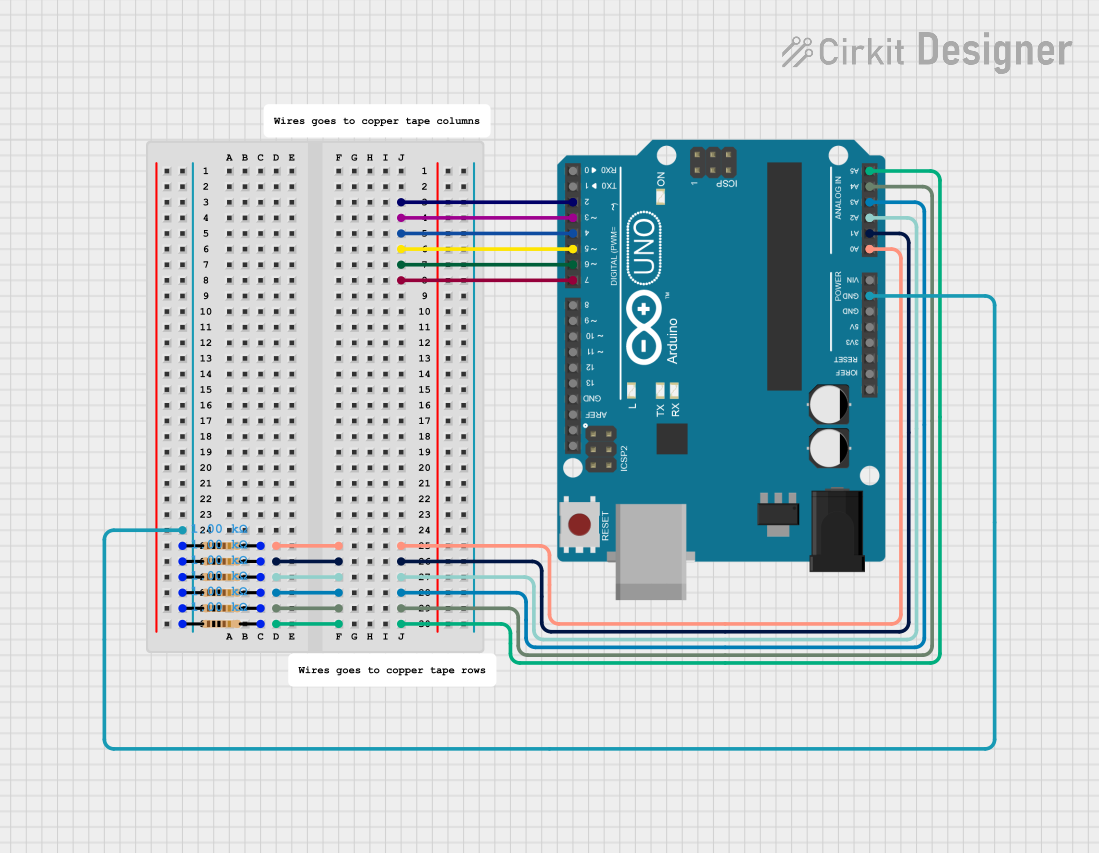
This circuit features an Arduino UNO microcontroller connected to six 1k Ohm resistors. Each resistor is connected between the ground (GND) and one of the analog input pins (A0 to A5) on the Arduino, likely for the purpose of reading analog sensor values or creating a voltage divider network.
Open Project in Cirkit DesignerExplore Projects Built with GND
12V Multi-Component Control Circuit
This circuit appears to be a power distribution system that supplies power to various components from a 12V 5A power supply. It connects the negative terminal of the power supply to the ground (GND) pins of a mini diaphragm water pump, an RGB LED, a fan, and a water pump, while the positive DC output is connected to the positive pins of the RGB LED and presumably to other components through JST PH 2.0 connectors. The circuit lacks a controlling element, such as a microcontroller, suggesting that the components operate continuously or are switched externally.
Open Project in Cirkit DesignerPushbutton Interface with General Purpose I/O Plug
This circuit consists of a General Purpose Input/Output (GPIO) plug connected to four pushbuttons. Each pushbutton is wired to a unique input pin on the GPIO plug, allowing the state of each button (pressed or not pressed) to be detected individually. The common terminals of the pushbuttons are interconnected and likely serve as a ground or reference voltage connection.
Open Project in Cirkit DesignerBasic Surge Protection Circuit with Benedict Switch
The circuit includes a Benedict Switch connected in series with a Fuse Holder and an SPD (Surge Protection Device). The SPD is also connected to a Ground reference. This configuration suggests that the circuit is designed to control power flow, protect against overcurrent with the fuse, and guard against voltage surges with the SPD, with a safe path to ground for surge dissipation.
Open Project in Cirkit DesignerArduino UNO-Based Sensor Array with Resistor Network
This circuit features an Arduino UNO microcontroller connected to six 1k Ohm resistors. Each resistor is connected between the ground (GND) and one of the analog input pins (A0 to A5) on the Arduino, likely for the purpose of reading analog sensor values or creating a voltage divider network.
Open Project in Cirkit DesignerTechnical Specifications
- GND is not an active component but a critical connection in any circuit. It does not have specific voltage or current ratings but is defined as the zero-voltage reference point.
- GND is typically represented by a symbol in circuit diagrams: a set of horizontal lines decreasing in length or a triangle pointing downward.
Pin Configuration and Descriptions
GND is often associated with specific pins on electronic components or connectors. Below is an example of how GND is used in common devices:
| Device/Connector | Pin Name | Description |
|---|---|---|
| Arduino UNO | GND | Ground pin for completing the circuit. |
| USB Connector | GND | Ground connection for power and data. |
| Sensors (e.g., DHT11) | GND | Ground pin for power and signal return. |
Usage Instructions
How to Use GND in a Circuit:
- Identify the GND pin or terminal on your components, such as microcontrollers, sensors, or power supplies.
- Connect all GND pins in the circuit to a common ground point. This ensures a shared reference voltage and proper current return paths.
- If using a breadboard, connect the GND pin of your power source (e.g., battery or USB) to the ground rail of the breadboard. Then, connect all other components' GND pins to this rail.
Important Considerations and Best Practices:
- Always ensure that all components in a circuit share a common ground to avoid voltage mismatches or erratic behavior.
- For high-frequency or high-power circuits, use a ground plane (a large conductive area) to minimize noise and interference.
- Avoid creating ground loops, which occur when multiple ground paths exist, as they can introduce noise and instability.
- In circuits involving an Arduino UNO, connect the GND pin of the Arduino to the GND of all other components.
Example: Connecting GND to an Arduino UNO Below is an example of connecting a sensor to an Arduino UNO, including the GND connection:
// Example: Reading data from a sensor connected to an Arduino UNO
// Ensure the sensor's GND pin is connected to the Arduino's GND pin.

const int sensorPin = A0; // Sensor output connected to analog pin A0
int sensorValue = 0;      // Variable to store the sensor reading

void setup() {
  Serial.begin(9600); // Initialize serial communication
}

void loop() {
  sensorValue = analogRead(sensorPin); // Read the sensor value
  Serial.println(sensorValue);        // Print the value to the Serial Monitor
  delay(500);                         // Wait for 500ms before the next reading
}
Troubleshooting and FAQs
Common Issues:
- Circuit not working or behaving erratically:
- Ensure all components share a common ground connection.
- Check for loose or broken GND connections.
- Noise or interference in the circuit:
- Use a ground plane or thicker wires for GND connections in high-frequency circuits.
- Avoid long GND wires, as they can introduce resistance and noise.
- Voltage measurements are incorrect:
- Verify that the GND reference point is properly connected to the circuit.
- Circuit not working or behaving erratically:
FAQs:
- Can I connect multiple GND points in a circuit?
- Yes, all GND points should be connected to a common ground to ensure proper operation.
- What happens if I don't connect GND?
- The circuit will not function correctly, as there will be no return path for current, and voltage references will be undefined.
- Is GND always at 0V?
- GND is defined as the 0V reference point in a circuit. However, in some systems, it may not be physically at 0V relative to the earth ground.
- Can I connect multiple GND points in a circuit?
By following these guidelines and best practices, you can ensure that GND connections in your circuits are reliable and effective.