
How to Use 18650 Li-ion Battery x 2: Examples, Pinouts, and Specs
 Design with 18650 Li-ion Battery x 2 in Cirkit Designer
Introduction
The Samsung 18650 Li-ion Battery is a rechargeable lithium-ion battery known for its high energy density, long cycle life, and reliability. This documentation covers the use of two 18650 batteries in series or parallel configurations. These batteries are widely used in portable electronics, power banks, flashlights, and electric vehicles due to their compact size and excellent performance.
When used in pairs, the 18650 batteries can provide higher voltage (in series) or increased capacity (in parallel), making them versatile for various applications.
Explore Projects Built with 18650 Li-ion Battery x 2
 Open Project in Cirkit Designer
 Open Project in Cirkit Designer
 Open Project in Cirkit Designer
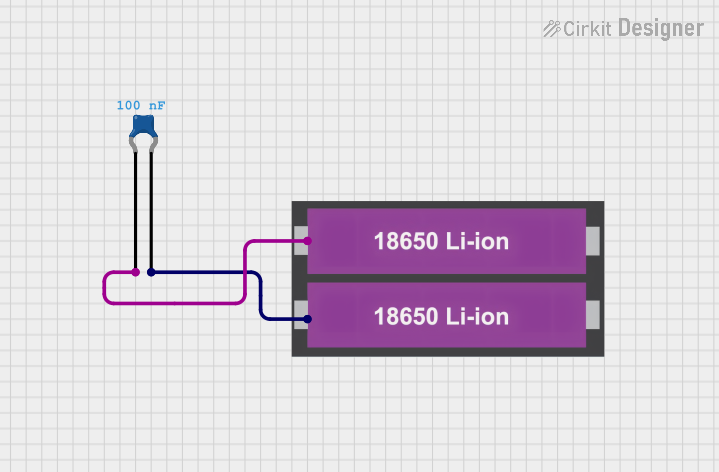 Open Project in Cirkit Designer
Explore Projects Built with 18650 Li-ion Battery x 2
Open Project in Cirkit DesignerOpen Project in Cirkit DesignerOpen Project in Cirkit DesignerOpen Project in Cirkit DesignerTechnical Specifications
Below are the key technical details for the Samsung 18650 Li-ion Battery:
| Specification | Value |
|---|---|
| Manufacturer | Samsung |
| Manufacturer Part ID | 18650 |
| Nominal Voltage (Single) | 3.6V |
| Nominal Capacity (Single) | 2600mAh to 3500mAh (varies by model) |
| Maximum Discharge Current | 10A to 30A (varies by model) |
| Charging Voltage | 4.2V |
| Charging Current | Standard: 0.5C, Max: 1C |
| Dimensions (Single) | 18mm (diameter) x 65mm (length) |
| Weight (Single) | ~45g |
| Chemistry | Lithium-ion (LiNiCoAlO2) |
| Cycle Life | ~500-1000 cycles |
| Operating Temperature | Charge: 0°C to 45°C, Discharge: -20°C to 60°C |
Pin Configuration and Descriptions
The 18650 battery does not have traditional pins but features two terminals:
| Terminal | Description |
|---|---|
| Positive (+) | The positive terminal of the battery |
| Negative (-) | The negative terminal of the battery |
When connecting two 18650 batteries, ensure proper polarity to avoid damage or hazards.
Usage Instructions
Using 18650 Batteries in a Circuit
Determine Configuration:
- Series Connection: Connect the positive terminal of one battery to the negative terminal of the other. This doubles the voltage while maintaining the same capacity.
- Parallel Connection: Connect the positive terminals together and the negative terminals together. This doubles the capacity while maintaining the same voltage.
Battery Holder:
- Use a suitable 18650 battery holder to securely mount the batteries and ensure proper connections.
Protection Circuit:
- Always use a Battery Management System (BMS) or protection circuit to prevent overcharging, over-discharging, and short circuits.
Charging:
- Use a dedicated Li-ion battery charger with a constant current/constant voltage (CC/CV) charging profile. Ensure the charger is compatible with the combined voltage and capacity of the two batteries.
Load Connection:
- Connect the load to the output terminals of the battery pack. Ensure the load does not exceed the maximum discharge current of the batteries.
Important Considerations and Best Practices
- Safety: Never short-circuit the terminals or expose the batteries to fire or water.
- Balancing: For series configurations, use a BMS with cell balancing to ensure even charging and discharging.
- Storage: Store batteries in a cool, dry place at ~50% charge for long-term storage.
- Disposal: Recycle used batteries at certified e-waste facilities.
Example: Connecting to an Arduino UNO
To power an Arduino UNO using two 18650 batteries in series (7.2V nominal), you can use a DC-DC step-down converter to regulate the voltage to 5V. Below is an example circuit and code:
Circuit
- Connect the positive terminal of the battery pack to the input of the DC-DC converter.
- Connect the output of the DC-DC converter to the Arduino UNO's 5V and GND pins.
Code
// Example code to blink an LED connected to pin 13 on Arduino UNO
// Ensure the Arduino is powered via the 5V pin using the 18650 battery pack

void setup() {
  pinMode(13, OUTPUT); // Set pin 13 as an output
}

void loop() {
  digitalWrite(13, HIGH); // Turn the LED on
  delay(1000);            // Wait for 1 second
  digitalWrite(13, LOW);  // Turn the LED off
  delay(1000);            // Wait for 1 second
}
Troubleshooting and FAQs
Common Issues
Battery Overheating:
- Cause: Overcharging, over-discharging, or excessive current draw.
- Solution: Use a BMS and ensure the load is within the battery's discharge limits.
Uneven Charging in Series:
- Cause: Lack of cell balancing.
- Solution: Use a BMS with balancing features.
No Output Voltage:
- Cause: Protection circuit triggered due to over-discharge or short circuit.
- Solution: Recharge the batteries using a compatible charger.
Arduino Not Powering On:
- Cause: Incorrect voltage or polarity.
- Solution: Verify the output voltage of the DC-DC converter and check connections.
FAQs
Can I use 18650 batteries without a BMS?
- It is not recommended. A BMS ensures safety and prolongs battery life by preventing overcharging, over-discharging, and short circuits.
How do I know when the batteries are fully charged?
- A fully charged 18650 battery will have a voltage of 4.2V. Use a charger with an indicator or measure the voltage with a multimeter.
Can I mix different brands or capacities of 18650 batteries?
- No, always use identical batteries with the same capacity, brand, and charge state to avoid imbalances.
What is the maximum load I can connect to two 18650 batteries in parallel?
- The maximum load depends on the combined discharge current rating of the batteries. For example, if each battery supports 10A, the parallel configuration can handle up to 20A.
By following this documentation, you can safely and effectively use two Samsung 18650 Li-ion batteries in your projects.