
How to Use A4988: Examples, Pinouts, and Specs
 Design with A4988 in Cirkit Designer
Introduction
The A4988 is a microstepping driver designed for controlling bipolar stepper motors. It is widely used in applications requiring precise motor control, such as 3D printers, CNC machines, and robotics. The A4988 supports microstepping resolutions of full step, half step, quarter step, eighth step, and sixteenth step, enabling smooth and accurate motor operation. Additionally, it features adjustable current control, thermal shutdown, and overcurrent protection, making it a reliable choice for various projects.
Explore Projects Built with A4988
 Open Project in Cirkit Designer
 Open Project in Cirkit Designer
 Open Project in Cirkit Designer
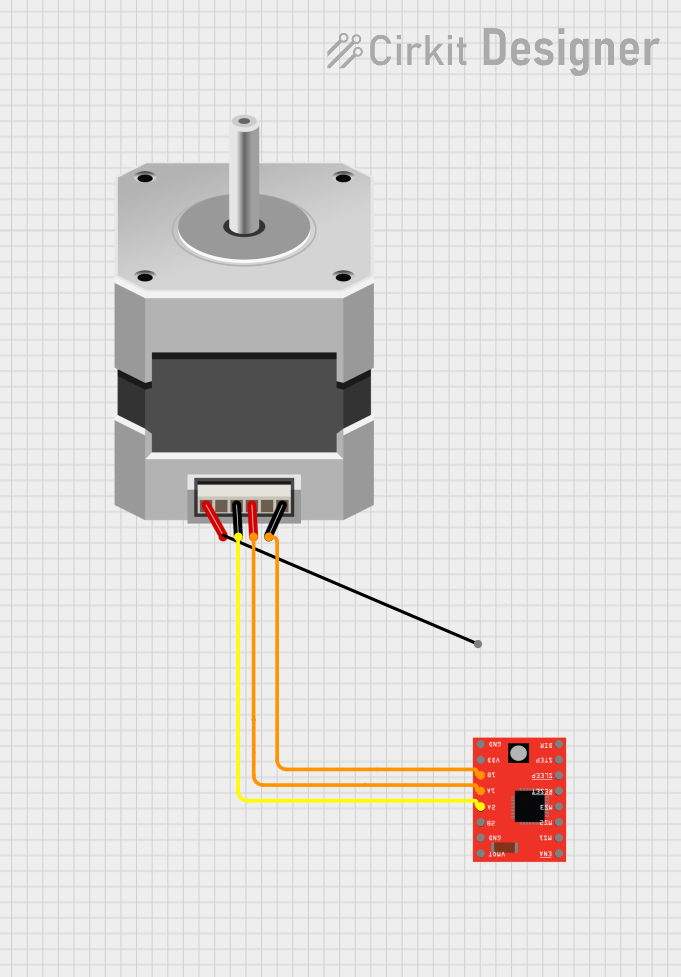 Open Project in Cirkit Designer
Explore Projects Built with A4988
Open Project in Cirkit DesignerOpen Project in Cirkit DesignerOpen Project in Cirkit DesignerOpen Project in Cirkit DesignerCommon Applications
- 3D printers for precise movement of print heads
- CNC machines for accurate tool positioning
- Robotics for controlling robotic arms and wheels
- Automated systems requiring stepper motor control
Technical Specifications
The A4988 is a compact and versatile stepper motor driver with the following key specifications:
| Parameter | Value |
|---|---|
| Motor Type Supported | Bipolar stepper motors |
| Operating Voltage (Vcc) | 8V to 35V |
| Logic Voltage (Vdd) | 3.3V or 5V |
| Maximum Current per Phase | 2A (with sufficient cooling) |
| Microstepping Modes | Full, 1/2, 1/4, 1/8, 1/16 |
| Current Control | Adjustable via potentiometer |
| Protection Features | Overcurrent, thermal shutdown |
| Step Frequency | Up to 500 kHz |
Pin Configuration and Descriptions
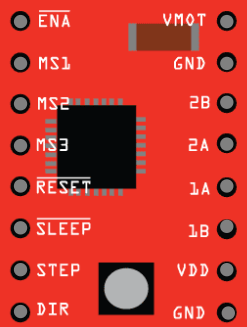
The A4988 has 16 pins, each serving a specific function. Below is the pinout and description:
| Pin Name | Type | Description |
|---|---|---|
| VMOT | Power | Motor power supply (8V to 35V). Connect to the stepper motor's power source. |
| GND | Power | Ground connection for motor power supply. |
| VDD | Power | Logic voltage supply (3.3V or 5V). |
| GND | Power | Ground connection for logic voltage supply. |
| 1A, 1B | Output | Connect to one coil of the stepper motor. |
| 2A, 2B | Output | Connect to the other coil of the stepper motor. |
| STEP | Input | Pulse signal to control motor steps. |
| DIR | Input | Direction control signal. |
| ENABLE | Input | Enables or disables the driver (active low). |
| MS1, MS2, MS3 | Input | Microstepping resolution selection pins. |
| RESET | Input | Resets the driver (active low). |
| SLEEP | Input | Puts the driver into low-power sleep mode (active low). |
| REF | Input | Reference voltage for current control. Adjusted via the onboard potentiometer. |
| FAULT | Output | Indicates fault conditions (e.g., overcurrent, thermal shutdown). |
Usage Instructions
Connecting the A4988 to a Stepper Motor
- Power Supply: Connect VMOT and GND to the motor power supply (8V to 35V). Add a decoupling capacitor (e.g., 100 µF) across these pins to reduce voltage spikes.
- Logic Voltage: Connect VDD and GND to the logic power supply (3.3V or 5V).
- Motor Coils: Connect the stepper motor's two coils to the 1A, 1B, 2A, and 2B pins. Ensure the correct pairing of the motor wires.
- Control Pins: Connect STEP and DIR to your microcontroller or control circuit. Use ENABLE, MS1, MS2, MS3, RESET, and SLEEP as needed for additional control.
Adjusting Current Limit
- Locate the small potentiometer on the A4988 board.
- Use a multimeter to measure the voltage at the REF pin.
- Adjust the potentiometer to set the desired current limit using the formula: [ I_{max} = \frac{V_{REF}}{8 \times R_{sense}} ] where ( R_{sense} ) is typically 0.1Ω (check your board's documentation).
Example: Using A4988 with Arduino UNO
Below is an example code to control a stepper motor using the A4988 and Arduino UNO:
// Define control pins
#define STEP_PIN 3  // Connect to STEP pin on A4988
#define DIR_PIN 4   // Connect to DIR pin on A4988

void setup() {
  pinMode(STEP_PIN, OUTPUT); // Set STEP pin as output
  pinMode(DIR_PIN, OUTPUT);  // Set DIR pin as output

  digitalWrite(DIR_PIN, HIGH); // Set initial direction (HIGH or LOW)
}

void loop() {
  // Generate a pulse to move the motor one step
  digitalWrite(STEP_PIN, HIGH); // Set STEP pin HIGH
  delayMicroseconds(1000);      // Wait for 1 ms
  digitalWrite(STEP_PIN, LOW);  // Set STEP pin LOW
  delayMicroseconds(1000);      // Wait for 1 ms
}
Best Practices
- Use a heatsink or active cooling if driving motors at high currents.
- Always power the logic voltage (VDD) before the motor voltage (VMOT) to avoid damage.
- Avoid connecting or disconnecting the motor while the driver is powered.
Troubleshooting and FAQs
Common Issues
Motor Not Moving:
- Check the wiring of the motor coils. Ensure the correct pairing of wires.
- Verify that the STEP and DIR signals are being sent correctly.
- Ensure the current limit is set appropriately for your motor.
Driver Overheating:
- Use a heatsink or active cooling to dissipate heat.
- Reduce the current limit using the potentiometer.
Motor Vibrates but Doesn't Rotate:
- Check the microstepping settings (MS1, MS2, MS3).
- Ensure the motor is receiving sufficient voltage and current.
FAULT Pin Active:
- Check for overcurrent or thermal shutdown conditions.
- Verify that the motor and power supply are within the driver's specifications.
FAQs
Q: Can I use the A4988 with a unipolar stepper motor?
A: No, the A4988 is designed for bipolar stepper motors only.
Q: How do I select the microstepping mode?
A: Use the MS1, MS2, and MS3 pins to configure the microstepping mode as shown below:
| MS1 | MS2 | MS3 | Microstepping Mode |
|---|---|---|---|
| LOW | LOW | LOW | Full Step |
| HIGH | LOW | LOW | Half Step |
| LOW | HIGH | LOW | Quarter Step |
| HIGH | HIGH | LOW | Eighth Step |
| HIGH | HIGH | HIGH | Sixteenth Step |
Q: What happens if I exceed the current limit?
A: The A4988 has built-in overcurrent protection and will shut down to prevent damage. Reduce the current limit or improve cooling to resolve the issue.