
How to Use IRIV EdgeAI CM5: Examples, Pinouts, and Specs
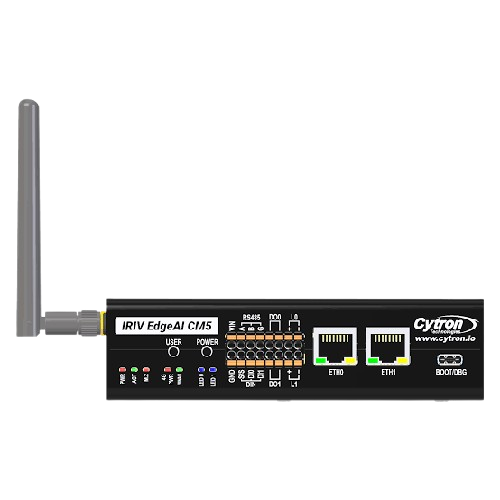
 Design with IRIV EdgeAI CM5 in Cirkit Designer
Introduction
The IRIV EdgeAI CM5 by Cytron Technologies (Part ID: IRIV-EdgeAI-CM5) is a compact, high-performance computing module tailored for edge AI applications. It is designed to handle advanced machine learning and computer vision tasks, making it ideal for real-time data analysis and decision-making in IoT, robotics, and automation systems. With its optimized processing capabilities, the IRIV EdgeAI CM5 enables developers to deploy AI models directly at the edge, reducing latency and reliance on cloud computing.
Explore Projects Built with IRIV EdgeAI CM5
 Open Project in Cirkit Designer
 Open Project in Cirkit Designer
 Open Project in Cirkit Designer
 Open Project in Cirkit Designer
Explore Projects Built with IRIV EdgeAI CM5
Open Project in Cirkit DesignerOpen Project in Cirkit DesignerOpen Project in Cirkit DesignerOpen Project in Cirkit DesignerCommon Applications
- IoT Devices: Real-time data processing for smart home and industrial IoT systems.
- Robotics: Object detection, path planning, and autonomous navigation.
- Surveillance Systems: AI-powered video analytics for security and monitoring.
- Healthcare: Edge-based diagnostic tools and patient monitoring systems.
- Smart Cities: Traffic management, environmental monitoring, and public safety.
Technical Specifications
Key Technical Details
| Parameter | Specification |
|---|---|
| Processor | Quad-core ARM Cortex-A53 @ 1.5 GHz |
| AI Accelerator | Integrated Neural Processing Unit (NPU) with 1 TOPS (Tera Operations Per Second) |
| Memory | 4GB LPDDR4 RAM |
| Storage | 16GB eMMC (expandable via microSD card slot) |
| Connectivity | Wi-Fi 802.11ac, Bluetooth 5.0, Gigabit Ethernet |
| Operating Voltage | 5V DC |
| Power Consumption | Typical: 3W, Max: 5W |
| Operating Temperature Range | -20°C to 70°C |
| Dimensions | 85mm x 56mm x 20mm |
| Weight | 50g |
Pin Configuration and Descriptions
The IRIV EdgeAI CM5 features a 40-pin GPIO header for interfacing with external devices. Below is the pinout configuration:
| Pin Number | Pin Name | Description | Voltage Level |
|---|---|---|---|
| 1 | 3.3V | Power supply (3.3V output) | 3.3V |
| 2 | 5V | Power supply (5V output) | 5V |
| 3 | GPIO2 (SDA) | I2C Data | 3.3V |
| 4 | 5V | Power supply (5V output) | 5V |
| 5 | GPIO3 (SCL) | I2C Clock | 3.3V |
| 6 | GND | Ground | 0V |
| 7 | GPIO4 | General-purpose I/O | 3.3V |
| 8 | GPIO14 (TXD) | UART Transmit | 3.3V |
| 9 | GND | Ground | 0V |
| 10 | GPIO15 (RXD) | UART Receive | 3.3V |
| ... | ... | ... | ... |
| 39 | GPIO21 | General-purpose I/O | 3.3V |
| 40 | GPIO22 | General-purpose I/O | 3.3V |
Note: For the full pinout, refer to the official datasheet provided by Cytron Technologies.
Usage Instructions
How to Use the IRIV EdgeAI CM5 in a Circuit
- Power Supply: Connect a stable 5V DC power source to the 5V pin or via the USB-C port.
- Peripheral Connections: Use the 40-pin GPIO header to interface with sensors, actuators, or other peripherals.
- AI Model Deployment:
- Train your AI model using a framework like TensorFlow or PyTorch.
- Convert the model to a format compatible with the integrated NPU (e.g., TensorFlow Lite).
- Deploy the model to the CM5 using the provided SDK or tools.
- Programming: The CM5 supports multiple programming languages, including Python and C++. Use the Cytron EdgeAI SDK for optimized performance.
Important Considerations
- Cooling: Ensure adequate ventilation or use a heatsink if operating under high computational loads.
- Power Supply: Use a regulated power source to avoid voltage fluctuations that may damage the module.
- Firmware Updates: Regularly check for firmware updates from Cytron Technologies to ensure optimal performance and security.
- GPIO Voltage Levels: The GPIO pins operate at 3.3V logic levels. Use level shifters if interfacing with 5V devices.
Example: Connecting to an Arduino UNO
The IRIV EdgeAI CM5 can communicate with an Arduino UNO via UART. Below is an example of how to send data from the Arduino to the CM5.
Arduino Code
// Example: Sending data from Arduino UNO to IRIV EdgeAI CM5 via UART

void setup() {
  Serial.begin(9600); // Initialize UART communication at 9600 baud rate
}

void loop() {
  Serial.println("Hello, IRIV EdgeAI CM5!"); // Send a message to the CM5
  delay(1000); // Wait for 1 second before sending the next message
}
Python Code for IRIV EdgeAI CM5
Example: Receiving data on IRIV EdgeAI CM5 from Arduino UNO via UART
import serial
Initialize UART communication (adjust port and baud rate as needed)
ser = serial.Serial('/dev/ttyS0', 9600, timeout=1)
while True: data = ser.readline().decode('utf-8').strip() # Read and decode incoming data if data: print(f"Received: {data}") # Print the received message
---
Troubleshooting and FAQs
Common Issues and Solutions
Module Not Powering On:
- Ensure the power supply provides a stable 5V DC output.
- Check the USB-C cable or GPIO power connections for faults.
GPIO Pins Not Responding:
- Verify the GPIO pin configuration in your code.
- Ensure the connected device operates at 3.3V logic levels.
AI Model Not Running:
- Confirm the model is converted to a format compatible with the NPU.
- Check for errors in the deployment process using the Cytron EdgeAI SDK.
Overheating:
- Use a heatsink or active cooling if the module operates under heavy loads for extended periods.
FAQs
Q: Can I use the IRIV EdgeAI CM5 with a battery?
- A: Yes, as long as the battery provides a stable 5V output. Consider using a power management module for safety.
Q: What operating systems are supported?
- A: The CM5 supports Linux-based operating systems optimized for edge AI applications.
Q: How do I update the firmware?
- A: Download the latest firmware from the Cytron Technologies website and follow the update instructions provided in the user manual.
Q: Can I connect multiple sensors to the CM5?
- A: Yes, the 40-pin GPIO header allows for multiple sensor connections. Use I2C, SPI, or UART protocols as needed.
This concludes the documentation for the IRIV EdgeAI CM5. For further assistance, refer to the official resources provided by Cytron Technologies.