
How to Use QTR8A: Examples, Pinouts, and Specs
 Design with QTR8A in Cirkit Designer
Introduction
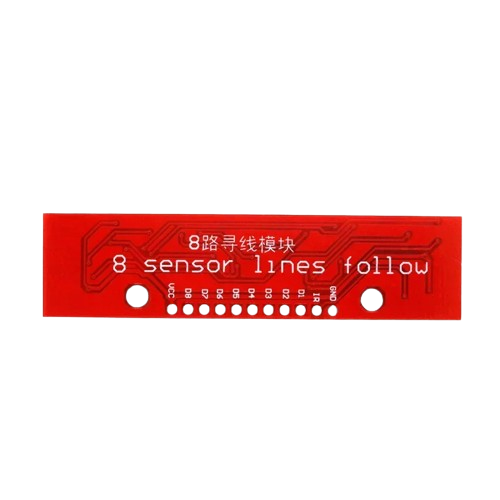
The QTR8A is an 8-channel infrared (IR) reflective sensor array designed for detecting the presence of objects or measuring distances. It features eight pairs of IR emitters and photodetectors arranged in a linear configuration, making it ideal for applications requiring precise tracking or proximity sensing. This sensor array is commonly used in robotics, line-following robots, and automation systems where accurate detection of reflective surfaces or objects is essential.
Explore Projects Built with QTR8A
 Open Project in Cirkit Designer
 Open Project in Cirkit Designer
 Open Project in Cirkit Designer
 Open Project in Cirkit Designer
Explore Projects Built with QTR8A
Open Project in Cirkit DesignerOpen Project in Cirkit DesignerOpen Project in Cirkit DesignerOpen Project in Cirkit DesignerCommon Applications
- Line-following robots
- Edge detection in robotics
- Object tracking and proximity sensing
- Industrial automation systems
- Position sensing in conveyor belts
Technical Specifications
Key Technical Details
- Operating Voltage: 5V DC
- Current Consumption: ~100 mA (all LEDs on)
- Output Type: Analog voltage (0V to 5V per channel)
- Sensor Count: 8 IR emitter-detector pairs
- Detection Range: 3 mm to 30 mm (depending on surface reflectivity)
- Dimensions: 76.2 mm × 12.7 mm × 3.2 mm
- Weight: ~3 g
- Connector Type: 0.1" pitch header pins
Pin Configuration and Descriptions
The QTR8A sensor array has a 10-pin header for interfacing. The pinout is as follows:
| Pin | Name | Description |
|---|---|---|
| 1 | VCC | Power supply input (5V DC). |
| 2 | GND | Ground connection. |
| 3 | OUT1 | Analog output for sensor 1 (leftmost sensor). |
| 4 | OUT2 | Analog output for sensor 2. |
| 5 | OUT3 | Analog output for sensor 3. |
| 6 | OUT4 | Analog output for sensor 4. |
| 7 | OUT5 | Analog output for sensor 5. |
| 8 | OUT6 | Analog output for sensor 6. |
| 9 | OUT7 | Analog output for sensor 7. |
| 10 | OUT8 | Analog output for sensor 8 (rightmost sensor). |
Usage Instructions
How to Use the QTR8A in a Circuit
Powering the Sensor Array:
- Connect the VCC pin to a 5V DC power source.
- Connect the GND pin to the ground of your circuit.
Reading Sensor Outputs:
- Each sensor output (OUT1 to OUT8) provides an analog voltage proportional to the reflectivity of the surface beneath it.
- Use an analog-to-digital converter (ADC) on a microcontroller (e.g., Arduino UNO) to read the sensor values.
Mounting the Sensor:
- Position the QTR8A sensor array approximately 3 mm to 10 mm above the surface for optimal performance.
- Ensure the IR emitters face the surface to be detected.
Interfacing with an Arduino UNO:
- Connect the sensor outputs (OUT1 to OUT8) to the analog input pins (A0 to A7) of the Arduino UNO.
- Use the following sample code to read and display sensor values.
Sample Arduino Code
// QTR8A Sensor Array Example Code
// Reads analog values from the QTR8A sensor array and prints them to the Serial Monitor.

const int sensorPins[8] = {A0, A1, A2, A3, A4, A5, A6, A7}; // Analog pins for sensors
int sensorValues[8]; // Array to store sensor readings

void setup() {
  Serial.begin(9600); // Initialize serial communication at 9600 baud
  for (int i = 0; i < 8; i++) {
    pinMode(sensorPins[i], INPUT); // Set sensor pins as input
  }
}

void loop() {
  // Read sensor values
  for (int i = 0; i < 8; i++) {
    sensorValues[i] = analogRead(sensorPins[i]); // Read analog value
  }

  // Print sensor values to Serial Monitor
  for (int i = 0; i < 8; i++) {
    Serial.print("Sensor ");
    Serial.print(i + 1);
    Serial.print(": ");
    Serial.print(sensorValues[i]);
    Serial.print("\t"); // Tab space for better readability
  }
  Serial.println(); // New line after printing all sensor values
  delay(100); // Short delay for stability
}
Important Considerations and Best Practices
- Surface Reflectivity: The sensor's performance depends on the reflectivity of the surface. Darker surfaces reflect less IR light, resulting in lower output voltages.
- Ambient Light Interference: Minimize ambient IR light interference by shielding the sensor or using it in controlled lighting conditions.
- Sensor Calibration: Calibrate the sensor array for your specific application to improve accuracy. This can involve determining threshold values for detecting lines or objects.
- Power Supply: Ensure a stable 5V power supply to avoid fluctuations in sensor readings.
Troubleshooting and FAQs
Common Issues and Solutions
No Output or Incorrect Readings:
- Cause: Improper power connection.
- Solution: Verify that the VCC and GND pins are correctly connected to a 5V power source and ground.
Inconsistent Sensor Readings:
- Cause: Ambient IR light interference or unstable power supply.
- Solution: Shield the sensor from external IR sources and ensure a stable 5V power supply.
Low Sensitivity to Reflective Surfaces:
- Cause: Sensor height is too high or surface reflectivity is too low.
- Solution: Adjust the sensor height to be within the recommended range (3 mm to 10 mm). Use surfaces with higher reflectivity if possible.
Sensor Outputs All Read Maximum or Minimum Values:
- Cause: Incorrect wiring or damaged sensor.
- Solution: Check the wiring and ensure all connections are secure. If the issue persists, test each sensor individually to identify any damaged components.
FAQs
Q1: Can the QTR8A detect colors?
A1: No, the QTR8A is designed to detect reflectivity, not color. It can differentiate between light and dark surfaces based on their reflectivity.
Q2: What is the maximum distance the QTR8A can detect?
A2: The detection range is typically 3 mm to 30 mm, depending on the reflectivity of the surface.
Q3: Can I use fewer than 8 sensors?
A3: Yes, you can use fewer sensors by connecting only the desired output pins to your microcontroller.
Q4: Is the QTR8A compatible with 3.3V systems?
A4: The QTR8A is designed for 5V operation. To use it with a 3.3V system, you may need a level shifter or voltage divider for the outputs.