
How to Use DIODE ARR SCHOT 150V 30A TO247AD: Examples, Pinouts, and Specs
 Design with DIODE ARR SCHOT 150V 30A TO247AD in Cirkit Designer
Introduction
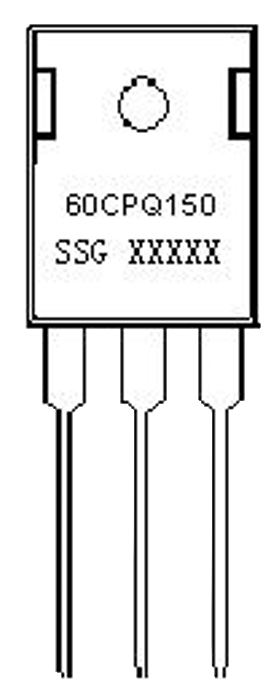
The DIODE ARR SCHOT 150V 30A TO247AD (Manufacturer Part ID: 60CPQ150) is a high-performance Schottky diode manufactured by SMC Diode Solutions. This diode is designed for applications requiring fast switching speeds, low forward voltage drops, and high current handling capabilities. It is housed in a robust TO-247AD package, making it suitable for high-power applications.
Explore Projects Built with DIODE ARR SCHOT 150V 30A TO247AD
 Open Project in Cirkit Designer
 Open Project in Cirkit Designer
 Open Project in Cirkit Designer
 Open Project in Cirkit Designer
Explore Projects Built with DIODE ARR SCHOT 150V 30A TO247AD
Open Project in Cirkit DesignerOpen Project in Cirkit DesignerOpen Project in Cirkit DesignerOpen Project in Cirkit DesignerCommon Applications and Use Cases
- Power supply rectification
- DC-DC converters
- Freewheeling diodes in motor drives
- High-frequency inverters
- Solar panel bypass diodes
- Battery charging systems
Technical Specifications
Key Technical Details
| Parameter | Value |
|---|---|
| Manufacturer | SMC Diode Solutions |
| Part Number | 60CPQ150 |
| Diode Type | Schottky |
| Maximum Reverse Voltage (VR) | 150V |
| Maximum Forward Current (IF) | 30A |
| Forward Voltage Drop (VF) | 0.84V (typical at 15A) |
| Reverse Leakage Current (IR) | 1mA (typical at 150V) |
| Maximum Junction Temperature (Tj) | -55°C to +150°C |
| Package Type | TO-247AD |
| Reverse Recovery Time (trr) | Negligible (Schottky diodes are fast-switching) |
Pin Configuration and Descriptions
The TO-247AD package has three pins, as described below:
| Pin Number | Pin Name | Description |
|---|---|---|
| 1 | Anode 1 (A1) | Positive terminal for diode 1 |
| 2 | Cathode (K) | Shared negative terminal for both diodes |
| 3 | Anode 2 (A2) | Positive terminal for diode 2 |
Package Diagram
Below is a simplified representation of the TO-247AD pinout:
   _______
  |       |
  |       |
  |   K   |  <-- Cathode (Pin 2)
  |_______|
   |  |  |
  A1  K  A2
  |   |   |
 Pin1 Pin2 Pin3
Usage Instructions
How to Use the Component in a Circuit
- Determine Voltage and Current Ratings: Ensure the diode's reverse voltage (150V) and forward current (30A) ratings are suitable for your application.
- Connect the Pins Correctly:
- Connect the Anode (A1 or A2) to the positive side of the circuit.
- Connect the Cathode (K) to the negative side of the circuit.
- Heat Dissipation: Use an appropriate heatsink with the TO-247AD package to manage heat dissipation, especially in high-current applications.
- Protection: Add a fuse or circuit breaker to protect the diode from overcurrent conditions.
Important Considerations and Best Practices
- Thermal Management: The diode can generate significant heat during operation. Ensure proper cooling using heatsinks or forced air cooling.
- Reverse Voltage: Do not exceed the maximum reverse voltage of 150V to avoid damaging the diode.
- Parasitic Inductance: Minimize parasitic inductance in high-frequency circuits by keeping PCB traces short and using proper layout techniques.
- Parallel Operation: If using multiple diodes in parallel, ensure proper current sharing by adding small resistors in series with each diode.
Example: Using the Diode with an Arduino UNO
While the diode itself is not directly interfaced with an Arduino, it can be used in circuits involving the Arduino, such as motor drivers or power supplies. Below is an example of using the diode in a motor driver circuit:
/*
 * Example: Using the 60CPQ150 Schottky diode in a motor driver circuit
 * This code demonstrates controlling a motor using an Arduino UNO and
 * a Schottky diode for freewheeling protection.
 */

const int motorPin = 9; // PWM pin connected to motor driver input

void setup() {
  pinMode(motorPin, OUTPUT); // Set motor pin as output
}

void loop() {
  analogWrite(motorPin, 128); // Run motor at 50% speed
  delay(5000);               // Run for 5 seconds
  analogWrite(motorPin, 0);  // Stop motor
  delay(2000);               // Wait for 2 seconds
}
In this circuit:
- The 60CPQ150 Schottky diode is connected across the motor terminals to protect against voltage spikes caused by the motor's inductive load.
- The cathode (K) is connected to the positive terminal of the motor, and the anode (A1 or A2) is connected to the negative terminal.
Troubleshooting and FAQs
Common Issues and Solutions
| Issue | Possible Cause | Solution |
|---|---|---|
| Diode overheating | Insufficient cooling or overcurrent | Use a larger heatsink or reduce load |
| High reverse leakage current | Exceeding reverse voltage rating | Ensure reverse voltage is <150V |
| Circuit not functioning | Incorrect pin connections | Verify anode and cathode connections |
| Low efficiency in circuit | High forward voltage drop | Check for excessive current draw |
FAQs
Can I use this diode in parallel with another diode?
- Yes, but ensure proper current sharing by adding small resistors in series with each diode.
What is the maximum operating temperature?
- The diode can operate up to a junction temperature of 150°C, but ensure adequate cooling to maintain reliability.
Is this diode suitable for high-frequency applications?
- Yes, the Schottky diode's fast switching speed makes it ideal for high-frequency circuits.
Can I use this diode for solar panel applications?
- Absolutely. The low forward voltage drop and high current rating make it suitable as a bypass diode in solar panels.
By following this documentation, you can effectively integrate the 60CPQ150 Schottky diode into your electronic designs for optimal performance and reliability.