
How to Use NUCLEO-U385RG-Q: Examples, Pinouts, and Specs
 Design with NUCLEO-U385RG-Q in Cirkit Designer
Introduction
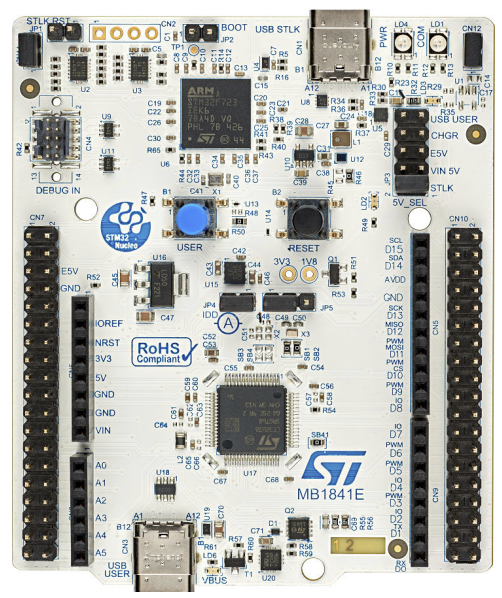
The NUCLEO-U385RG-Q is a development board manufactured by STMicroelectronics, featuring the powerful STM32 microcontroller. This board is designed to facilitate rapid prototyping and development of embedded applications. It offers a flexible platform with multiple connectivity options, including USB, UART, I2C, and more. The NUCLEO-U385RG-Q is compatible with a wide range of expansion boards and shields, making it an excellent choice for both beginners and experienced developers.
Explore Projects Built with NUCLEO-U385RG-Q
 Open Project in Cirkit Designer
 Open Project in Cirkit Designer
 Open Project in Cirkit Designer
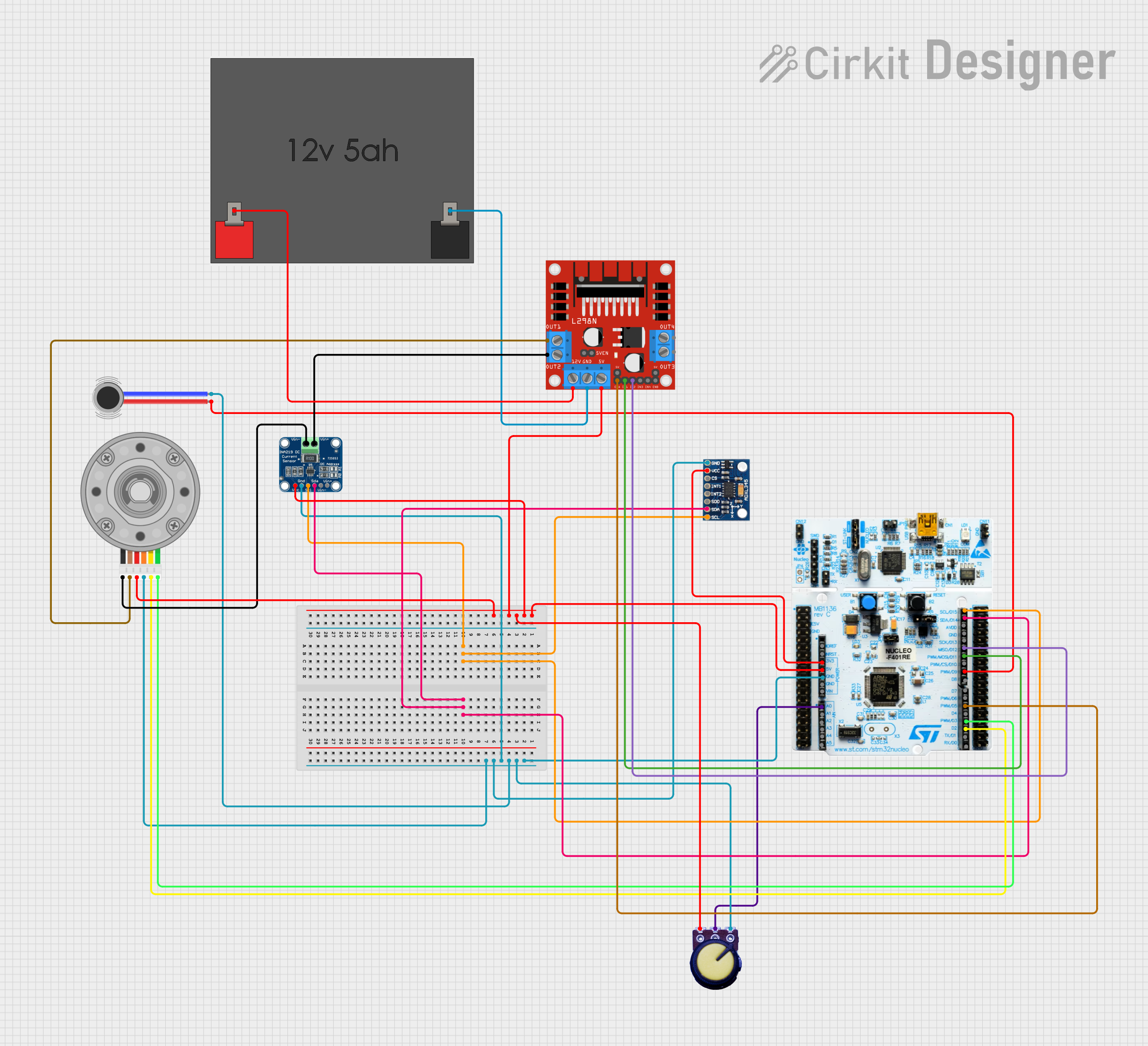 Open Project in Cirkit Designer
Explore Projects Built with NUCLEO-U385RG-Q
Open Project in Cirkit DesignerOpen Project in Cirkit DesignerOpen Project in Cirkit DesignerOpen Project in Cirkit DesignerCommon Applications and Use Cases
- IoT (Internet of Things) device prototyping
- Industrial automation and control systems
- Sensor data acquisition and processing
- Robotics and motor control
- Educational and research projects
- Low-power embedded systems
Technical Specifications
Key Technical Details
| Parameter | Specification |
|---|---|
| Microcontroller | STM32U585RG (Arm® Cortex®-M33 core with TrustZone®) |
| Operating Voltage | 3.3V (core) / 5V (USB and external power supply) |
| Clock Speed | Up to 160 MHz |
| Flash Memory | 2 MB |
| SRAM | 786 KB |
| GPIO Pins | 76 (multipurpose, configurable) |
| Communication Interfaces | USB, UART, I2C, SPI, CAN, LIN, and more |
| Debugging Interface | ST-LINK/V3E (integrated debugger/programmer) |
| Power Supply Options | USB, external power supply (VIN), or ST-LINK USB |
| Expansion Compatibility | Arduino Uno V3 connectors and ST morpho connectors |
| Dimensions | 68.6 mm x 53.3 mm |
Pin Configuration and Descriptions
Arduino Uno V3 Connector Pinout
| Pin Name | Functionality | Description |
|---|---|---|
| A0-A5 | Analog Input | 6 analog input pins for sensors or other devices |
| D0-D13 | Digital I/O | 14 digital I/O pins (PWM available on some pins) |
| VIN | Power Input | External power supply input (7-12V recommended) |
| 3.3V | Power Output | 3.3V regulated output |
| 5V | Power Output | 5V regulated output |
| GND | Ground | Common ground |
| RESET | Reset | Resets the microcontroller |
ST Morpho Connector Pinout
| Pin Name | Functionality | Description |
|---|---|---|
| GPIOx | General Purpose I/O | Configurable pins for digital/analog I/O |
| VDD | Power Supply | Power supply for external peripherals |
| GND | Ground | Common ground |
| USARTx | UART Communication | Serial communication pins |
| I2Cx | I2C Communication | I2C interface pins |
| SPIx | SPI Communication | SPI interface pins |
Usage Instructions
How to Use the NUCLEO-U385RG-Q in a Circuit
Powering the Board:
- Connect the board to your computer via the USB cable for power and programming.
- Alternatively, use an external power supply through the VIN pin or ST-LINK USB.
Programming the Board:
- Install the STM32CubeIDE or any compatible IDE.
- Connect the board to your computer using the USB cable.
- Use the integrated ST-LINK/V3E debugger to upload your code.
Connecting Peripherals:
- Use the Arduino Uno V3 connectors for shields or sensors.
- For advanced configurations, use the ST morpho connectors to access additional GPIOs and interfaces.
Running Your Application:
- After uploading the code, the board will automatically reset and execute the program.
- Monitor the output using a serial terminal (if applicable).
Important Considerations and Best Practices
- Ensure the power supply voltage does not exceed the recommended range to avoid damaging the board.
- Use proper pull-up or pull-down resistors for GPIO pins when required.
- Avoid connecting high-current devices directly to the GPIO pins; use external drivers or relays.
- When using the board in low-power applications, configure the microcontroller's power modes appropriately.
Example Code for Arduino IDE
The NUCLEO-U385RG-Q can be programmed using the Arduino IDE. Below is an example code to blink an LED connected to pin D13:
// Blink an LED on pin D13
// This example demonstrates basic GPIO functionality

void setup() {
  pinMode(13, OUTPUT); // Set pin D13 as an output
}

void loop() {
  digitalWrite(13, HIGH); // Turn the LED on
  delay(1000);            // Wait for 1 second
  digitalWrite(13, LOW);  // Turn the LED off
  delay(1000);            // Wait for 1 second
}
Troubleshooting and FAQs
Common Issues and Solutions
Board Not Detected by the Computer:
- Ensure the USB cable is properly connected and functional.
- Verify that the ST-LINK drivers are installed on your computer.
Code Upload Fails:
- Check that the correct board and port are selected in your IDE.
- Ensure no other application is using the ST-LINK interface.
Peripherals Not Working:
- Double-check the wiring and connections.
- Verify that the correct pins are configured in your code.
Board Overheating:
- Ensure the power supply voltage is within the recommended range.
- Avoid drawing excessive current from the GPIO pins.
FAQs
Q: Can I use the NUCLEO-U385RG-Q with Arduino libraries?
A: Yes, the board is compatible with Arduino libraries when using the STM32 Arduino core.
Q: What IDEs are supported?
A: The board supports STM32CubeIDE, Keil MDK, IAR Embedded Workbench, and the Arduino IDE.
Q: How do I reset the board?
A: Press the RESET button on the board or use the software reset functionality in your IDE.
Q: Can I use multiple communication interfaces simultaneously?
A: Yes, the STM32 microcontroller supports concurrent use of multiple communication interfaces like UART, I2C, and SPI.
Q: Is the board suitable for low-power applications?
A: Absolutely. The STM32U585RG microcontroller includes advanced power-saving features, making it ideal for low-power designs.