
How to Use Modul Charging TP4056: Examples, Pinouts, and Specs
 Design with Modul Charging TP4056 in Cirkit Designer
Introduction
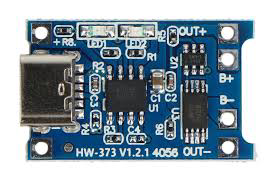
The TP4056 is a lithium battery charger module designed for charging single-cell lithium-ion batteries. It utilizes a constant current/constant voltage (CC/CV) charging method, ensuring safe and efficient charging. The module is equipped with overcharge protection, thermal regulation, and a straightforward interface, making it ideal for integration into a wide range of electronic projects.
Explore Projects Built with Modul Charging TP4056
 Open Project in Cirkit Designer
 Open Project in Cirkit Designer
 Open Project in Cirkit Designer
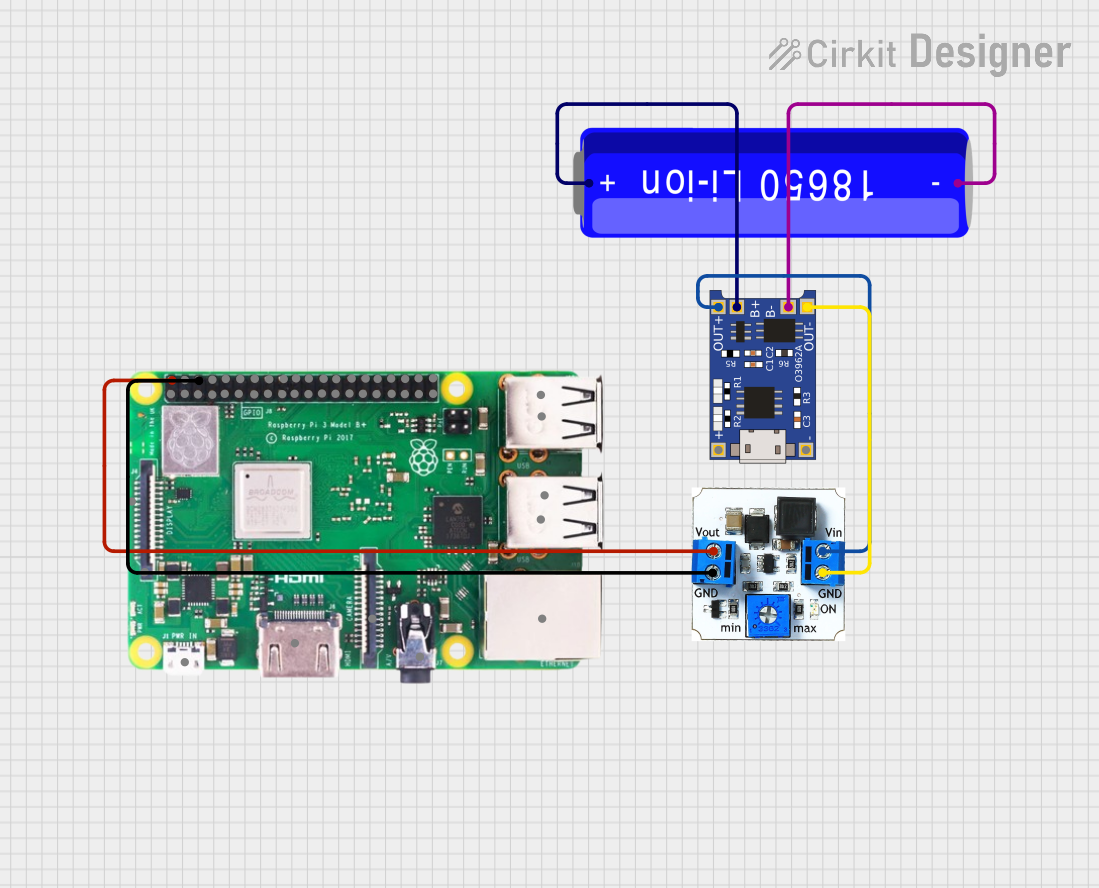 Open Project in Cirkit Designer
Explore Projects Built with Modul Charging TP4056
Open Project in Cirkit DesignerOpen Project in Cirkit DesignerOpen Project in Cirkit DesignerOpen Project in Cirkit DesignerCommon Applications and Use Cases
- Charging single-cell lithium-ion or lithium-polymer batteries.
- Power banks and portable electronic devices.
- DIY electronics projects requiring rechargeable battery integration.
- Battery-powered IoT devices.
- Prototyping and testing of lithium-ion battery systems.
Technical Specifications
Key Technical Details
- Input Voltage: 4.5V to 5.5V (typically powered via micro-USB or external DC source).
- Charging Voltage: 4.2V ± 1%.
- Charging Current: Programmable up to 1A (default: 1A).
- Battery Type: Single-cell lithium-ion or lithium-polymer.
- Protection Features:
- Overcharge protection.
- Reverse polarity protection (on some versions).
- Thermal regulation to prevent overheating.
- LED Indicators:
- Red LED: Charging in progress.
- Blue LED: Charging complete.
- Operating Temperature: -10°C to +85°C.
Pin Configuration and Descriptions
The TP4056 module typically has six pins for integration into circuits. Below is the pinout description:
| Pin Name | Description |
|---|---|
| BAT+ | Positive terminal for the lithium-ion battery. |
| BAT- | Negative terminal for the lithium-ion battery. |
| IN+ | Positive input voltage (4.5V to 5.5V). |
| IN- | Negative input voltage (ground). |
| OUT+ | Positive output voltage (connected to the load, if applicable). |
| OUT- | Negative output voltage (ground, connected to the load, if applicable). |
Note: Some TP4056 modules include a micro-USB port for easy connection to a 5V power source.
Usage Instructions
How to Use the TP4056 in a Circuit
Power Input:
- Connect a 5V DC power source to the IN+ and IN- pins or use the onboard micro-USB port.
- Ensure the input voltage is within the range of 4.5V to 5.5V to avoid damaging the module.
Battery Connection:
- Connect the positive terminal of the lithium-ion battery to the BAT+ pin.
- Connect the negative terminal of the battery to the BAT- pin.
- Ensure correct polarity to prevent damage to the battery or module.
Load Connection (Optional):
- If you want to power a load while charging the battery, connect the load to the OUT+ and OUT- pins.
- Ensure the load does not exceed the module's current rating.
Programming the Charging Current:
- The default charging current is 1A. To adjust it, replace the onboard resistor (Rprog) with a resistor of the desired value.
- Use the formula:
Icharge = 1200 / Rprog (kΩ)to calculate the charging current.
Monitoring the Charging Status:
- Observe the onboard LEDs:
- Red LED: Charging in progress.
- Blue LED: Charging complete.
- Observe the onboard LEDs:
Important Considerations and Best Practices
- Always use a high-quality lithium-ion battery with built-in protection circuitry.
- Avoid exceeding the module's input voltage or current limits.
- Ensure proper heat dissipation, especially when charging at high currents.
- Do not short-circuit the battery terminals or module pins.
- Disconnect the battery from the module if it will not be used for an extended period.
Example: Using TP4056 with Arduino UNO
The TP4056 can be used to charge a battery that powers an Arduino UNO. Below is an example of how to monitor the battery voltage using the Arduino:
// Example: Monitor battery voltage using Arduino UNO
// Connect the battery's positive terminal to an analog pin (e.g., A0)
// Use a voltage divider to ensure the voltage is within the Arduino's ADC range

const int batteryPin = A0; // Analog pin connected to the battery
const float voltageDividerRatio = 2.0; // Adjust based on your resistor values
const float referenceVoltage = 5.0; // Arduino's reference voltage (5V for UNO)

void setup() {
  Serial.begin(9600); // Initialize serial communication
}

void loop() {
  int rawValue = analogRead(batteryPin); // Read the analog value
  float batteryVoltage = (rawValue / 1023.0) * referenceVoltage * voltageDividerRatio;

  // Print the battery voltage to the Serial Monitor
  Serial.print("Battery Voltage: ");
  Serial.print(batteryVoltage);
  Serial.println(" V");

  delay(1000); // Wait for 1 second before the next reading
}
Note: Use a voltage divider to scale down the battery voltage if it exceeds the Arduino's ADC input range (0-5V).
Troubleshooting and FAQs
Common Issues and Solutions
Module Overheating:
- Cause: High charging current or insufficient heat dissipation.
- Solution: Reduce the charging current by replacing the Rprog resistor or improve ventilation.
Battery Not Charging:
- Cause: Incorrect wiring or damaged battery.
- Solution: Verify the connections and ensure the battery is functional.
LEDs Not Lighting Up:
- Cause: No input power or faulty module.
- Solution: Check the input voltage and ensure the module is not damaged.
Load Not Receiving Power:
- Cause: Load current exceeds the module's output capacity.
- Solution: Ensure the load current is within the module's limits.
FAQs
Can I use the TP4056 to charge multiple batteries in series?
- No, the TP4056 is designed for single-cell lithium-ion batteries only.
What happens if I exceed the input voltage?
- Exceeding the input voltage may permanently damage the module.
Can I use the TP4056 without a battery?
- No, the module is designed to work with a battery connected to the BAT+ and BAT- pins.
How do I adjust the charging current?
- Replace the Rprog resistor with a resistor of the desired value. Use the formula:
Icharge = 1200 / Rprog (kΩ).
- Replace the Rprog resistor with a resistor of the desired value. Use the formula:
By following this documentation, you can safely and effectively use the TP4056 module in your projects.