
How to Use KBT 3.7V 4000mAh Li-Polymer Battery: Examples, Pinouts, and Specs
 Design with KBT 3.7V 4000mAh Li-Polymer Battery in Cirkit Designer
Introduction
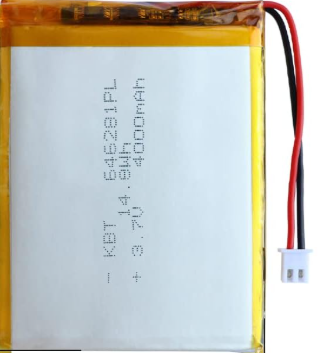
The KBT 3.7V 4000mAh Li-Polymer Battery (Manufacturer Part ID: 646281) is a rechargeable lithium polymer battery designed for use in a wide range of electronic devices. With a nominal voltage of 3.7V and a high capacity of 4000mAh, this battery is ideal for applications requiring reliable and long-lasting power. Its compact and lightweight design makes it suitable for portable devices, IoT projects, and embedded systems.
Explore Projects Built with KBT 3.7V 4000mAh Li-Polymer Battery
 Open Project in Cirkit Designer
 Open Project in Cirkit Designer
 Open Project in Cirkit Designer
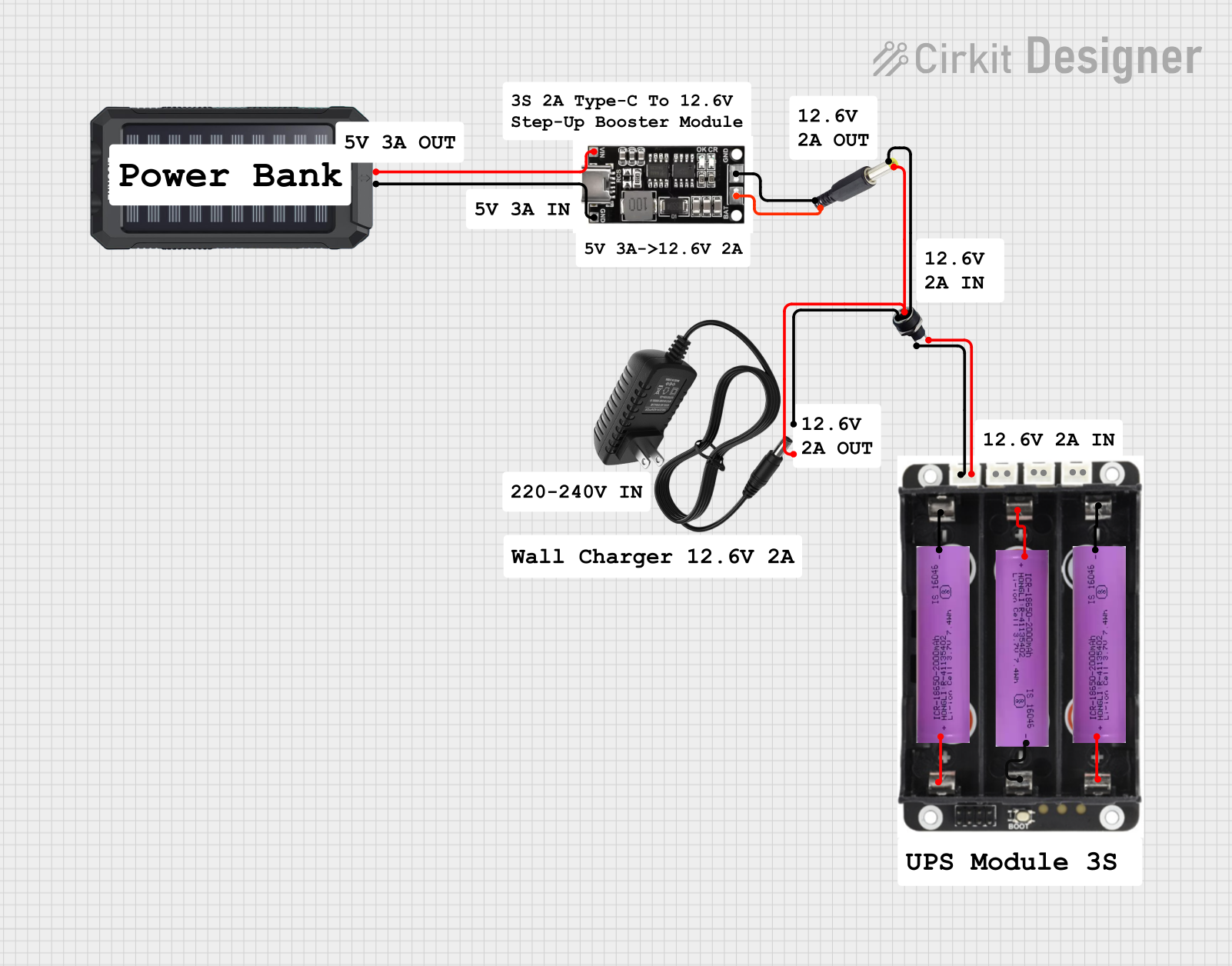 Open Project in Cirkit Designer
Explore Projects Built with KBT 3.7V 4000mAh Li-Polymer Battery
Open Project in Cirkit DesignerOpen Project in Cirkit DesignerOpen Project in Cirkit DesignerOpen Project in Cirkit DesignerCommon Applications and Use Cases
- Powering portable electronic devices such as tablets, smartphones, and handheld gaming consoles.
- Supplying energy to IoT devices, including sensors and wireless modules.
- Use in robotics, drones, and RC vehicles.
- Backup power for embedded systems and microcontroller-based projects.
- DIY electronics and prototyping.
Technical Specifications
The following table outlines the key technical details of the KBT 3.7V 4000mAh Li-Polymer Battery:
| Parameter | Specification |
|---|---|
| Nominal Voltage | 3.7V |
| Capacity | 4000mAh |
| Chemistry | Lithium Polymer (Li-Polymer) |
| Charging Voltage | 4.2V ± 0.05V |
| Discharge Cutoff Voltage | 3.0V |
| Maximum Discharge Current | 2C (8A) |
| Standard Charge Current | 0.5C (2A) |
| Dimensions (L x W x H) | Varies (refer to product datasheet) |
| Weight | Approximately 70g |
| Connector Type | JST or bare wire (varies by model) |
| Manufacturer | Amazon |
| Manufacturer Part ID | 646281 |
Pin Configuration and Descriptions
The battery typically comes with a two-wire configuration. The pinout is as follows:
| Pin | Wire Color | Description |
|---|---|---|
| + | Red | Positive terminal (3.7V nominal) |
| - | Black | Negative terminal (Ground) |
Note: Ensure the connector type matches your application. Some models may include a JST connector, while others may have bare wires.
Usage Instructions
How to Use the Battery in a Circuit
Connection:
- Identify the positive (red) and negative (black) wires of the battery.
- Connect the positive terminal to the power input of your circuit and the negative terminal to the ground.
- If using a connector, ensure it is securely attached to the corresponding socket.
Charging:
- Use a compatible Li-Polymer battery charger with a charging voltage of 4.2V.
- Set the charging current to 0.5C (2A) for standard charging or up to 1C (4A) for faster charging, if supported by the charger.
- Avoid overcharging or discharging below 3.0V to maintain battery health.
Discharge:
- Ensure the load does not exceed the maximum discharge current of 8A.
- Use a battery protection circuit to prevent over-discharge, over-current, or short circuits.
Mounting:
- Secure the battery in your device using adhesive or a battery holder to prevent movement during operation.
Important Considerations and Best Practices
- Safety: Avoid puncturing, short-circuiting, or exposing the battery to high temperatures.
- Storage: Store the battery in a cool, dry place at a charge level of 40-60% for long-term storage.
- Compatibility: Verify that the battery's voltage and capacity meet the requirements of your device.
- Protection Circuit: Use a Battery Management System (BMS) to ensure safe operation.
Example: Connecting to an Arduino UNO
The KBT 3.7V 4000mAh battery can be used to power an Arduino UNO via a DC-DC step-up converter to boost the voltage to 5V. Below is an example circuit and code:
Circuit Setup
- Connect the battery's positive terminal to the input of the DC-DC step-up converter.
- Connect the battery's negative terminal to the ground of the converter.
- Connect the output of the converter (5V and GND) to the Arduino UNO's 5V and GND pins.
Arduino Code Example
// Example code to blink an LED using an Arduino UNO powered by the KBT battery

const int ledPin = 13; // Pin connected to the onboard LED

void setup() {
  pinMode(ledPin, OUTPUT); // Set the LED pin as an output
}

void loop() {
  digitalWrite(ledPin, HIGH); // Turn the LED on
  delay(1000);               // Wait for 1 second
  digitalWrite(ledPin, LOW);  // Turn the LED off
  delay(1000);               // Wait for 1 second
}
Note: Ensure the DC-DC converter is configured to output 5V before connecting it to the Arduino.
Troubleshooting and FAQs
Common Issues and Solutions
Battery Not Charging:
- Cause: Charger not compatible or faulty.
- Solution: Use a charger specifically designed for Li-Polymer batteries with a 4.2V output.
Device Not Powering On:
- Cause: Battery voltage too low or incorrect connection.
- Solution: Check the battery voltage with a multimeter and ensure proper wiring.
Battery Overheating:
- Cause: Overcharging or excessive discharge current.
- Solution: Use a charger with overcharge protection and ensure the load does not exceed 8A.
Short Battery Life:
- Cause: Frequent deep discharges or improper storage.
- Solution: Avoid discharging below 3.0V and store the battery at 40-60% charge.
FAQs
Q: Can I use this battery to power a Raspberry Pi?
- A: Yes, but you will need a DC-DC step-up converter to boost the voltage to 5V.
Q: How long will the battery last on a single charge?
- A: Battery life depends on the load. For example, a 1A load will last approximately 4 hours (4000mAh ÷ 1000mA).
Q: Is the battery safe for air travel?
- A: Yes, but check airline regulations for lithium batteries and ensure proper packaging.
Q: Can I connect multiple batteries in series or parallel?
- A: Yes, but ensure proper balancing and use a BMS to manage the configuration.
By following this documentation, you can safely and effectively use the KBT 3.7V 4000mAh Li-Polymer Battery in your projects.