
How to Use AC-DC power converter: Examples, Pinouts, and Specs
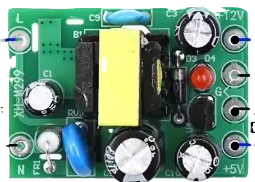
 Design with AC-DC power converter in Cirkit Designer
Introduction
The AC-DC Power Converter (Manufacturer Part ID: 120V-AC to 5V&12V-DC) is a versatile electronic component designed to convert alternating current (AC) from a standard power outlet into direct current (DC) suitable for powering electronic devices. Manufactured by AliExpress Shop#1103102195 Store, this converter is commonly used in power supplies for a wide range of applications, including embedded systems, IoT devices, and consumer electronics.
Explore Projects Built with AC-DC power converter
 Open Project in Cirkit Designer
 Open Project in Cirkit Designer
 Open Project in Cirkit Designer
 Open Project in Cirkit Designer
Explore Projects Built with AC-DC power converter
Open Project in Cirkit DesignerOpen Project in Cirkit DesignerOpen Project in Cirkit DesignerOpen Project in Cirkit DesignerCommon Applications and Use Cases
- Powering microcontrollers, sensors, and modules in embedded systems
- Supplying DC voltage to IoT devices and smart home appliances
- Providing stable DC power for LED lighting systems
- Charging batteries or powering small DC motors
- General-purpose DC power supply for prototyping and testing circuits
Technical Specifications
The following table outlines the key technical details of the AC-DC Power Converter:
| Parameter | Value |
|---|---|
| Input Voltage Range | 100V - 240V AC |
| Output Voltage | 5V DC, 12V DC |
| Output Current | 5V: 2A, 12V: 1A |
| Power Output | 20W (maximum) |
| Efficiency | ≥ 85% |
| Operating Temperature | -20°C to +60°C |
| Dimensions | 50mm x 25mm x 20mm |
| Weight | 30g |
| Safety Features | Over-voltage, over-current, and short-circuit protection |
Pin Configuration and Descriptions
The AC-DC Power Converter has the following pin configuration:
| Pin Name | Description |
|---|---|
| AC-L | Live wire input for AC power (100V - 240V AC) |
| AC-N | Neutral wire input for AC power |
| GND | Ground connection for DC output |
| +5V | Positive 5V DC output |
| +12V | Positive 12V DC output |
Usage Instructions
How to Use the Component in a Circuit
Connect the AC Input:
- Attach the AC-L pin to the live wire of the AC power source.
- Attach the AC-N pin to the neutral wire of the AC power source.
- Ensure proper insulation and secure connections to avoid electrical hazards.
Connect the DC Output:
- Use the +5V pin to power devices requiring 5V DC.
- Use the +12V pin to power devices requiring 12V DC.
- Connect the GND pin to the ground of your circuit.
Verify Connections:
- Double-check all connections before powering the circuit.
- Use a multimeter to confirm the output voltage levels.
Power On:
- Plug the AC input into a power outlet and switch it on.
- Verify that the connected devices are receiving the correct voltage.
Important Considerations and Best Practices
- Safety First: Always handle the AC input with care to avoid electric shock. Use insulated tools and ensure proper grounding.
- Load Limits: Do not exceed the maximum output current (5V: 2A, 12V: 1A) to prevent overheating or damage.
- Ventilation: Ensure adequate airflow around the converter to maintain safe operating temperatures.
- Testing: Use a multimeter to verify the output voltage before connecting sensitive devices.
- Arduino Compatibility: This converter can be used to power an Arduino UNO by connecting the +5V output to the Arduino's 5V pin and GND to the Arduino's GND pin.
Example: Powering an Arduino UNO
// Example code to blink an LED using an Arduino UNO powered by the AC-DC converter

// Pin 13 is connected to the onboard LED
const int ledPin = 13;

void setup() {
  pinMode(ledPin, OUTPUT); // Set pin 13 as an output
}

void loop() {
  digitalWrite(ledPin, HIGH); // Turn the LED on
  delay(1000);                // Wait for 1 second
  digitalWrite(ledPin, LOW);  // Turn the LED off
  delay(1000);                // Wait for 1 second
}
Note: Ensure the AC-DC converter's 5V output is connected to the Arduino's 5V pin and GND to GND.
Troubleshooting and FAQs
Common Issues and Solutions
No Output Voltage:
- Cause: Incorrect AC input connections or no power supply.
- Solution: Verify the AC-L and AC-N connections and ensure the power outlet is functional.
Overheating:
- Cause: Exceeding the maximum output current or poor ventilation.
- Solution: Reduce the load or improve airflow around the converter.
Voltage Fluctuations:
- Cause: Unstable AC input or excessive load.
- Solution: Use a voltage stabilizer for the AC input or reduce the load.
Short Circuit Protection Triggered:
- Cause: A short circuit in the connected load.
- Solution: Inspect the connected circuit for shorts and resolve the issue before reconnecting.
FAQs
Q1: Can this converter be used outdoors?
A1: No, this converter is not waterproof or weatherproof. Use it only in dry, indoor environments.
Q2: Can I use both the 5V and 12V outputs simultaneously?
A2: Yes, but ensure the combined load does not exceed the maximum power output of 20W.
Q3: Is this converter compatible with rechargeable batteries?
A3: Yes, but you must use a proper charging circuit to regulate the charging process.
Q4: What happens if the input voltage exceeds 240V AC?
A4: The converter may get damaged. Always ensure the input voltage is within the specified range (100V - 240V AC).
By following this documentation, you can safely and effectively use the AC-DC Power Converter in your projects.